
Parkinson's Disease Care at Home: Medication Timing, Fall Prevention & Equipment Guide
The short version
- Medication timing is the highest-impact thing a family controls. Levodopa works in narrow windows. A dose given an hour late can mean an hour of being unable to stand — and Parkinson's medication must never be stopped abruptly.
- Falls are the main threat to independence, and Parkinson's falls are different: backwards, during turns, and while freezing in doorways. Standard "elderly fall-proofing" advice misses most of it.
- Freezing of gait is not stubbornness or weakness. Pulling the person forward makes it worse. Rhythmic cues — counting, marching, stepping over a line — usually break it.
- Some common medicines make Parkinson's dramatically worse, including certain anti-vomiting drugs. Every new prescription should be checked against the Parkinson's diagnosis.
- Sudden worsening is usually an infection, not progression. A urinary infection can look exactly like the disease advancing overnight.
- Exercise is treatment, not a wellness add-on. Big, effortful, repeated movement is one of the few things that reliably improves function in Parkinson's.
Parkinson's is unusual among conditions we support at home: the patient often looks fine at 10am and cannot rise from a chair at 1pm. Families are given tablets and a follow-up date, but rarely a system — clock-based dosing, a house that does not trigger freezing, a walker that helps instead of causing a stumble, and a plan for the day the swallowing changes. This guide is that system.
What actually changes at home when someone has Parkinson's?
Four motor features drive most of the daily difficulty: slowness of movement (bradykinesia), stiffness (rigidity), tremor, and loss of balance. But the things that most disrupt a household are often non-motor — constipation, blood pressure drops on standing, disturbed sleep, soft speech, drooling, low mood and, later, memory change. Planning only for tremor is the most common mistake families make.
| What you see | What is happening | What helps at home |
|---|---|---|
| Slow, small movements | Bradykinesia — the amplitude of movement shrinks without the person noticing. | Deliberately "big" movement practice, verbal cues to take larger steps. |
| Stiffness and aching | Rigidity in trunk and limbs; often mistaken for arthritis. | Daily stretching, physiotherapy, medication timing review. |
| Tremor at rest | Typically worse when the limb is still, better during purposeful action. | Weighted cutlery, wide-handled utensils, non-slip mats. |
| Stooped posture, shuffling | Postural change plus reduced step length; centre of gravity moves forward. | Posture work, a correctly-fitted rollator rather than a lightweight stick. |
| Feet "stuck to the floor" | Freezing of gait — often at doorways, turns and crowded spaces. | Rhythmic cueing, clear floor paths, removing visual clutter. |
| Very soft, monotone voice | Hypophonia — the person believes they are speaking at normal volume. | Speech therapy, and asking rather than assuming they are withdrawn. |
| Dizziness on standing | Orthostatic hypotension, from the disease or its medication. | Rise in stages, lying-and-standing BP readings, report to the doctor. |
| Acting out dreams at night | REM sleep behaviour disorder — shouting, kicking, falling out of bed. | Bed rails, a clear bedside area, and reporting it to the neurologist. |
Why is Parkinson's medication timing so important at home?
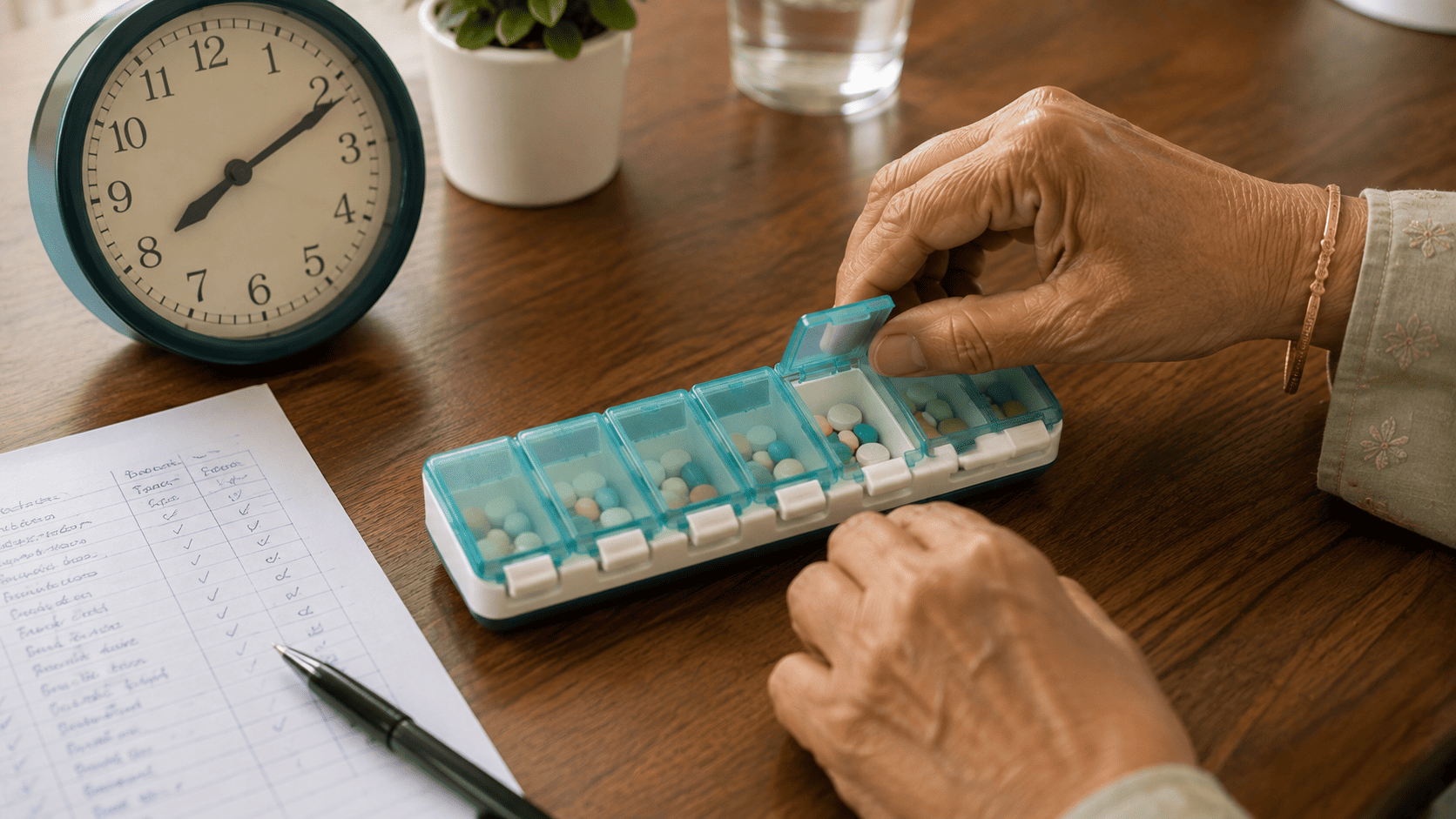
Because Parkinson's medication replaces a chemical the brain no longer makes enough of, and it works only while blood levels stay in range. As the disease progresses, that window narrows. Doses given on the clock — not "with breakfast" or "when he remembers" — are what keep a person mobile. Late doses produce "off" periods where walking, speaking and swallowing all deteriorate within the hour.
The home dosing rules
- Fixed clock times, alarms set. Write the times on paper and stick them where the tablets are kept. Aim to give each dose within a few minutes of the scheduled time.
- Protein can interfere with levodopa absorption. If the neurologist has advised taking it before food, follow that instruction rather than folding it into mealtimes for convenience.
- Never stop Parkinson's medication abruptly. Sudden withdrawal can cause a severe and dangerous reaction. If tablets are being vomited, cannot be swallowed, or the patient is admitted to hospital, tell the treating doctor immediately — do not simply skip doses.
- Carry the schedule to every hospital visit. Ward drug rounds run on ward timings, not on the patient's Parkinson's timings. The written schedule is how families protect against that.
- Keep a simple "off" diary for two weeks before a neurology review: time of dose, time symptoms returned. That diary is usually more useful to the doctor than a description of a typical day.
Some common medicines make Parkinson's much worse
Certain anti-vomiting and anti-psychotic medications block the same dopamine pathway that Parkinson's treatment supports, and can cause a sharp deterioration in movement. Two frequently prescribed anti-nausea drugs in India fall into this group. Before any new prescription — from a GP, a dentist, an emergency room, or a chemist's counter suggestion — state clearly that the patient has Parkinson's disease and ask whether the drug is safe.
What is freezing of gait, and how do you get someone out of it?
Freezing is a sudden, temporary inability to start or continue walking — the feet feel glued to the floor while the upper body keeps moving forward. It is a major fall trigger. The way out is a rhythmic external cue, not force: counting aloud, marching on the spot, shifting weight side to side, or stepping over a visible line on the floor.
Cueing techniques that work
Count it out
Say "one, two, one, two" in a steady rhythm and ask them to step on the beat. An auditory beat bypasses the stuck internal rhythm.
March on the spot
Lifting the knees deliberately, on the spot, often unlocks the pattern before forward walking resumes.
Step over a line
A visual target — a strip of tape on the floor at a doorway, or the caregiver's foot — gives the brain something to step over.
Weight shift first
Rock gently from side to side before attempting a step. Freezing often breaks with the weight transfer, not the step itself.
Reset the turn
Turns are the highest-risk moment. Walk a wide arc rather than pivoting on the spot, and never turn in a doorway.
Never pull
Pulling the person's arm moves the body while the feet stay planted — which is exactly how a fall happens. Stand beside them and cue instead.
Where freezing tends to happen in an Indian home
- Doorways and narrow passages, especially between rooms of different floor colour.
- The bathroom threshold, where the level changes and the floor is wet.
- Turning in the kitchen or in front of a chair before sitting.
- Crowded rooms and any situation that feels hurried — freezing worsens under time pressure.
- Rugs, dhurries and cable runs, which act as visual barriers even when they pose no real obstacle.
How do you make a house safe for someone with Parkinson's?
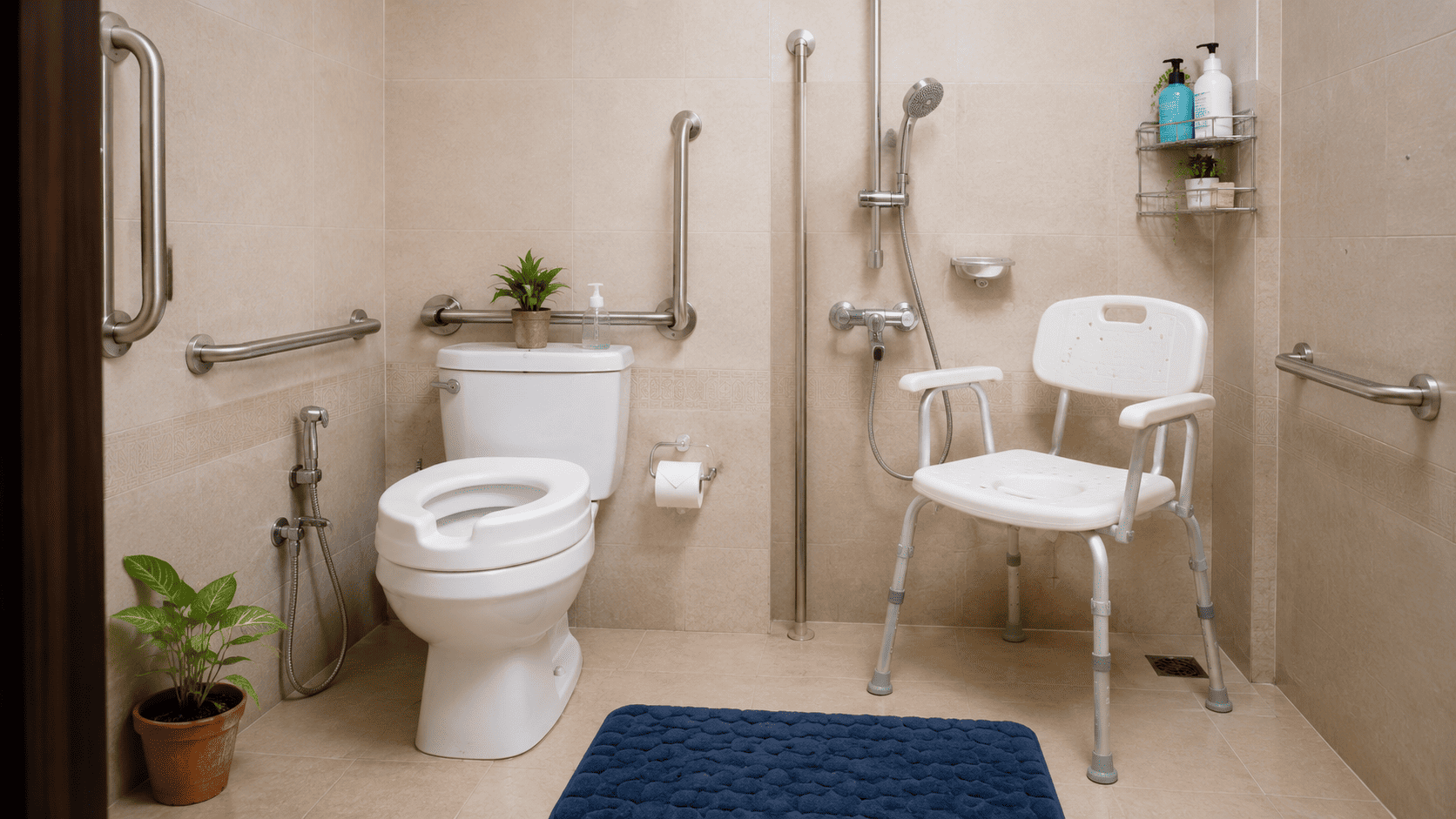
By designing for backward falls and freezing, not just for slipping. People with Parkinson's commonly fall backwards or during a turn, cannot correct quickly, and often cannot break the fall with their arms. The highest-value changes are grab bars where transfers happen, a chair that is high and firm with armrests, clear straight walking paths, and light at night.
| Area | The Parkinson's-specific risk | What to change |
|---|---|---|
| Bathroom | Wet floor plus a threshold plus a turn — the three highest-risk elements together. | Grab bars beside the toilet and in the shower, raised toilet seat, shower chair, non-slip mat, no loose bucket in the walking path. |
| Bedroom | Getting out of bed at night, often in the dark and in an "off" period. | Bed rail or bed pole, motion-sensor night light, commode chair beside the bed, phone within reach. |
| Living room | Deep soft sofas make standing up almost impossible during an off period. | A firm chair with a high seat and both armrests; remove low centre tables from the walking line. |
| Floors and doorways | Rugs, thresholds and colour changes trigger freezing. | Remove loose rugs, tape floor cues at problem doorways, keep a clear straight path between the bed, bathroom and chair. |
| Kitchen | Carrying hot items while walking — both hands occupied and no balance reserve. | Use a trolley, keep daily items at waist height, never carry hot liquid and walk. |
| Stairs | Descending is the danger, particularly with poor depth judgement. | Handrails on both sides, contrast tape on step edges, avoid stairs during off periods. |
| Footwear | Loose chappals and slippers come off mid-step and cause trips. | Closed, well-fitted shoes with a firm sole and no thick grip that catches on the floor. |
Same-day delivery across Delhi NCR and Tricity, subject to stock and service availability.
What equipment does a Parkinson's patient need at home?
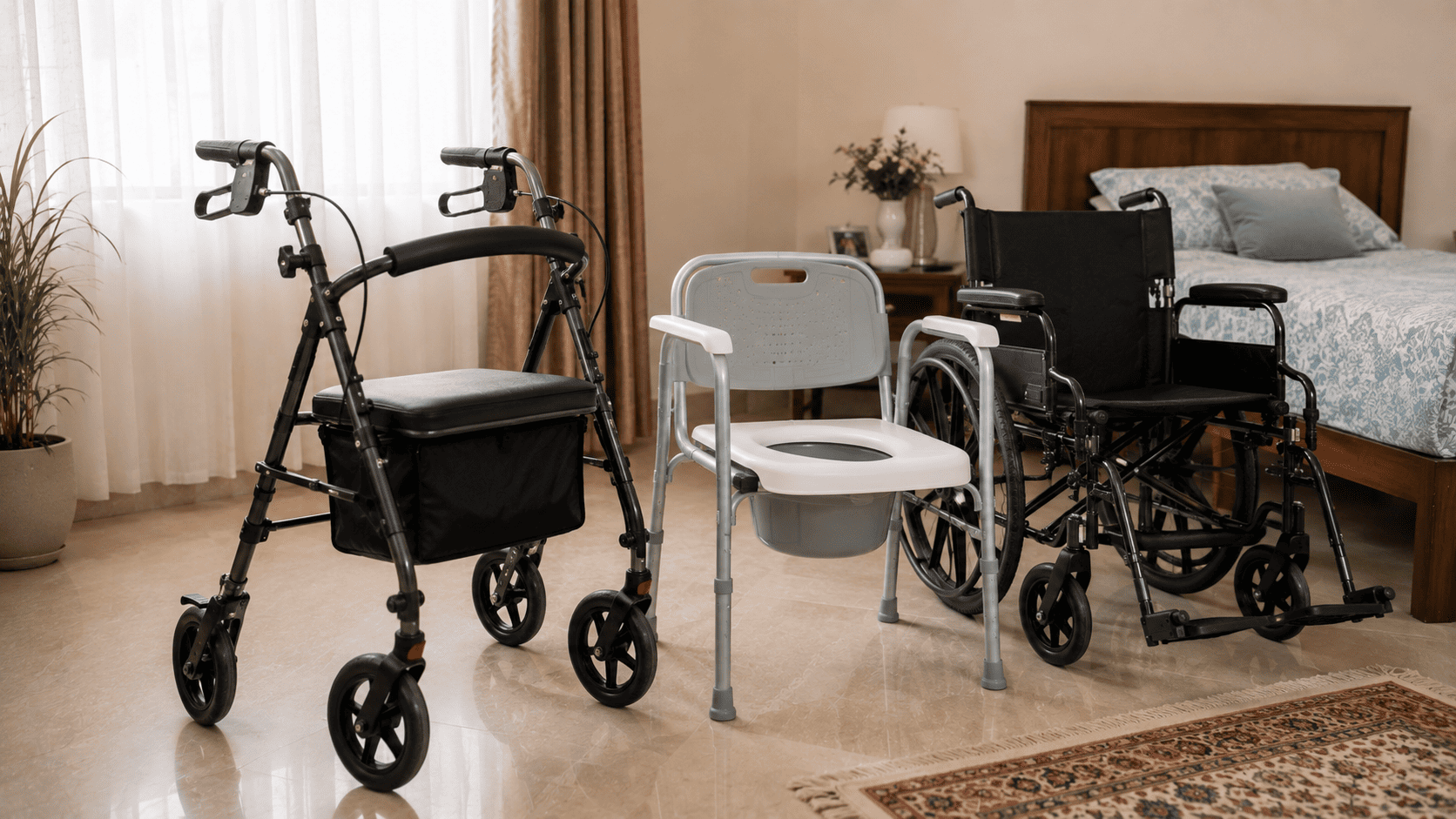
It depends on the stage, and it changes. Early on, the need is minimal — good footwear, a firm chair, grab bars. In the middle stage, a wheeled walker, commode chair and shower chair carry most of the load. In the advanced stage, a hospital bed, pressure-relieving mattress and wheelchair become necessary. Buying the advanced-stage list early is wasted money; having none of it ready when the stage changes is a fall waiting to happen.
| Stage | Usually needed | Why |
|---|---|---|
| Early — independent, mild slowness or tremor | Firm high-seat chair, bathroom grab bars, non-slip mats, proper shoes, BP monitor, home physiotherapy | The priority is exercise capacity and preventing the first fall, not mobility aids. |
| Middle — balance affected, occasional freezing | Four-wheeled rollator with brakes and a seat, commode chair, shower chair, raised toilet seat, bed rail or bed pole | Rest points and safe transfers matter more than distance. A seat on the walker allows recovery from fatigue. |
| Frequent falls or long off periods | Wheelchair for outdoor distance, transfer belt, satin bedsheet for turning, adjustable bed, pulse oximeter | Function now varies hour to hour, so the home must work at the patient's worst hour, not the average one. |
| Advanced — largely chair or bed-bound | Hospital bed with backrest and rails, air or alpha mattress, wheelchair with headrest, patient lift, positioning pillows | Skin protection, safe handling and caregiver back safety become the daily priority. |
| Swallowing affected at any stage | Bed with backrest elevation, suction machine, nebuliser if prescribed, pulse oximeter | Aspiration pneumonia is one of the most serious complications in advanced Parkinson's. |
Small aids that make a disproportionate difference
- Satin or silk bedsheet and pyjamas — reduces friction so the person can turn in bed themselves for far longer.
- Weighted or wide-grip cutlery and a plate guard, which keep independent eating possible with tremor.
- A rollator with a seat and brakes, not a lightweight pick-up walker — pick-up walkers can worsen freezing.
- Button hooks, elastic laces, front-fastening clothes to protect independent dressing.
- A weekly pill organiser with alarms, which is the cheapest clinically significant purchase on this page.
- A raised toilet seat with armrests, which converts the hardest transfer of the day into a manageable one.
Healthy Jeena Sikho supplies the mobility and bedside items on this list across Delhi NCR and Tricity — see hospital beds on rent, our home care equipment shop, and the walker range.
Does exercise actually help Parkinson's, or just general fitness?
It helps the Parkinson's itself. Structured, effortful exercise is one of the few interventions that consistently improves walking speed, balance and daily function in Parkinson's, and it is recommended alongside medication rather than instead of it. The key features are big amplitude, high effort, repetition, and consistency — a gentle ten-minute stroll does not produce the same effect.
What a home exercise week can look like
| Component | What it targets | Practical form at home |
|---|---|---|
| Amplitude training | Bradykinesia — retraining exaggerated, large movements. | Big-reach, big-step drills taught by a physiotherapist and repeated daily. |
| Balance and gait work | Falls, turning, freezing. | Supervised turning practice, step-over drills, cued walking. |
| Aerobic work | Endurance, mood, sleep. | Stationary cycle or treadmill at a challenging but safe pace. |
| Strength | Rising from a chair, climbing stairs, avoiding deconditioning. | Sit-to-stand repetitions, resistance bands, leg work. |
| Flexibility and posture | Rigidity and stooping. | Daily trunk rotation and chest-opening stretches. |
| Voice | Soft speech and swallow strength. | Loud speech drills guided by a speech therapist. |
Schedule exercise during an "on" period, when medication is working — not first thing in the morning before the first dose has taken effect. Healthy Jeena Sikho offers home physiotherapy and a panel of rehabilitation doctors, and our guide to home physiotherapy equipment covers what is worth keeping between sessions.
How do you handle eating, swallowing and weight loss in Parkinson's?
Carefully, and early. Swallowing difficulty develops gradually in Parkinson's and is often silent — food or fluid can enter the airway without triggering a cough. Slow eating, coughing at meals, a wet voice, drooling or unexplained weight loss all warrant a swallow assessment rather than a change of cook.
- Sit fully upright for meals and stay upright for 30 minutes afterwards.
- Time meals to "on" periods. Chewing and swallowing are motor tasks, and they get worse when medication wears off.
- Small mouthfuls, no rushing, no talking while eating. Allow far more time than seems reasonable.
- Follow prescribed textures and fluid consistencies exactly if a speech therapist has set them.
- Watch the weight. Steady weight loss is common and matters — it affects strength, skin and medication response.
- Constipation is a Parkinson's symptom, not a side issue. It affects comfort, appetite and even how well tablets are absorbed. Raise it with the doctor rather than self-treating long term.
- Oral hygiene after every meal, which reduces chest infection risk in anyone with an unsafe swallow.
What does a well-run Parkinson's day look like?
It runs on the medication clock. The whole day is built around dose times: activity, meals, bathing and outings are placed in "on" windows, and rest, seated tasks and safety supervision fill the "off" ones. Families who plan this way lose far fewer hours than families who plan around the clock on the wall.
- First dose before getting out of bed, if the neurologist has advised it, so that the first transfer of the day happens with medication working.
- Bathing, physiotherapy and outings in on periods. The bathroom during an off period is the single most dangerous combination in the house.
- Seated, low-risk tasks in off periods — reading, voice exercises, hand exercises, conversation.
- Allow far more time than feels necessary. Rushing a person with Parkinson's reliably produces freezing and falls.
- Let them do it themselves wherever it is safe. Taking over tasks to save time accelerates loss of function.
- Night plan. Commode by the bed, night light, phone in reach — nocturnal bathroom trips during an off period are a leading fall scenario.
Caregiving in Parkinson's is a multi-year role, not a recovery period. Fatigue, back injury from unassisted transfers and social isolation are predictable, and arranging relief early is part of the care plan, not an admission of failure.
When should you call the doctor urgently?
Seek medical help immediately if you see any of these
- A sudden, dramatic worsening over hours or a day or two. This is far more often an infection — commonly a urinary or chest infection — than the disease advancing. It needs investigation, not a medication increase at home.
- Parkinson's medication has been missed, vomited or stopped. Abrupt withdrawal can cause a severe reaction with rigidity, fever and confusion. Contact the doctor the same day.
- High fever with stiffness, confusion or reduced alertness.
- New hallucinations, severe confusion, or a sudden change in behaviour — often medication-related and adjustable.
- Fever, breathlessness or a rattling chest after choking or a period of poor swallowing.
- A fall with a head injury, or any fall the person cannot explain, especially on blood thinners.
- Repeated fainting or near-fainting on standing.
- Inability to pass urine, or a sudden change in continence with confusion.
How common is Parkinson's in India, and why does home care matter here?
Parkinson's is among the fastest-growing neurological conditions worldwide, and India carries a large and rising share of it. Because movement-disorder specialists and structured rehabilitation programmes are concentrated in a few large cities, most Indian families manage the condition at home for years between hospital visits — which makes the quality of the home system the main determinant of daily life.
Global Burden of Disease analysis found that 6.1 million people worldwide had Parkinson's disease in 2016, compared with 2.5 million in 1990, with age-standardised prevalence rising 21.7% over that period — meaning the increase was not explained by population ageing alone.1 More recent projections using GBD 2021 data estimate that global cases could roughly double again by 2050.2
For India specifically, the India State-Level Disease Burden Initiative reported that the contribution of non-communicable neurological disorders — the group that includes Parkinson's — to India's total disease burden more than doubled between 1990 and 2019, and identified high blood pressure, air pollution and dietary risks among the leading contributors to neurological disease burden in the country.3 Community-based prevalence estimates for Parkinson's in India vary considerably between studies and regions, reflecting differences in method and case-finding.4
What this means for families in Punjab and Delhi NCR
- Neurology follow-up is periodic; care is daily. The "off" diary and the medication chart are how a family makes a three-month review useful.
- Therapy is largely home-based. Physiotherapy, occupational therapy and speech therapy at home fill the gap left by scarce outpatient rehabilitation slots.
- Winter reduces movement. Cold months mean less walking, more sitting and more stiffness — exactly when function slips and falls increase.
- Multi-doctor prescribing is a real risk. With several specialists involved, the Parkinson's diagnosis must be stated at every consultation to avoid an unsafe drug being added.
Should you rent or buy Parkinson's home care equipment?
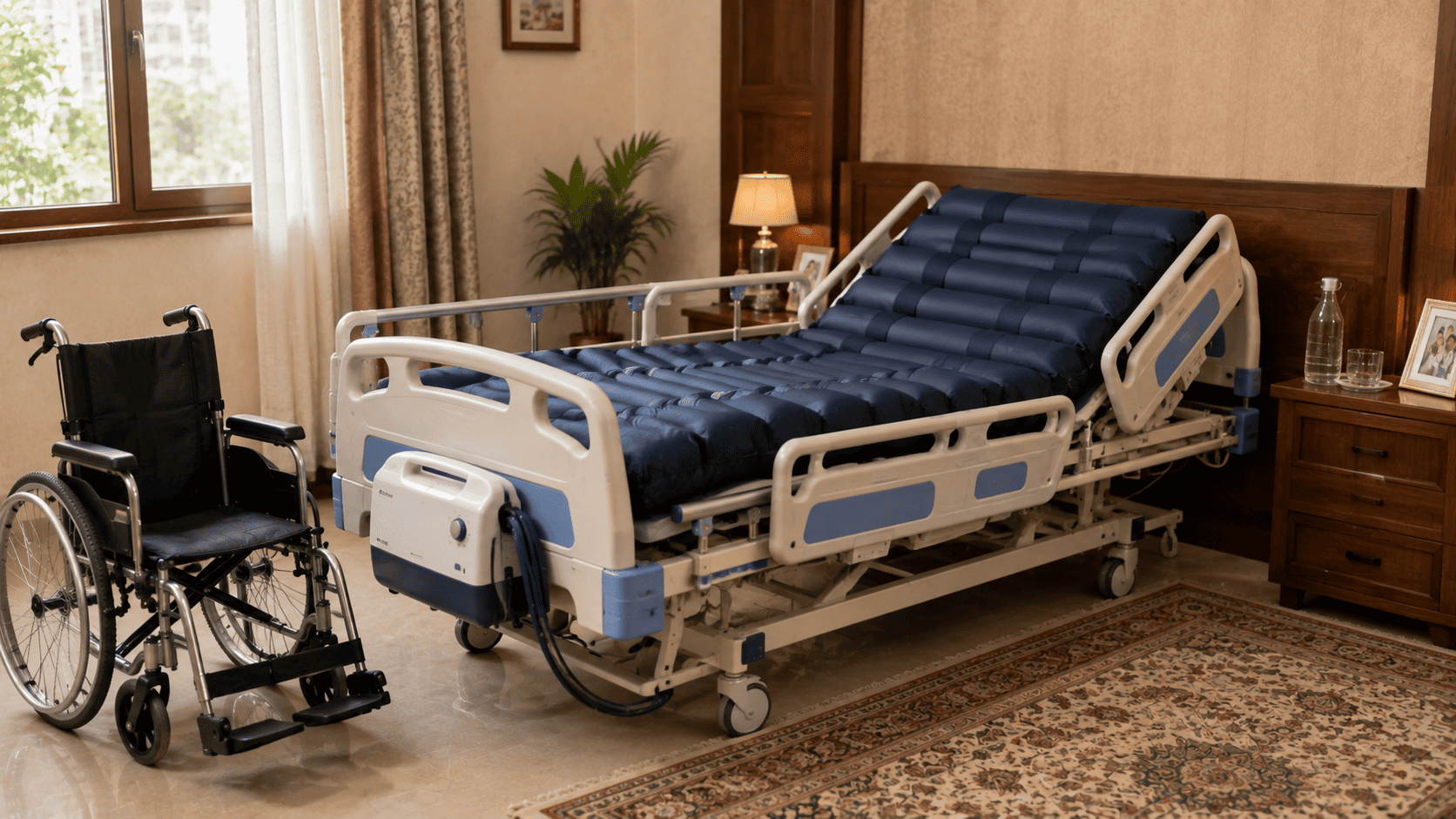
Parkinson's differs from a post-surgical recovery: the requirement grows rather than shrinks. That changes the calculation. Items likely to be needed permanently — a rollator, a shower chair, a raised toilet seat — are usually worth buying. Items needed for a defined phase, or that may need upgrading as the stage changes, are better rented.
| Item | Usually better to | Reasoning |
|---|---|---|
| Rollator / walker, shower chair, raised toilet seat, grab bars | Buy | Needed daily and indefinitely once required; low cost relative to years of use. |
| Wheelchair | Rent first | Often needed only for outdoor distance at first; the required type may change as posture and head control change. |
| Hospital bed | Rent | Requirement may start intermittent, and the specification that suits the patient often becomes clear only after a few weeks of use. |
| Air / alpha mattress | Rent | Needed when time in bed increases; servicing and pump replacement are covered during the rental period. |
| Suction machine, nebuliser | Rent | Often needed for defined episodes rather than continuously. |
| Patient lift / transfer aids | Rent | Requirement depends on the caregiver as much as the patient, and is best trialled before purchase. |
How Healthy Jeena Sikho supports Parkinson's families
- Equipment that scales with the stage. Rental means the setup can move from a walker to a wheelchair to a hospital bed without a fresh purchase at each step.
- The full home care list in one place. Hospital beds, air and alpha mattresses, wheelchairs, walkers, commode and shower chairs, suction machines and nebulisers.
- Home physiotherapy alongside the equipment. Physiotherapy and rehabilitation support, so movement training and the equipment are one arrangement rather than two.
- Delivery across Delhi NCR and Tricity. Service availability includes Delhi, Gurugram, Noida, Faridabad, Ghaziabad, Chandigarh, Mohali and Panchkula.
- Home installation and demonstration. Our team sets up the bed and mattress and demonstrates safe operation, transfers and basic maintenance.
- Servicing and replacement support. Rental equipment is supported during the rental tenure according to applicable service terms.
Frequently Asked Questions About Parkinson's Care at Home
Can a person with Parkinson's live at home safely?
Most people with Parkinson's live at home for many years. Safety depends on three things being in place: medication given on time, a home set up for falls and freezing, and regular physiotherapy. As the condition progresses the level of support increases, but a move away from home is not the usual outcome of a diagnosis.
Why does my father move well in the morning and badly by afternoon?
This pattern usually reflects medication "on" and "off" periods. As Parkinson's progresses, the effect of each dose lasts less time, so function fluctuates through the day. Keeping a written diary of dose times and when symptoms return gives the neurologist what they need to adjust the regimen. Do not change doses at home.
Is it dangerous to miss a dose of Parkinson's medication?
A single late dose usually causes a period of worse movement. Repeatedly missed doses, or stopping the medication abruptly, can cause a serious reaction involving severe stiffness, fever and confusion. If tablets cannot be taken — because of vomiting, swallowing difficulty or a hospital admission — contact the treating doctor the same day rather than simply skipping them.
How do you stop someone freezing in a doorway?
Do not pull them forward. Ask them to stop trying to walk, shift their weight from side to side, then step on a rhythm you count aloud, or step over a visible line such as tape on the floor or your own foot. Once moving, give them space and time — hurrying restarts the freeze.
Which walker is best for Parkinson's disease?
A four-wheeled rollator with hand brakes and a built-in seat is commonly preferred, because it allows continuous forward motion and provides a rest point. Lightweight pick-up walkers that must be lifted with each step can worsen freezing and disrupt walking rhythm. The final choice should follow a physiotherapist's assessment of the individual's balance and freezing pattern.
Why do Parkinson's symptoms suddenly get much worse?
A sudden deterioration over hours or days is most often caused by something other than the disease itself — commonly a urinary or chest infection, dehydration, constipation, a missed medication schedule, or a newly added drug that interferes with Parkinson's treatment. It should be medically assessed rather than assumed to be progression.
Does exercise slow down Parkinson's?
Structured exercise reliably improves walking, balance and daily function in Parkinson's, and is recommended as part of standard management alongside medication. Whether it alters the underlying course of the disease is still under study. Either way, it is one of the most worthwhile things a family can invest time in.
When does a Parkinson's patient need a hospital bed?
Usually when turning in bed becomes difficult, when getting up unassisted is unsafe, or when a long "off" period leaves the person unable to reposition themselves at night. Backrest elevation, height adjustment and side rails are what make daily care manageable for one caregiver. Before that stage, a satin bedsheet and a bed rail are often enough.
Can Parkinson's affect swallowing, and what should we do?
Yes, and it often develops gradually. Coughing at meals, a wet-sounding voice, food remaining in the mouth, drooling and unexplained weight loss are all reasons to ask for a swallow assessment. Some people aspirate without coughing, so the absence of coughing does not confirm that swallowing is safe.
How quickly can equipment be delivered?
Delivery time depends on location, stock and service availability. Across Delhi NCR and Tricity, same-day delivery may be available in selected locations. For a planned hospital discharge, sharing the date a day in advance allows the bed and mattress to be installed before the patient reaches home.
References
- GBD 2016 Parkinson's Disease Collaborators. Global, regional, and national burden of Parkinson's disease, 1990–2016: a systematic analysis for the Global Burden of Disease Study 2016 . Lancet Neurology 2018;17(11):939–953.
- Su D, Cui Y, He C, et al. Projections of global prevalence of Parkinson's disease to 2050, based on Global Burden of Disease 2021 data. BMJ 2025.
- India State-Level Disease Burden Initiative Neurological Disorders Collaborators. The burden of neurological disorders across the states of India: the Global Burden of Disease Study 1990–2019 . Lancet Global Health 2021;9(8):e1129–e1144.
- Gourie-Devi M. Epidemiology of neurological disorders in India: review of background, prevalence and incidence of epilepsy, stroke, Parkinson's disease and tremors. Neurology India 2014;62(6):588–598.
- Dorsey ER, Bloem BR. The Parkinson pandemic — a call to action . JAMA Neurology 2018;75(1):9–10.
- National Institute for Health and Care Excellence (NICE). Parkinson's disease in adults, NICE guideline NG71.
- European Physiotherapy Guideline for Parkinson's Disease, and Movement Disorder Society guidance on the management of Parkinson's disease.
Medical disclaimer. This page is general educational information about home care for Parkinson's disease. It is not medical advice and does not replace consultation with a qualified neurologist, physician, physiotherapist or speech and language therapist. Parkinson's medication, dose timing, exercise progression and swallowing management must be determined by the treating clinical team, and medication must never be started, changed or stopped at home. Healthy Jeena Sikho supplies, installs and services home medical equipment and arranges therapy services; we do not diagnose conditions or independently set clinical parameters. In an emergency, contact your physician or nearest hospital immediately.