Settling in safely
Focus on pain control, swelling, and short assisted walks with a walker. Bed, commode and walking path should already be set up before the patient reaches home.


Knee and hip replacement recovery setups in Chandigarh, Mohali, Panchkula and Kharar — installed before discharge.
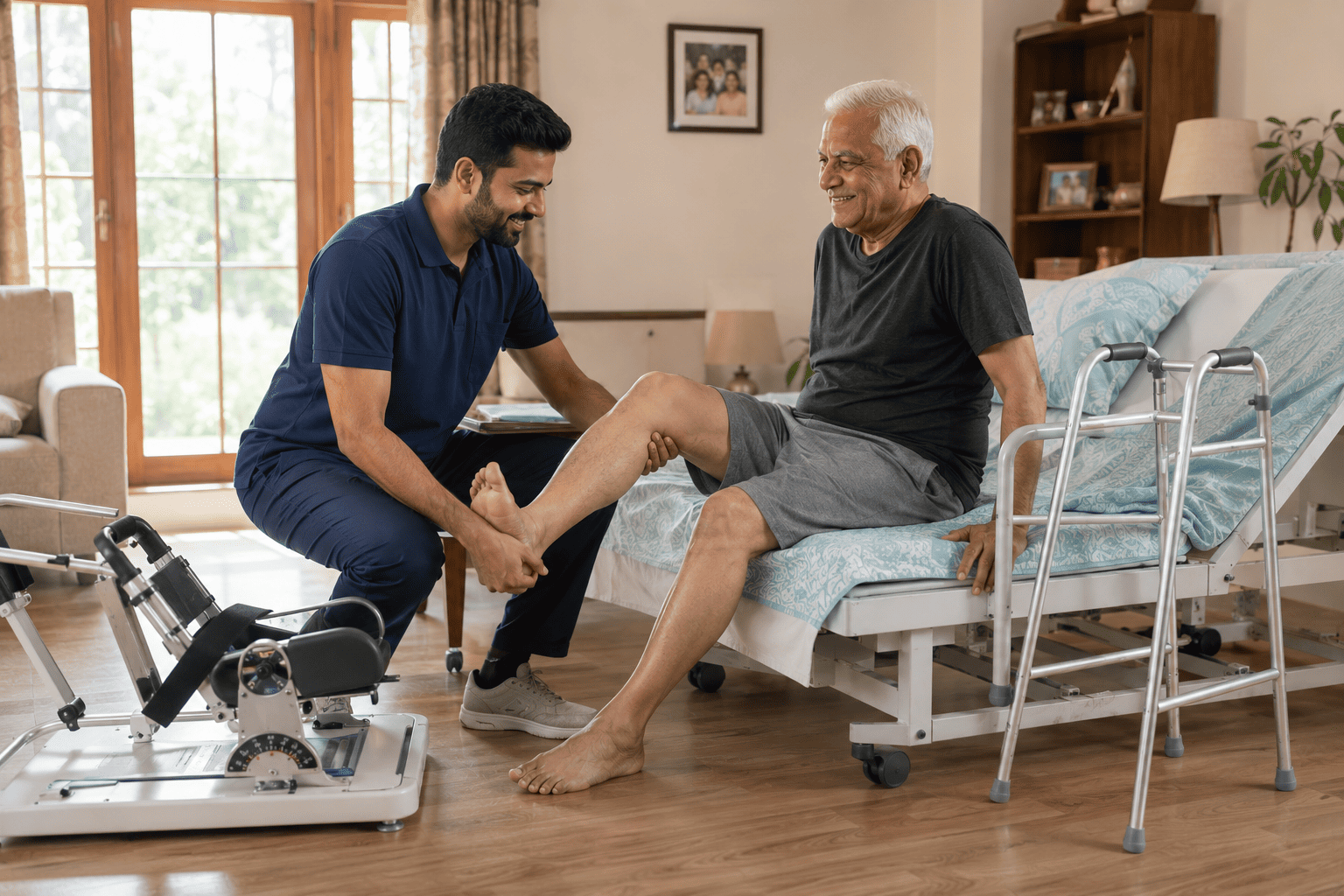
Joint replacement recovery at home is the structured rehabilitation a patient follows after knee or hip replacement, once the operating surgeon clears discharge. Healthy Jeena Sikho sets this up by delivering an electric hospital bed, CPM machine, walker, raised commode chair, DVT pump and ice therapy support, and by arranging home physiotherapy sessions that follow the surgeon's rehabilitation protocol.[1]
Joint replacement is different from most other surgeries in one important way: the result depends on what the patient does in the first six weeks, not on the operation alone. A knee that is not moved early can stiffen, and a hip that is bent past the limit set by the surgeon can dislocate. Healthy Jeena Sikho plans the home setup around these two risks, so the room itself makes correct movement easy and wrong movement difficult.
Healthy Jeena Sikho provides joint replacement recovery support at home across Chandigarh Tricity — Chandigarh, Mohali, Panchkula and Kharar. Healthy Jeena Sikho is ISO 9001:2015 certified and has operated since 2015. Patients recovering from spine, cardiac, abdominal or other procedures can see the wider after surgery recovery at home setup instead, and bathroom changes are covered in the bathroom safety guide.
Medically reviewed by Dr. Ashnoor Kaur, Physiotherapist, Healthy Jeena Sikho.
A general guide to what most patients work towards. The actual schedule is always set by the operating surgeon, and Healthy Jeena Sikho matches the equipment and physiotherapy to that plan.
Focus on pain control, swelling, and short assisted walks with a walker. Bed, commode and walking path should already be set up before the patient reaches home.
Daily physiotherapy and CPM sessions to improve bending and straightening. Walking distance increases gradually, and stitches or staples are usually removed in this window.
Most patients shift from walker to stick, manage stairs with supervision and handle daily routines with less help. Equipment can start being returned.
Focus moves from movement to muscle strength and balance. Most patients return to everyday activity, with the surgeon clearing driving and travel.
Healthy Jeena Sikho builds the setup around which joint was replaced and how much help the patient needs at home. Share the discharge summary for an exact equipment list and cost breakup. For any other operation, the general post-operative care at home options apply.
Built around hip precautions, where correct heights matter more than machines.
Built around early movement, since knee range of motion is decided in the first few weeks.
For both knees together, revision surgery, or elderly patients who need daily assistance.
Requirements differ between knee and hip replacement. This is what Healthy Jeena Sikho typically installs for each.
| Equipment | Qty | HipReplacement | KneeReplacement | Bilateral& Senior |
|---|---|---|---|---|
| Electric hospital bed | 1 | ✓ | ✓ | ✓ |
| Walker | 1 | ✓ | ✓ | ✓ |
| Commode chair | 1 | ✓ | ✓ | ✓ |
| DVT pump | 1 | ✓ | ✓ | ✓ |
| Home physiotherapy | Per session | ✓ | ✓ | ✓ |
| Abduction pillow | 1 | ✓ | × | × |
| CPM machine | 1 | × | ✓ | ✓ |
| Ice therapy support | 1 | × | ✓ | ✓ |
| Wheelchair | 1 | × | × | ✓ |
| Air mattress | 1 | × | × | ✓ |
| Trained attendant | 1 | × | × | ✓ |
A CPM machine, short for Continuous Passive Motion machine, is a motorised device that holds the operated leg in a cradle and slowly bends and straightens the knee through a set range, without the patient using any muscle effort. The angle is increased gradually as the knee tolerates more, which is why the machine is set to whatever range the operating surgeon has advised for that stage of recovery.
Its purpose is to keep the joint moving on days when pain, swelling or fatigue make active exercise difficult, so the patient does not lose ground between physiotherapy sessions. It supplements physiotherapy rather than replacing it, since muscle strength still has to be built through active exercise.
Practice varies between surgeons and hospitals. A Cochrane systematic review of CPM after total knee replacement, covering 24 trials and 1,445 participants, found only small, short-term effects on knee range of motion when CPM was added to standard physiotherapy, which is why some surgeons prescribe it routinely and others do not.[2] Healthy Jeena Sikho supplies the machine on monthly rental where the surgeon has advised it, usually for the first three to six weeks, and demonstrates the settings at the time of installation so the family can run sessions correctly.
Both are joint replacements, but the home setup and the precautions are almost opposite. Confirm every point with the operating surgeon, since protocols vary by surgical approach.
| Parameter | Knee Replacement | Hip Replacement |
|---|---|---|
| Main goal | Regain bending and full straightening early | Protect the joint from dislocation while healing |
| Key risk | Lasting stiffness if movement starts late | Dislocation from bending or twisting too far |
| Bed requirement | Adjustable backrest and side railings | Higher bed so the hip is not bent deeply on getting up |
| Toilet requirement | Standard commode chair | Raised commode seat to keep the hip above the safe angle |
| CPM machine | Advised by some surgeons for early range of motion | Not usually required |
| Sleeping position | Avoid a pillow under the knee, which limits straightening | Abduction pillow between the legs if the surgeon has advised it |
| Typical walking aid | Walker first, then stick as strength returns | Walker first, then stick as strength returns |
Falls are most common in the first weeks after joint replacement, at home, during ordinary movements such as getting out of bed at night. Healthy Jeena Sikho checks these points during the free home assessment.
The recovery room should avoid stairs entirely in the first weeks, with the bathroom as close as possible.
Loose rugs, wires, low stools and door thresholds should be removed along the bed-to-bathroom route.
Indian-style toilets are unusable after joint replacement, so a raised commode chair is essential from day one. See the full bathroom safety guide.
Night trips to the bathroom are when most falls happen, so the switch should be reachable from the bed.
Low sofas trap the patient. A firm chair with armrests allows standing up without straining the new joint.
Medicines, water and phone should need no bending or stretching, especially after hip replacement.
A small clear area beside the bed lets the physiotherapist work without moving furniture every session.
Someone should be available at night in the first week, since getting up alone is the highest-risk moment.
Most families arrange this a day before discharge, so the room is ready before the patient reaches home.
Call or WhatsApp which joint was replaced, the discharge date and the surgeon's rehabilitation instructions to Healthy Jeena Sikho.
The team checks room access, bathroom distance, bed height and walking path, then finalises the equipment list.
Equipment is delivered and installed by a technician, and the family is shown how to use the bed, walker and CPM machine.
Physiotherapists start sessions on the surgeon's schedule and track range of motion progress week by week.
The cost of joint replacement recovery at home is not a single fixed number. Healthy Jeena Sikho prepares a quote after reviewing the discharge summary, because the final cost depends on four things: which joint was replaced, the equipment mix, the number of physiotherapy sessions the surgeon has advised, and the delivery location within Chandigarh Tricity.
Knee replacement setups usually cost more than hip setups, because the CPM machine and ice therapy support are added. Bilateral and elderly cases cost more again, since a wheelchair, air mattress and attendant are typically required. Equipment is charged on monthly rental, and most joint replacement patients need it for only one to two months, so the total outlay is far smaller than for long-term care.
Because rental is monthly, families can return the walker, CPM machine or commode chair as soon as the patient no longer needs them, instead of paying for a full month of unused equipment. Healthy Jeena Sikho shares a written breakup of rental, deposit and physiotherapy charges before anything is dispatched, so families know the full cost in advance. Current rental rates for individual items are listed on each product page on healthyjeenasikho.com.
Joint replacement recovery setups are delivered and installed across Chandigarh Tricity, subject to serviceable pin code and equipment availability.
Equipment and physiotherapy support from the Healthy Jeena Sikho physiotherapy centre in Mohali, Sector 71. Same-day setup available in most Tricity locations.
Healthy Jeena Sikho regularly sets up joint replacement recovery rooms for families discharged from Tricity hospitals, including PGIMER Chandigarh, Government Medical College and Hospital Sector 32, Fortis Mohali, Max Mohali, Ivy Hospital Mohali, Grecian Super Speciality Hospital Mohali, Alchemist Hospital Panchkula and Paras Health Panchkula.
Healthy Jeena Sikho is not affiliated with, endorsed by or a service partner of any of the hospitals named above. They are listed only to indicate where families who use this service are commonly discharged from.
Healthy Jeena Sikho also delivers medical equipment in Delhi NCR, Ludhiana, Jalandhar, Jaipur and Lucknow. Joint replacement recovery setups outside Tricity are arranged case by case — check the city pages on healthyjeenasikho.com or call to confirm availability at your pin code.
Healthy Jeena Sikho is an ISO 9001:2015 certified home healthcare provider operating across North India.
A decade of supplying home medical equipment and arranging nursing, attendant and physiotherapy support for recovering patients.
Rehabilitation sessions in the patient's own environment, following the operating surgeon's protocol.
The recovery room can be set up the day before, so nothing is arranged in a rush on discharge day.
The machine is installed, settings explained and the family trained to run sessions correctly.
Rented items can be returned as the patient becomes independent, so families do not pay for unused equipment.
Most knee replacement patients need an electric hospital bed, walker, commode chair, DVT pump and ice therapy support, plus a CPM machine where the surgeon has advised one. Healthy Jeena Sikho finalises the list after a free home assessment and installs everything before discharge.
A CPM machine slowly bends and straightens the operated knee through a set range without muscle effort, keeping the joint moving on days when pain or swelling make active exercise difficult. It supplements physiotherapy rather than replacing it, and evidence for added benefit is modest, so some surgeons prescribe it and others do not. Healthy Jeena Sikho supplies it on monthly rental where the surgeon has advised it.
Most patients need equipment for one to two months. The walker is usually replaced by a stick around week four to six, and the CPM machine is typically used for the first three to six weeks. Since Healthy Jeena Sikho rents monthly, items can be returned early as the patient becomes independent.
Rehabilitation usually begins within the first few days, but the exact schedule is always set by the operating surgeon. Healthy Jeena Sikho arranges home physiotherapy sessions according to that protocol, since delayed movement after knee replacement can limit the joint's range.
An electric hospital bed with height adjustment and side railings is preferred. It lets the patient sit up and get out safely without straining the new joint, and the height can be raised for hip replacement patients so the hip is not bent deeply while standing up.
Sitting on a low seat bends the hip past the angle most surgeons allow in the early weeks, which risks dislocation. A raised commode chair keeps the hip within the safe range. Indian-style toilets are unusable after either joint replacement, so this is arranged from day one.
Knee recovery is about regaining movement early, so a CPM machine and daily physiotherapy matter most. Hip recovery is about protecting the joint, so correct bed, chair and toilet heights and an abduction pillow matter more than machines. Healthy Jeena Sikho supplies a different setup for each.
Yes. Healthy Jeena Sikho provides trained attendants in 12-hour and 24-hour shifts. Families usually arrange help for the first one to two weeks, especially at night, since getting up alone is the highest-risk moment for a fall.
Yes, but rental is usually more economical for joint replacement, since the equipment is needed for only one to two months. Purchase makes more sense for an elderly patient who will continue needing a bed or wheelchair beyond this recovery.
A refundable security deposit applies to rented equipment. The amount depends on the items selected and is confirmed in writing before dispatch.
Joint replacement recovery setups are provided across Chandigarh Tricity, covering Chandigarh, Mohali, Panchkula and Kharar, subject to serviceable pin code. Healthy Jeena Sikho also supplies medical equipment in Delhi NCR, Ludhiana, Jalandhar, Jaipur and Lucknow, where a recovery setup can be arranged on request.
Call +91 98769 78488 or message +91 98759 15278 on WhatsApp with which joint was replaced, the discharge date, the surgeon's rehabilitation instructions and the delivery location. Healthy Jeena Sikho will share the equipment list, cost breakup and setup timeline.