
Bathroom Safety After Surgery or Stroke: Fixing the Most Dangerous Room in the House
The short version
- The bathroom is where recovering patients fall. Wet tiles, hard surfaces, tight space, low seats and the one place people insist on being alone — every risk factor in one room.
- An Indian-style toilet is not usable after hip, knee or spine surgery. It requires exactly the deep squat those operations forbid. Arrange a commode chair before discharge, not after the first attempt.
- Suction grab bars are not grab bars. They come off under load, which is precisely when they are needed. Anything the patient's weight goes through must be bolted into the wall.
- Sit to bathe. Standing on wet tiles is the fall. A shower chair with rubber tips and a handheld shower removes most of the risk for a fraction of the cost of a fracture.
- Turn the geyser down and test the water on the strong side. After a stroke or with diabetic neuropathy, the affected side may not feel a scald until the skin is already burnt.
- Never let the door be bolted from inside. If a patient collapses against an inward-opening bolted door, the family cannot reach them.
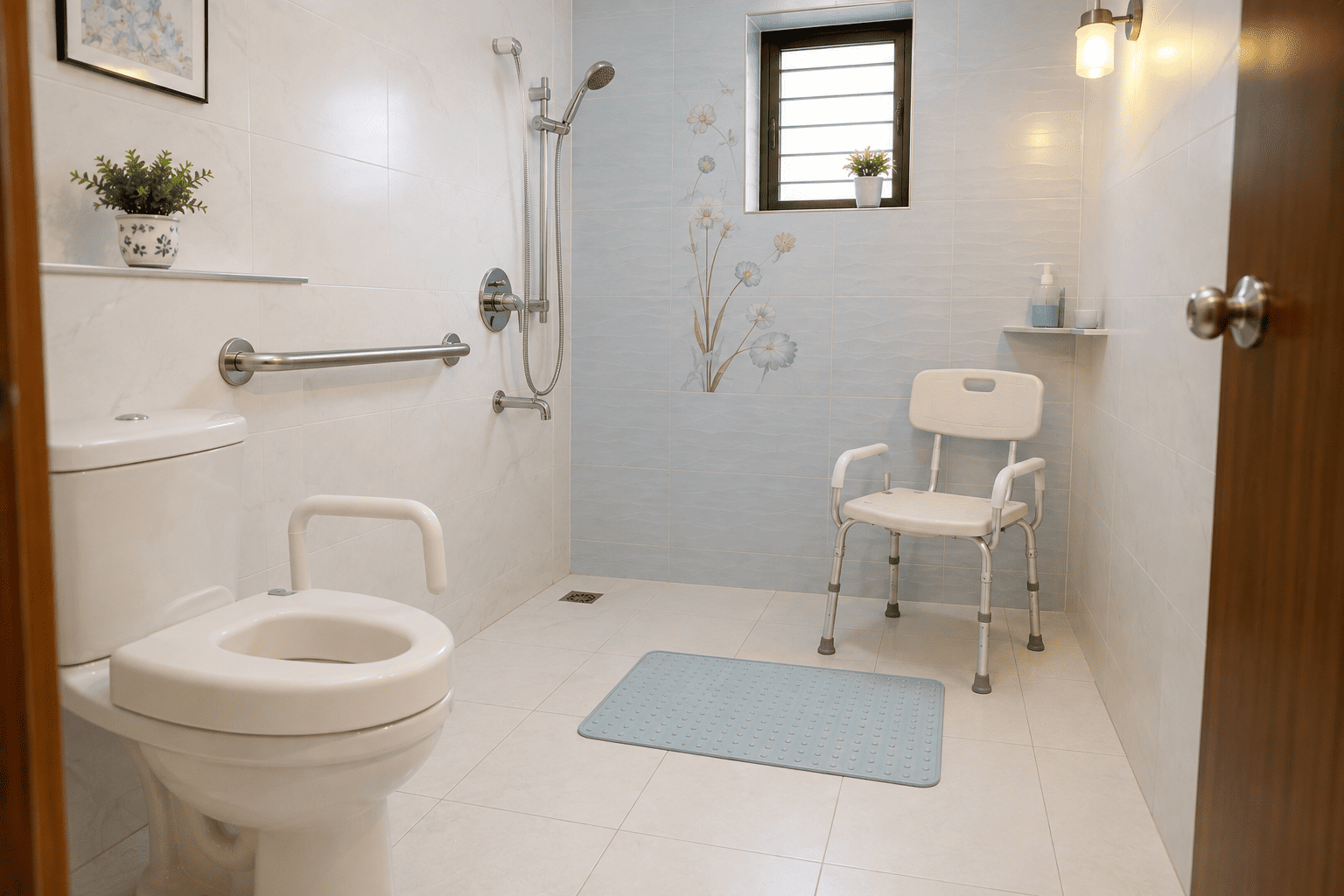
Every discharge summary says "avoid falls". Nobody says that the fall will almost certainly happen in the bathroom, at night, on the way back from the toilet, in the second week when the patient has started feeling confident. Bathrooms concentrate risk: they are wet, hard, small, poorly lit and private. This guide covers what to actually change — grab bar positions, seat heights, floor treatment, water temperature, door arrangement — and what is different after a hip replacement, a spine surgery or a stroke.
Why is the bathroom the most dangerous room?
Because it combines a wet slippery floor, hard surfaces with no soft landing, very little space to recover balance, low seats that demand maximum leg strength, and a patient who wants privacy. Recovery also creates its own risk: patients regain confidence faster than they regain balance, and the bathroom is the first place they insist on managing alone.
Wet, smooth floor
Glazed tiles with water and soap film have almost no grip, and grip is what a weak leg depends on entirely.
Nothing safe to grab
People reach for the towel rail, the tap, the basin edge or the door. None of them is fixed to take body weight.
Low seats
Standing up from a low toilet is the hardest movement a recovering patient makes, and it happens several times a day.
Hard surfaces
Tiles, taps, cistern corners and door frames turn a stumble into a head injury or a hip fracture.
Alone, behind a bolt
Dignity means privacy, and privacy means nobody sees the fall or can open the door afterwards.
Night trips
Half-asleep, poorly lit, in a hurry, often without the walking aid. The classic circumstances of a bathroom fall.
Falls happen outside the bathroom too — the medication review, the six highest-risk moments of the day and what to do immediately after a fall are covered in fall prevention during recovery.
What makes a typical Indian bathroom harder
Most Indian bathrooms are built as a single wet room: no separated dry zone, a floor that slopes to a drain, a raised threshold at the door, and often an Indian-style toilet. Every one of those features works against a patient with reduced strength, balance or hip movement.
| Feature | Why it is a problem | Practical fix |
|---|---|---|
| Indian-style toilet | Requires a deep squat, which is forbidden after hip, knee and spine surgery and impossible for most stroke patients. | Commode chair placed over it, or a bedside commode chair in the room. |
| Whole floor gets wet | There is no dry area to stand and dress in, so the patient is always on a wet surface. | Anti-skid treatment, a shower curtain to contain spray, and a dry mat outside the door. |
| Raised threshold at the door | A trip hazard for a walker, and impossible for a wheelchair. | Small ramp over the threshold, or remove the step where the drainage allows. |
| Bucket and mug bathing while seated on a low stool | Getting up from a low patla on a wet floor with wet hands is one of the highest-risk movements in the house. | Shower chair at proper seat height with rubber tips. |
| Door opens inwards with an inside bolt | A patient who collapses against the door blocks the only access. | Reverse the door to open outwards, or remove the bolt and use an occupied sign. |
| Overhead fixed shower only | Forces standing, and prevents seated washing. | Add a handheld shower on a flexible hose. |
| Instant geyser with no thermostat | Water temperature swings, and a patient with reduced sensation may not feel a scald. | Set the geyser lower and always test the water before the patient enters. |
| Bathroom far from the bedroom | Longer route means more steps, more fatigue and more chances to fall. | Move the patient's room closer, or use a commode chair at night. |
Where should grab bars be fixed?
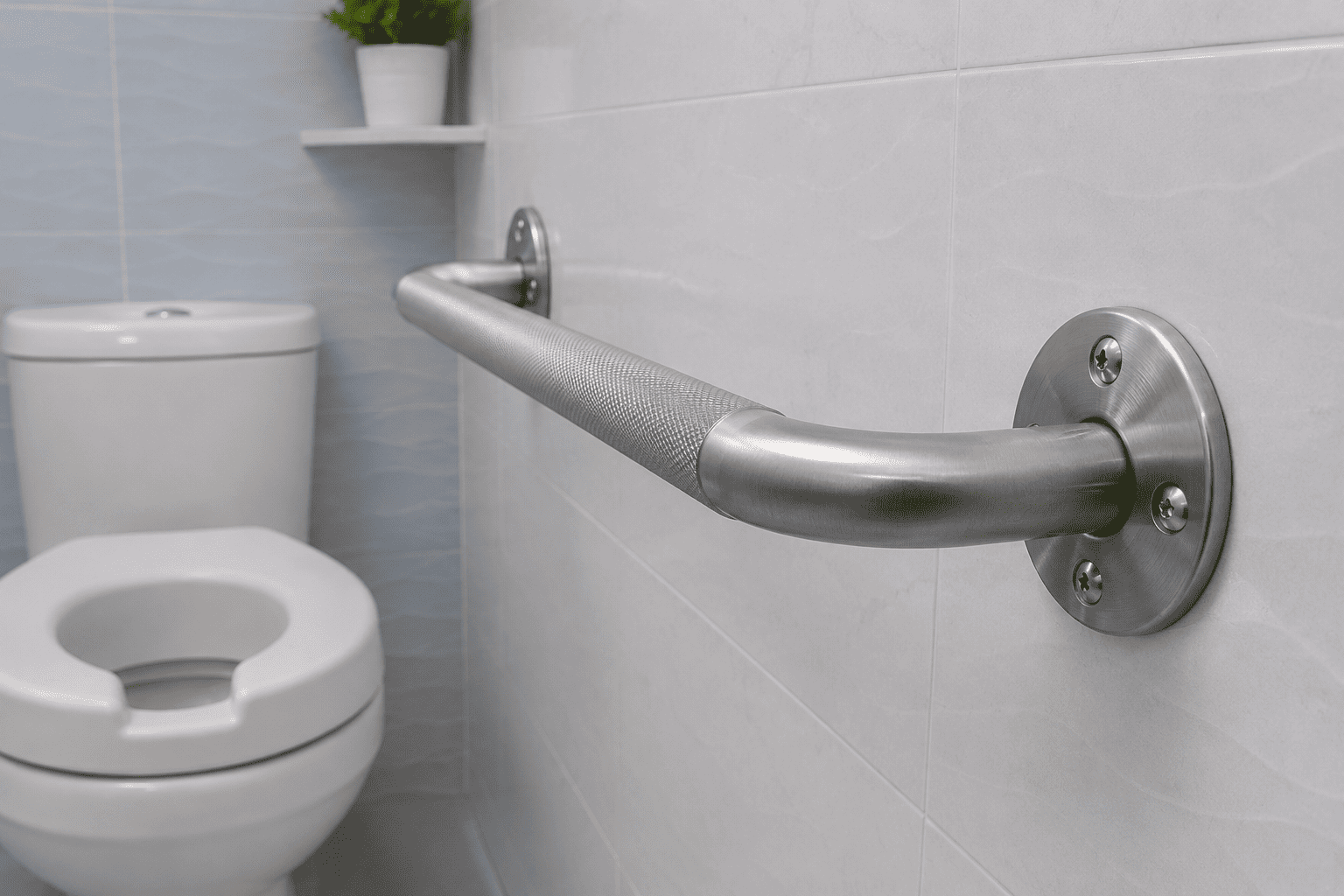
Three places matter most: beside the toilet, at the entry to the shower area, and inside the shower area within reach of a seated patient. Every bar must be bolted into masonry with proper anchors — never a suction-mounted bar, which releases under exactly the load it is meant to hold.
| Position | Orientation | Purpose |
|---|---|---|
| Beside the toilet, on the stronger side | Horizontal, roughly 70 to 85 cm from the floor | The push-off point for sitting down and standing up — the single most useful bar in the house. |
| Behind or beside the toilet | Vertical | Something to pull up on when rising, useful for patients with weak legs but good arms. |
| At the shower entry | Vertical | Steadies the patient at the moment of stepping onto wet floor. |
| Inside the shower area | Horizontal, reachable while seated | Lets a seated patient shift position and stand safely at the end. |
| Near the basin | Vertical or horizontal | Stops the patient leaning on the washbasin, which can crack or pull off the wall. |
Fitting rules that matter
- Bolt into masonry, never tile alone. Anchors must reach solid wall behind the tile.
- Test with full body weight before the patient uses it, by pulling hard on it yourself.
- Use a knurled or textured bar so a wet hand does not slide.
- Fit on the stronger side for a patient with one-sided weakness, and confirm the side with the physiotherapist.
- Leave about 4 to 5 cm clearance from the wall so the hand can wrap around fully.
- Do not use a towel rail as a grab bar. It is fixed to hold a towel, and it will come away from the wall.
Suction-cup bars are for balance only
Suction-mounted handles are widely sold and widely misunderstood. They can give a light steadying point on perfectly smooth tile, but they release without warning when a patient's full weight goes through them, and they fail faster on textured or grouted surfaces. Never rely on one for sit-to-stand or for a patient with a real risk of falling. Anything that takes body weight gets bolted in.
Getting the toilet right: height and seating
The seat should be high enough that the patient's hips stay level with or above the knees when seated. A standard Indian western toilet is usually too low for a post-surgical patient, so a raised toilet seat or a commode chair placed over the toilet closes the gap. After a hip replacement this is a precaution, not a comfort measure.
Which option for which patient
| Option | Best suited for | Notes |
|---|---|---|
| Raised toilet seat | Patient who can walk to the bathroom but struggles to stand from a low seat | Cheapest fix. Must clamp firmly; a seat that shifts is worse than none. |
| Commode chair over the toilet | Patient needing height plus armrests to push up from | Armrests do most of the work. Adjustable legs let you set the exact height. |
| Bedside commode chair | Night use, long bathroom distance, or a patient too weak to walk there | Removes the highest-risk trip entirely. Empty and clean promptly. |
| Commode chair over an Indian toilet | Homes with only an Indian-style toilet | The standard solution after hip, knee and spine surgery. Check the frame is stable on the floor slope. |
| Wheeled shower commode chair | Patient who cannot walk and must be wheeled in | Needs a threshold-free doorway and enough turning space inside. |
Sitting down and standing up safely
- Walk right up to the toilet and turn slowly by stepping the feet round — never twist on one leg.
- Feel the seat with the back of both legs before starting to sit.
- Reach back for the armrests or the grab bar, one hand at a time.
- Slide the operated leg forward if a hip or knee has been replaced, then lower slowly by bending the knees.
- To stand, shuffle forward to the edge, lean forward with the nose over the toes, and push up through the armrests rather than pulling on anything in front.
- Stand still for a moment before walking, because standing up quickly can cause dizziness.
Commode chairs, raised seats, shower chairs and wheelchairs are all available on monthly rent, which suits a requirement that usually lasts weeks rather than years. See the wheelchair range and the full medical equipment on rent list, or arrange the whole setup through after surgery recovery at home.
How should a recovering patient bathe safely?
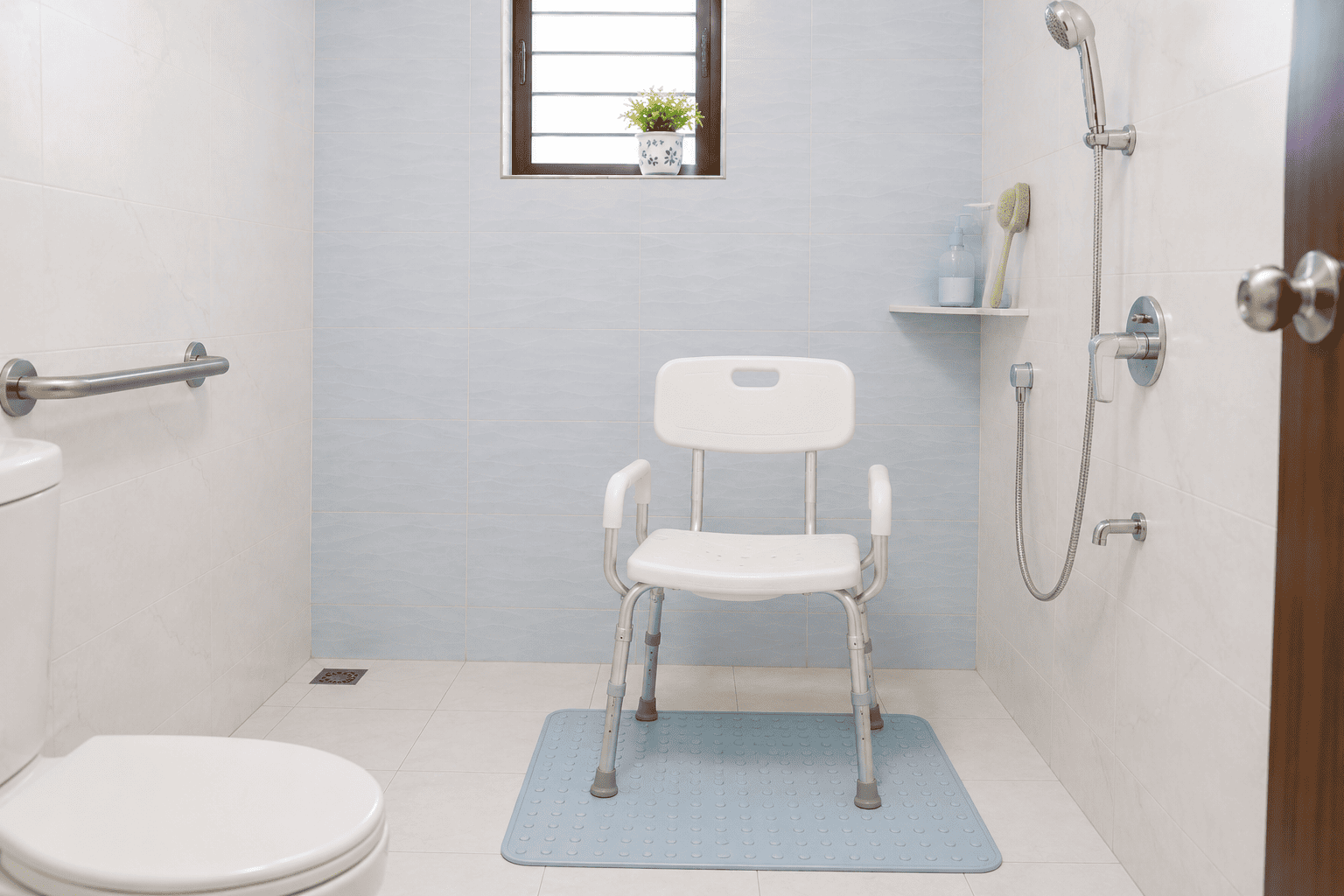
Seated, with a handheld shower, on an anti-skid surface, with someone within earshot. Standing to bathe on wet tiles is the single riskiest thing a recovering patient does, and a shower chair removes almost all of that risk. Until the surgeon clears the wound for water, a sponge bath in bed is the safer route.
The seated bathing setup
- Shower chair or stool with rubber-tipped legs, backrest preferred, height set so the feet rest flat on the floor.
- Handheld shower on a flexible hose, so the patient washes without turning or reaching overhead.
- Everything within reach before starting — soap, shampoo, mug, towel, change of clothes. Nobody should be reaching or standing mid-bath.
- Long-handled sponge for the back, feet and the far side, especially with restricted hip or shoulder movement.
- Liquid soap or a soap on a rope. A dropped bar of soap is a fall waiting for someone to bend down.
- Anti-skid mat inside the wet area and a dry absorbent mat outside the door.
- Towel and clothes on a stool within reach, so the patient does not walk wet across the room to dress.
Water temperature is a safety issue, not comfort
After a stroke, with diabetic neuropathy or with a spinal cord injury, sensation on the affected side may be reduced or absent. A patient can hold a limb under water hot enough to scald and not feel it until the skin is damaged. Set the geyser to a moderate temperature rather than maximum, always test the water yourself or with the patient's unaffected hand or elbow first, and never start a shower with hot water running directly onto a numb limb.
Do not get the wound wet until the surgeon says so
Every surgery has its own timeline for water contact, and it depends on the dressing, the wound and the closure method. Until the operating team clears it, use a sponge bath and keep the wound area dry, or use the waterproof dressing they have specified. Do not soak in a bucket or tub, do not scrub the wound, and pat the area dry rather than rubbing. Report any redness, discharge, swelling or opening of the wound the same day.
Floor, lighting and the door
Fix the surface, remove the trip hazards, light the whole route, and make sure the door can be opened from outside. These four are cheap, take an afternoon, and prevent more injuries than any single piece of equipment.
Floor
- Use a proper anti-skid mat with suction grip in the wet area, not a loose plastic or cloth mat that slides.
- Consider anti-skid tile treatment if the existing tiles are glazed and slippery, which is common in older Indian bathrooms.
- Squeegee or mop after every use so the next person is not walking onto standing water.
- Remove loose mats from the route between the bed and the bathroom — a rug edge is a walker's worst enemy.
- Ramp the threshold if there is a step at the bathroom door.
Lighting
- A switch reachable from the bed, so the patient never crosses a dark room.
- A low night light on the route and inside the bathroom, left on all night.
- Bright, even light inside the bathroom — shadows hide water on the floor.
The door
- Make it open outwards if possible, so a collapsed patient does not block it.
- Remove the inside bolt or replace it with a lock that can be released from outside. Use an occupied sign for privacy instead.
- Check the clear width — a walker needs roughly 75 to 80 cm of actual opening, and a wheelchair the same or more.
- Keep a phone or call bell within reach of the toilet and the shower chair.
What changes after specific surgeries and after a stroke
The equipment is similar, but the forbidden movements and the working side change. Precautions differ between patients and between surgical approaches, so the operating surgeon's or physiotherapist's specific instruction always overrides a general rule.
| Condition | Bathroom priority | Avoid |
|---|---|---|
| Hip replacement | Raised seat height so the hip is not bent deeply, grab bar on the unoperated side, shower chair, long-handled sponge and a long shoehorn. | Squatting, deep bending to wash the feet, crossing the legs, twisting the leg inwards. |
| Knee replacement | Higher seat, armrests to push from, operated leg slid forward when sitting and standing. | Pivoting on the operated leg, kneeling, low stools. |
| Spine surgery | Everything within reach at waist to shoulder height, long-handled aids, seat height that avoids bending. | Bending forward, twisting at the waist, lifting a bucket. |
| Abdominal surgery | Wound kept dry as advised, support the abdomen with a hand when standing, no straining. | Lifting buckets, straining on the toilet, soaking the wound. |
| Cardiac surgery | Seated bathing, moderate water temperature, unhurried pace, someone within earshot. | Very hot water, long steamy baths, pushing or pulling with the arms across the chest. |
| Stroke with one-sided weakness | Grab bar and transfers towards the strong side, seated bathing, one-handed technique taught by the therapist, water tested on the unaffected side. | Pulling on the weak arm, standing to bathe, hot water on a numb limb. |
| Reduced sensation or diabetes | Geyser set lower, water always tested first, feet checked after every bath. | Judging water temperature with the affected limb. |
| Dizziness or low blood pressure | Seated bathing, cooler water, slow position changes, never locking the door. | Hot showers, standing up quickly, bathing alone in the house. |
Stroke: the one-handed bathroom
A hemiplegic patient has to relearn the bathroom with one working hand. The practical answers are a shower chair so balance is not part of the problem, a handheld shower, liquid soap in a pump bottle, a long-handled sponge, and a nail brush suction-mounted to wash the strong hand. The weak arm should be supported and washed carefully, never pulled or used as a handle. Sensation may also be reduced on that side, so the water temperature is always checked with the strong hand or elbow first, and the skin on the weak side inspected after each bath.
The routine that keeps it safe
- Fixed bathing time in daylight, when the caregiver is fresh and the light is good.
- Never bathe when alone in the house in the first weeks, even if the patient insists.
- Announce and agree the plan before starting, so both people move together.
- Walking aid comes to the bathroom door every time, including at night.
- Time-limit the toilet. Sitting for twenty minutes on a hard rim is a pressure injury risk.
- Dry the floor immediately afterwards, before the next person walks in.
- Dry between the toes and check the feet, especially in diabetic patients.
- Fluids matter. Patients who avoid drinking water to avoid toilet trips end up dehydrated, constipated and more likely to faint.
If a fall happens in the bathroom
- Do not try to lift the patient up on your own, and do not pull them up by the arms.
- Check whether they are fully alert, ask about pain, and look for an obviously deformed limb before moving anything.
- Call an ambulance or the treating doctor for head injury, severe pain, an inability to move a limb, or any head knock in a patient on blood thinners — even if they seem fine afterwards.
- If no injury is suspected, get at least two people, dry the floor first, and consider a hoist rather than a manual lift.
- Report every fall to the treating team, including the ones with no injury. Repeated falls mean the setup needs changing.
Bathroom safety checklist before discharge
- Grab bar bolted beside the toilet on the patient's stronger side.
- Grab bar at the shower entry and one reachable from the shower chair.
- Raised toilet seat or commode chair, height checked against the patient's knee height.
- Commode chair over the Indian toilet, if that is the only one available.
- Shower chair with rubber tips and a backrest.
- Handheld shower fitted on a flexible hose.
- Anti-skid mat inside, dry mat outside, all loose mats removed from the route.
- Threshold ramped or removed.
- Geyser temperature turned down and tested.
- Light switch reachable from the bed, night light on the route.
- Door opening outwards, or the inside bolt removed.
- Phone or call bell within reach of the toilet and the chair.
- Long-handled sponge, liquid soap and towel placed within reach.
- Bedside commode arranged for night use if the bathroom is far.
This checklist is one part of preparing the whole room before the patient comes home — bed placement, clearances and power points are covered in how to set up a patient room at home, and the transfer technique itself in how to move and transfer a bedridden patient.
Where Healthy Jeena Sikho delivers commode and shower equipment
Delhi NCR: Delhi, Noida, Greater Noida, Gurugram, Faridabad and Ghaziabad.
Chandigarh Tricity: Chandigarh, Mohali, Panchkula and Kharar, served from the head office and store in Sector 73, Mohali.
Punjab: Ludhiana, Jalandhar and Bathinda.
Rajasthan and Uttar Pradesh: Jaipur and Lucknow.
Equipment sales are available more widely across India. Delivery, installation, home nursing and attendant support are limited to the cities listed above, subject to serviceable pin code and stock. Call +91 98769 78488 or WhatsApp +91 98759 15278.
How Healthy Jeena Sikho helps make the bathroom safe
- Free home assessment. The team checks bathroom distance, door width, threshold, seat height and the route from the bed before recommending anything.
- Commode and shower seating on rent. Commode chairs, shower chairs, raised seats and wheeled shower commodes, matched to the patient's height and weight-bearing status.
- Height set for the patient, not the box. Adjustable legs are set to the individual's knee height at installation rather than left at the factory setting.
- Physiotherapy at home. A physiotherapist can watch a real toilet and shower transfer in your actual bathroom and correct the technique, which no guide can do.
- Attendants and nurses. 12-hour and 24-hour shifts including night duty, for families where bathroom trips are the hardest part of the day.
- Delivery across North India. Delhi, Noida, Greater Noida, Gurugram, Faridabad, Ghaziabad, Chandigarh, Mohali, Panchkula, Kharar, Ludhiana, Jalandhar, Bathinda, Jaipur and Lucknow.
For the full recovery setup see joint replacement recovery at home, stroke recovery at home, or the recovering at home hub.
Free home assessment and same-day delivery in serviceable locations, subject to stock and service availability. Call +91 98769 78488 or WhatsApp +91 98759 15278.
Frequently Asked Questions About Bathroom Safety
Can a patient use an Indian-style toilet after knee or hip replacement?
No. An Indian-style toilet requires a deep squat, which bends the hip and knee far beyond what is allowed in the early weeks after joint replacement and risks dislocation of a new hip. The standard solution is a commode chair placed over the Indian toilet, or a bedside commode chair in the patient's room. Arrange it before discharge rather than after the first failed attempt.
Where exactly should a grab bar be installed beside the toilet?
Horizontally on the patient's stronger side, roughly 70 to 85 cm from the floor, positioned so the patient can reach it while seated and push against it while standing. Leave about 4 to 5 cm clearance from the wall so the hand can wrap around. It must be bolted into masonry with proper anchors, and the exact height should be confirmed against the individual patient by the physiotherapist.
Are suction grab bars safe?
Not for weight bearing. Suction-mounted handles can give a light steadying point on perfectly smooth tile, but they release without warning under full body weight and fail faster on textured or grouted surfaces. Anything the patient's weight goes through must be bolted into the wall.
How high should the toilet seat be for a recovering patient?
High enough that the hips stay level with or above the knees when seated, which usually means adding height to a standard western toilet with a raised seat or a commode chair. After a hip replacement this is a surgical precaution rather than a comfort choice. Set the height against the individual patient's knee height rather than a fixed number.
Should a patient shower standing or sitting after surgery?
Sitting, on a shower chair with rubber-tipped legs, using a handheld shower. Standing on wet tiles is the highest-risk activity a recovering patient performs, and seated bathing removes most of that risk. Until the surgeon clears the wound for water contact, a sponge bath is the safer option.
When can a surgical wound get wet?
Only when the operating team says so. The timeline depends on the wound, the dressing and the closure method, and it differs between procedures. Until then use a sponge bath or the waterproof dressing specified by the surgeon, do not soak the area, and pat rather than rub it dry. Report redness, discharge, swelling or wound opening the same day.
Why is water temperature a safety issue after a stroke?
Sensation on the affected side may be reduced or absent after a stroke, and the same applies with diabetic neuropathy or spinal cord injury. A patient can hold a limb under water hot enough to scald without feeling it until the skin is damaged. Set the geyser to a moderate temperature, test the water with the unaffected hand or elbow first, and never direct hot water onto a numb limb.
Should the bathroom door be locked?
No. If a patient collapses against an inward-opening bolted door, the family cannot reach them. Remove the inside bolt or replace it with a lock that can be released from outside, and use an occupied sign for privacy. Where possible, reverse the door so it opens outwards.
Is a bedside commode better than walking to the bathroom at night?
In the early weeks, usually yes. Night trips to the bathroom are when most falls happen — the patient is half-asleep, the light is poor and the walking aid is often left behind. A bedside commode removes that trip entirely. It should be emptied and cleaned promptly, and the patient should not be left sitting on it for long periods.
What should be done if a patient falls in the bathroom?
Do not lift them up alone or pull them by the arms. Check whether they are fully alert, ask about pain and look for an obviously deformed limb first. Call for medical help for head injury, severe pain, an inability to move a limb, or any head knock in a patient on blood thinners. If no injury is suspected, get at least two people, dry the floor first, and report the fall to the treating team afterwards.
In which cities does Healthy Jeena Sikho deliver commode and shower equipment?
Delivery, installation, home nursing and attendant support are available in Delhi, Noida, Greater Noida, Gurugram, Faridabad, Ghaziabad, Chandigarh, Mohali, Panchkula, Kharar, Ludhiana, Jalandhar, Bathinda, Jaipur and Lucknow, subject to serviceable pin code and stock. Equipment sales are available more widely across India. Call +91 98769 78488 or WhatsApp +91 98759 15278 to check your location.
References and further reading
- National Institute for Health and Care Excellence (NICE). Falls in older people: assessing risk and prevention, clinical guideline CG161.
- World Health Organization. WHO global report on falls prevention in older age.
- Bureau of Indian Standards. IS 4963: Recommendations for building and facilities for persons with disabilities — grab bar placement, clear door widths and accessible sanitary facilities.
- Ministry of Housing and Urban Affairs, Government of India. Harmonised Guidelines and Standards for Universal Accessibility in India.
- American Academy of Orthopaedic Surgeons. Total hip replacement and total knee replacement: activities and precautions after surgery.
- American Heart Association / American Stroke Association. Guidelines for adult stroke rehabilitation and recovery.
Medical disclaimer. This page is general educational information about bathroom safety during recovery at home. It is not medical advice and does not replace assessment by a qualified physician, physiotherapist or occupational therapist. Weight-bearing status, post-surgical precautions, wound care timelines and when a wound may get wet must be determined by the treating clinical team, since these differ between patients and between surgical approaches. Grab bars and any structural modification should be fitted by a competent installer into a suitable wall. Healthy Jeena Sikho supplies, installs and services home medical equipment and arranges nursing, attendant and physiotherapy services, and does not diagnose conditions or independently set clinical parameters. After a fall involving head injury, severe pain or a limb that looks deformed, seek medical help immediately.