
Physiotherapy at Home After Hospitalisation: What to Expect
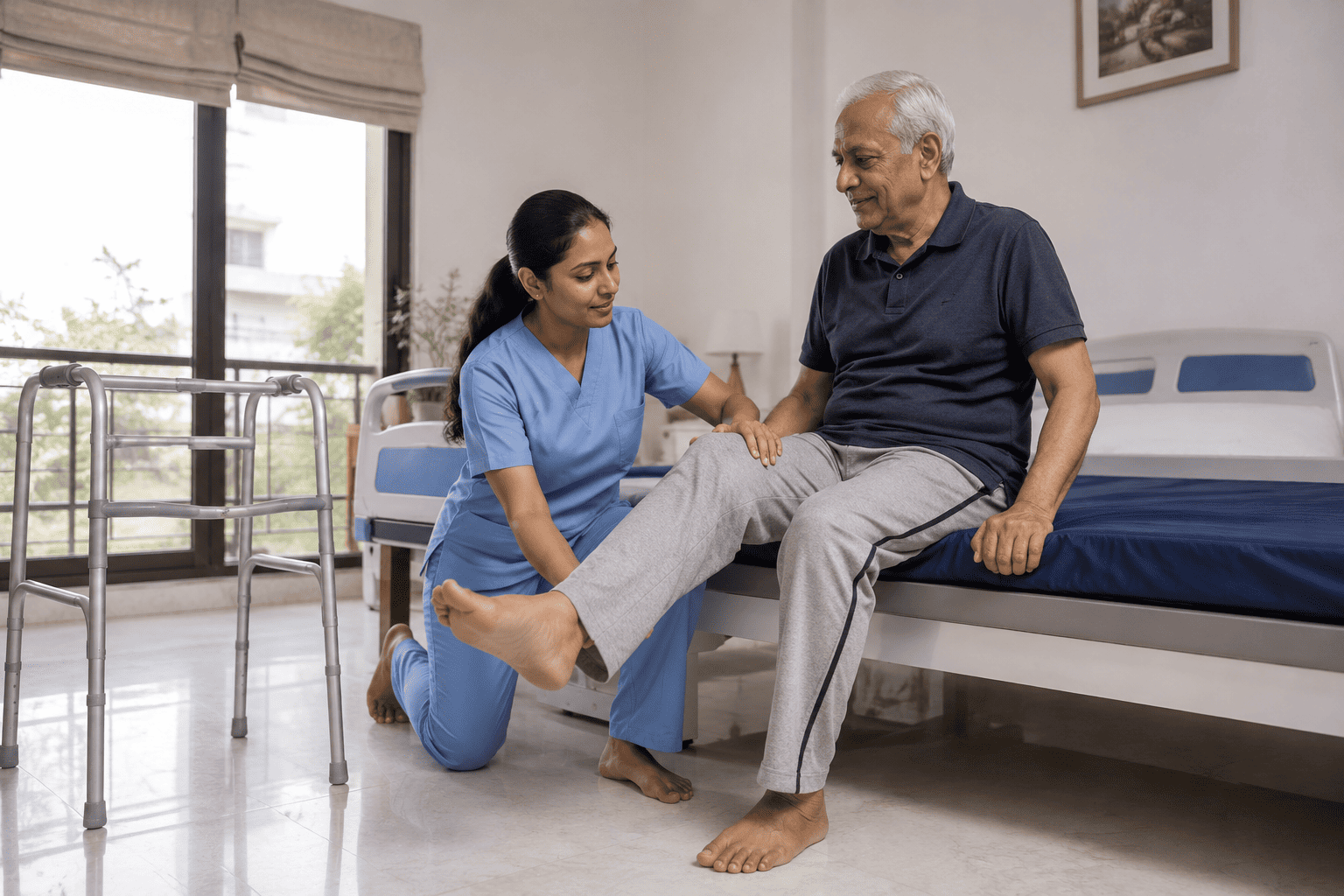
The short version
- The damage is done by the bed rest, not only by the illness. Muscle strength starts falling within days of lying still, and older patients lose it fastest. Two weeks in a hospital bed can cost more function than the condition that caused the admission.
- The gap between discharge and the first session is the real problem. Families take two or three weeks to arrange therapy. Those are the weeks where the most recovery was available.
- Home physiotherapy trains the actual house. The patient practises on their own stairs, their own bathroom, their own bed — not on gym equipment they will never use again.
- Chest physiotherapy is the most skipped and most useful. Breathing exercises after major surgery reduce the risk of chest infection, which is one of the commonest reasons a recovering patient is readmitted.1
- The session is 45 minutes. The recovery happens in the other 23 hours. The home exercise programme between visits is what actually produces change.
- Be wary of anyone who promises a cure or a timeline. A good physiotherapist sets goals, measures progress and adjusts. Nobody can guarantee how much function returns.
Discharge summaries in India usually end with two words — "physiotherapy advised" — and no explanation of what kind, how often, for how long, or who should provide it. The family then waits until the patient "gets a bit stronger" before starting, which is exactly backwards. This guide covers what home physiotherapy after hospitalisation actually involves, how to choose a physiotherapist, what a session looks like, and the warning signs that mean a session should stop.
Why does a patient need physiotherapy after hospitalisation?
Because lying in bed causes its own damage, separate from the illness. Muscles weaken, joints stiffen, balance deteriorates, lungs clear secretions less well and the heart adapts to doing less. Commonly cited figures put muscle strength loss at roughly 1 to 1.5 per cent for each day of strict bed rest, and older patients and those in intensive care lose it faster.1
This is why a patient who went into hospital walking can come out unable to stand, even when the original problem has been treated successfully. Physiotherapy after discharge is not about the surgery or the stroke alone. It is about reversing what two weeks of immobility did on top of it.
| What bed rest affects | What the patient notices | What physiotherapy does |
|---|---|---|
| Muscle strength | Legs feel heavy, cannot stand from a chair without pushing | Progressive strengthening, starting with what the patient can already do |
| Joint mobility | Stiff shoulder, knee that will not straighten, tight ankle | Range-of-motion work, passive at first, then active |
| Balance | Unsteady on standing, afraid of falling, holds furniture | Balance retraining and safe gait practice in the real house |
| Lung function | Shallow breathing, weak cough, rattling chest | Chest physiotherapy, breathing exercises, secretion clearance |
| Stamina | Exhausted after walking a few steps | Graded activity building, a little more each session |
| Confidence | Refuses to try, prefers the bed, becomes withdrawn | Supervised success at small tasks, which rebuilds willingness |
Do not wait for the patient to "get stronger first"
This is the single most common mistake families make. Strength does not return on its own during bed rest — it continues to fall. Rehabilitation usually begins as soon as the patient is medically stable, often within days of discharge,1 and the treating doctor or surgeon decides that timing. Waiting three weeks for the patient to feel ready means starting three weeks weaker.
What types of home physiotherapy are there?
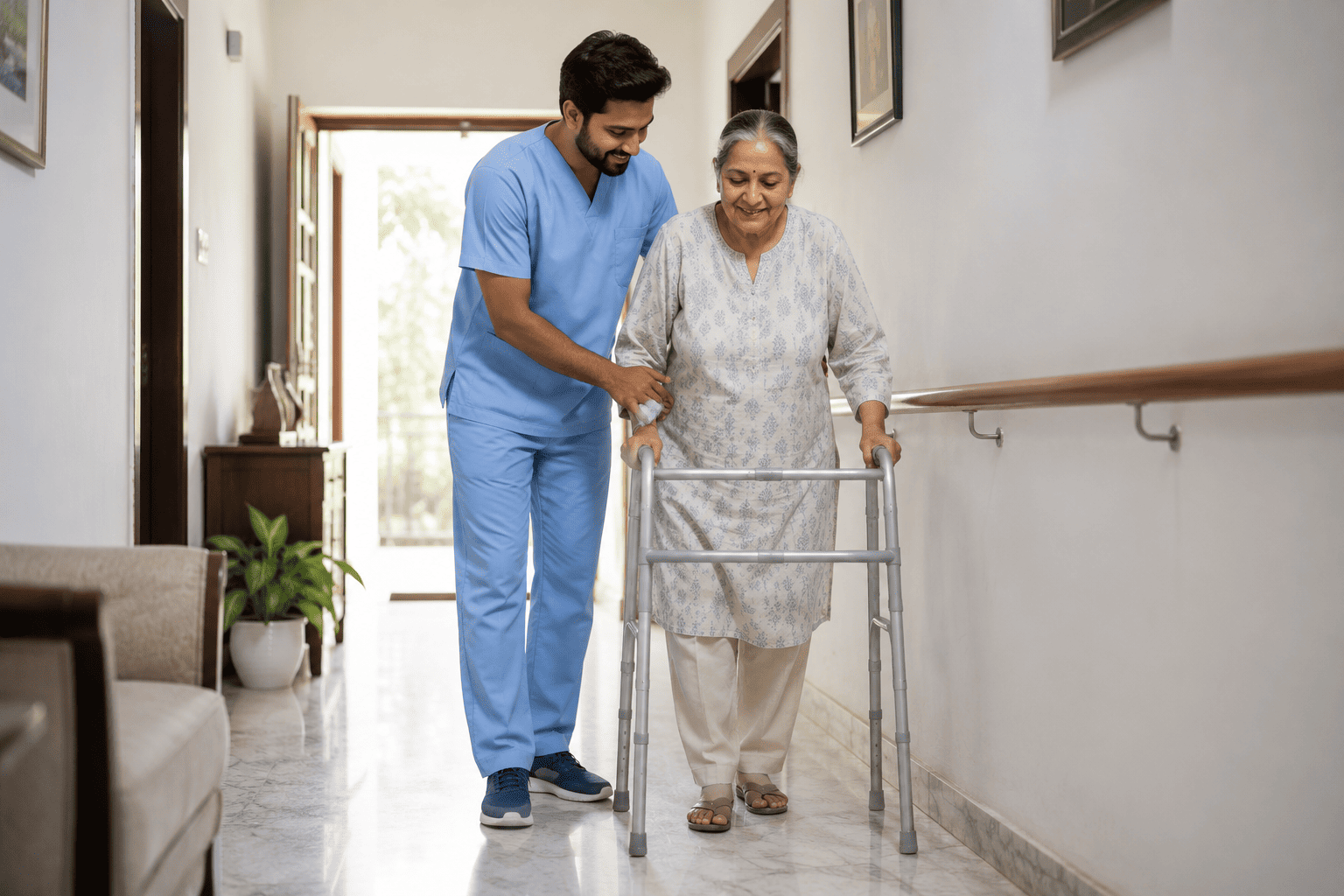
Physiotherapy is not one thing. The type must match what the patient actually lost — a stroke patient relearning movement patterns needs a different approach from a knee replacement patient regaining range, and both are different from a post-operative patient who mainly needs their chest cleared.
| Type | Used for | Focus of sessions |
|---|---|---|
| Neuro physiotherapy | Stroke, Parkinson's, spinal cord injury, brain injury | Movement re-education, spasticity management, balance, gait training, splinting |
| Orthopaedic physiotherapy | Joint replacement, fractures, spine surgery, sports injury — see physiotherapy after knee replacement | Range of motion, strengthening, weight bearing progression, walking pattern |
| Chest / respiratory physiotherapy | Post-operative patients, COPD, pneumonia, post-ICU, ventilated patients | Breathing exercises, secretion clearance, incentive spirometry, positioning |
| Cardiac rehabilitation | After bypass surgery, angioplasty, heart failure | Graded activity within safe limits, monitored exertion, sternal precautions |
| Geriatric physiotherapy | Elderly patients after any admission, frailty, falls5 | Strength, balance, fall prevention, functional independence |
| Post-ICU rehabilitation | Patients with ICU-acquired weakness after a long critical care stay1 | Very gradual mobilisation, breathing work, sitting balance before standing |
Many patients need more than one. A stroke patient with a chest infection needs neuro and respiratory work in the same session. A hip replacement in an elderly frail patient needs orthopaedic and geriatric approaches together. This is why the physiotherapist should see the discharge summary before the first session, not after.
What actually happens in a home physiotherapy session?
A typical session runs about 45 minutes and follows the same shape: check how the patient is, work through joint movement, strengthening and functional practice, then leave a home programme. The first visit is longer because it includes an assessment and goal setting.
1. Check-in
Pain level, sleep, how the home exercises went, any new symptoms, and vitals where relevant before starting.
2. Warm-up and mobility
Gentle joint movement, passive at first if the patient cannot move a limb themselves, progressing to assisted and then active.
3. Strengthening
Graded resistance work for the specific weak muscles, using body weight, bands or light weights as the patient allows.
4. Balance and transfers
Sitting balance before standing balance, then bed to chair, chair to stand, and turning safely.
5. Functional practice
The real tasks: walking to the bathroom, climbing the actual stairs, getting on and off the patient's own bed.
6. Home programme
Two or three exercises the family can supervise between visits, with repetitions, frequency and what to stop for.
The first session is different
Expect the first visit to include a full assessment: reading the discharge summary, testing muscle power and joint range, checking balance and walking, looking at the room and bathroom layout, and agreeing goals with the patient and family. A physiotherapist who starts exercises without doing this has not established what they are treating or how progress will be measured.
Chest physiotherapy: the most skipped part

After major surgery or a long admission, patients breathe shallowly because of pain, sedation and lying flat. Secretions collect in the lower lungs and are not cleared by a weak cough, and chest infection is one of the commonest reasons a recovering patient is readmitted.1 Breathing exercises and secretion clearance address exactly this, and take only a few minutes several times a day.
- Deep breathing exercises — slow full breaths with a hold at the top, repeated in short sets through the day rather than all at once.
- Incentive spirometry where prescribed — a simple device that gives the patient a visible target, which improves compliance enormously.
- Supported coughing and huffing — holding a pillow against an abdominal or chest wound makes coughing bearable, so the patient actually does it.
- Positioning and sitting upright — the single easiest intervention, and the reason an adjustable hospital bed matters clinically and not only for comfort.
- Percussion and postural drainage where the physiotherapist advises, particularly for patients with weak coughs or thick secretions.
- Early mobilisation — sitting out of bed and walking clears the chest better than any technique done lying down.
For patients discharged on oxygen or BiPAP, chest physiotherapy runs alongside the equipment rather than instead of it. Setups are covered in ICU care at home and after surgery recovery at home.
Home physiotherapy or clinic sessions?
Home, in the early weeks after discharge. The patient is too weak to travel, the journey itself consumes the energy the session needs, and the home is where the real obstacles are — their stairs, their bathroom, their bed height.3 Clinic sessions become useful later, when the patient is mobile and needs equipment that cannot come home.
| Consideration | Physiotherapy at home | Clinic sessions |
|---|---|---|
| Travel | None; the patient starts the session fresh | Journey exhausts a weak patient before the session begins |
| Environment | Practice on the patient's real stairs, bathroom and bed | Practice on standard gym equipment and parallel bars |
| Family involvement | Family watches and learns the technique, then continues it daily | Family often waits outside and never learns the exercises |
| Attention | One-to-one for the full session | Therapist may supervise several patients at once |
| Equipment | Portable equipment; larger machines not available | Full range of gym and electrotherapy equipment |
| Infection risk | Low; no shared space | Shared waiting area, which matters for post-operative patients |
| Best for | The first weeks after discharge, bedridden and dependent patients | Later stages, when the patient travels comfortably and needs equipment |
Patients in the Tricity who have progressed to travelling comfortably can switch to in-person sessions at the Healthy Jeena Sikho physiotherapy centre in Sector 71, Mohali.
How to choose a home physiotherapist
Check qualification, specialisation match and method. A physiotherapist in India holds a BPT or MPT degree and should be registered with the relevant state council.6 Beyond the paperwork, the practical test is simple: do they ask for the discharge summary, assess before treating, set measurable goals, and leave a home programme?
- Qualified and registered. BPT or MPT, with state council registration.6 Ask, and do not feel awkward asking.
- Specialisation matches the case. A neuro case needs someone comfortable with stroke rehabilitation, not only orthopaedic work.
- Asks for the discharge summary and the surgeon's or neurologist's instructions before the first session.
- Assesses before treating and records baseline measurements, so progress can be shown rather than claimed.
- Sets specific goals — "walk to the bathroom with a stick in four weeks" rather than "we will improve strength".
- Leaves a written home programme and teaches the family to supervise it.
- Communicates with the treating doctor where weight bearing, precautions or medication are involved.
- Does not promise a cure or a guaranteed timeline. Anyone who guarantees full recovery is selling, not treating.
- Reassesses periodically and adjusts the plan rather than repeating the same session for months.
The physiotherapists and rehabilitation doctors Healthy Jeena Sikho works with are listed on the panel of doctors for rehabilitation, pain management and physiotherapy.
How often and for how long?
Most patients start with three to five sessions a week and taper as they improve, with the treating doctor and physiotherapist setting the schedule. Duration depends far more on the condition than on the patient's age: an uncomplicated knee replacement may need six to eight weeks, while stroke rehabilitation often runs three to six months or longer.2
| Condition | Typical early frequency | Typical overall duration |
|---|---|---|
| Knee or hip replacement | Daily to 5 times a week initially | 6 to 12 weeks4 |
| Spine surgery | 3 to 5 times a week | 6 to 12 weeks, per surgeon's protocol |
| Stroke | Daily to 5 times a week in the first months | 3 to 6 months, often longer with maintenance therapy2 |
| Post-ICU weakness | Short daily sessions initially, built up gradually | 2 to 6 months depending on the length of the ICU stay |
| Major abdominal or cardiac surgery | 3 to 5 times a week, with daily breathing work | 4 to 12 weeks |
| Elderly after a general admission | 2 to 3 times a week | 4 to 8 weeks, then a maintenance programme |
| Long-term neurological conditions | 2 to 3 times a week | Ongoing maintenance to preserve function |
*These ranges are indicative. Actual frequency and duration are decided by the treating doctor and the assessing physiotherapist for each patient.
How to prepare for a home session
Five minutes of preparation makes the difference between a 45-minute session and 30 minutes of therapy plus 15 minutes of moving furniture. Clear a space, time the session sensibly around pain medication and meals, and have the family member who will supervise the exercises present.
- Clear floor space beside the bed, roughly two by two metres, with rugs and low stools removed.
- Loose comfortable clothing that allows the therapist to see and move the affected limb.
- Proper footwear — closed grip shoes or slippers, not loose chappals or bare feet.
- Time it right — not immediately after a heavy meal, and where pain is an issue, about half an hour after pain medication so the patient can participate.
- Water within reach, and the room ventilated and at a comfortable temperature.
- The supervising family member present, because they will run the home programme on the other days.
- Discharge summary, X-rays and medicine list available for the first session.
- Equipment ready — a walker or wheelchair, splints and any prescribed devices, rather than being fetched mid-session. A full list is in best home physiotherapy equipment for faster recovery.
When a session should stop
Stop the exercise and seek medical advice if any of these occur
- Chest pain, tightness or pressure, or pain spreading to the arm or jaw.
- Severe or sudden breathlessness, or lips and fingertips turning bluish.
- Dizziness, greying vision or a feeling of fainting on sitting or standing up.
- Sudden severe pain in the operated area, or a sensation of something giving way.
- Swelling, warmth or pain in one calf, which can indicate a clot in the leg.
- Palpitations or a racing, irregular heartbeat that does not settle with rest.
- Fever, or a wound that is newly red, swollen, discharging or foul-smelling.
- A fall during the session, particularly with any head impact in a patient on blood thinners.
Ordinary muscle fatigue and mild soreness the next day are expected. Sharp pain, pain that increases day on day, or any of the above are not, and should be reported rather than pushed through.
The part that matters most: between sessions
Three sessions a week is roughly two hours of supervised therapy out of 168. The home exercise programme is where recovery actually happens, and the families who do it daily see visibly different outcomes from those who wait for the therapist to arrive.
- Short and frequent beats long and occasional. Three ten-minute sessions through the day are better tolerated than one thirty-minute block.
- Write it down and tick it off. A simple sheet by the bed with exercises, repetitions and a daily tick keeps it honest.
- Let the patient do what they can do. Every task the family takes over is a task the patient stops practising.
- Sit out of bed daily, even if walking is not possible yet. Upright time is therapy.
- Report changes rather than adjusting exercises yourself — new pain, new swelling or a lost ability should go back to the physiotherapist.
- Keep the equipment set up. A walker parked in another room is a walker that does not get used.
What decides the cost of home physiotherapy?
Four things: the number of sessions, the specialisation required, the session duration and the travel distance. Neuro and cardiac rehabilitation typically cost more per session than general mobility work, and packages usually work out lower per session than booking individually.
- Session count. Frequency is set clinically, but a package of sessions is normally more economical than one-off visits.
- Specialisation. Neuro, cardiac and post-ICU rehabilitation require specific training and are priced accordingly.
- Duration. Standard sessions run about 45 minutes; longer sessions cost more.
- Location and travel. Distance within the Tricity service area affects the visit charge in outlying locations.
- Equipment. Any devices used at home — CPM machine, walker, exercise bands, splints — are separate from the session fee and are usually rented. Rental options are listed in the Healthy Jeena Sikho store.
Healthy Jeena Sikho shares session and package charges in writing before the first visit, so families can plan the whole rehabilitation period rather than paying visit by visit without knowing the total.
When does physiotherapy end?
When the agreed goals are met and the patient can maintain their function with a home programme alone. For many patients therapy does not stop abruptly — it tapers from five sessions a week to two, then to a monthly review, then to an independent routine.
- Goals met. The patient walks the distance, climbs the stairs or manages the task that was set at the start.
- Progress plateaus despite consistent work, at which point the physiotherapist reassesses rather than repeating the same plan.
- The patient can run the programme independently, or with family supervision alone.
- Maintenance continues for long-term conditions. In stroke, Parkinson's and other neurological conditions, periodic therapy preserves gains that would otherwise be lost.5
- Equipment goes back as it stops being used, which is one of the practical markers that recovery is progressing.
Where Healthy Jeena Sikho provides home physiotherapy
Home physiotherapy sessions are available across Chandigarh Tricity, delivered from the Healthy Jeena Sikho head office and store in Sector 73, Mohali, Punjab and the physiotherapy centre in Sector 71, Mohali.
Mohali: Mohali, Phase 1–11, Sector 70, Sector 71, Sector 79, Sector 82, Aerocity, Sohana, Balongi, Landran and Kharar.
Chandigarh: all sectors, including Manimajra, Sector 15, 22, 32, 35, 43, 44 and 47, Dhanas and Maloya.
Panchkula: Panchkula, MDC Panchkula, Sector 20, Pinjore, Kalka and Barwala.
Home medical equipment such as hospital beds, wheelchairs, walkers and CPM machines is delivered more widely. Physiotherapy sessions are currently limited to the Tricity areas listed above, subject to serviceable pin code and therapist availability. Call +91 98769 78488 or WhatsApp +91 98759 15278.
How Healthy Jeena Sikho arranges physiotherapy at home
- Qualified physiotherapists, matched to the case. Neuro, orthopaedic, chest, cardiac and geriatric rehabilitation, assigned according to what the patient actually needs.
- Assessment before treatment. The first visit covers the discharge summary, muscle power, joint range, balance and the home layout, with goals agreed with the family.
- Therapy and equipment in one arrangement. Hospital beds, wheelchairs, walkers, CPM machines and splints supplied alongside the sessions, so nothing is arranged twice.
- A written home programme. Exercises the family can supervise between visits, with repetitions and clear stop signals.
- Charges shared in advance. Session and package charges confirmed in writing before the first visit.
- A physiotherapy centre and home sessions across the Tricity. Healthy Jeena Sikho runs a physiotherapy centre in Sector 71, Mohali, and provides home physiotherapy in Chandigarh, Mohali, Panchkula and Kharar.
A free assessment call and same-day scheduling may be available across Chandigarh, Mohali, Panchkula and Kharar, subject to therapist availability. Call +91 98769 78488 or WhatsApp +91 98759 15278.
Frequently Asked Questions About Home Physiotherapy
When should physiotherapy start after hospital discharge?
Usually as soon as the patient is medically stable, often within days of discharge, with the exact timing set by the treating doctor or surgeon. Waiting for the patient to "get stronger first" is counterproductive, because strength continues to fall during bed rest rather than returning on its own. Arranging therapy before discharge avoids losing the early weeks entirely.
How many physiotherapy sessions are needed after surgery?
It varies by condition. Most patients start with three to five sessions a week and taper as they improve. An uncomplicated knee or hip replacement often needs six to twelve weeks, spine surgery a similar period, and stroke rehabilitation commonly three to six months or longer. The assessing physiotherapist and treating doctor set the actual plan.
Is home physiotherapy as effective as clinic sessions?
For the early weeks after discharge it is usually more practical, because the patient does not spend their limited energy travelling and practises on their own stairs, bathroom and bed rather than on gym equipment. The family also learns the technique and continues it. Clinic sessions become more useful later, when the patient travels comfortably and needs equipment that cannot be brought home.
How long is a home physiotherapy session?
Usually about 45 minutes, with the first visit running longer because it includes assessment and goal setting. The session covers a check-in, joint mobility work, strengthening, balance and transfers, functional practice such as walking or stairs, and a home programme for the days in between.
What qualification should a home physiotherapist have?
A BPT or MPT degree with registration under the relevant state council, and experience matching the case — neuro rehabilitation for a stroke patient, orthopaedic for a joint replacement, and respiratory training for chest work. Practically, they should ask for the discharge summary, assess before treating, set measurable goals and leave a written home programme.
What is chest physiotherapy and why does it matter?
It is breathing and secretion-clearance work — deep breathing exercises, incentive spirometry, supported coughing, positioning and early mobilisation. It matters because patients breathe shallowly after major surgery or a long admission, secretions collect, and chest infection is one of the commonest reasons a recovering patient is readmitted. It takes only a few minutes several times a day.
Can physiotherapy be done by a family member instead?
Family members should run the home exercise programme between visits, which is where most of the recovery happens. They should not design the programme, judge weight-bearing progression or manage a post-surgical protocol, since the wrong movement can damage a repair or a new joint. A physiotherapist assesses and sets the plan; the family carries it out.
When should a physiotherapy session be stopped?
Immediately if the patient develops chest pain, severe breathlessness, dizziness or a feeling of fainting, sudden severe pain in the operated area, swelling or pain in one calf, an irregular racing heartbeat, or a fever. Ordinary muscle fatigue and mild next-day soreness are expected, but any of these signs should be reported to the treating doctor rather than pushed through.
What decides the cost of home physiotherapy?
The number of sessions, the specialisation required, the session duration and the travel distance. Neuro, cardiac and post-ICU rehabilitation usually cost more per session than general mobility work, and packages are normally more economical than one-off visits. Equipment used at home is separate from the session fee and is usually rented.
When does physiotherapy stop?
When the agreed goals are met and the patient can maintain their function with a home programme alone. It usually tapers rather than stopping abruptly — from five sessions a week to two, then to periodic review. For long-term neurological conditions, maintenance therapy continues because gains are otherwise lost.
In which areas is home physiotherapy available?
Home physiotherapy sessions are available across Chandigarh Tricity. Chandigarh: all sectors, including Manimajra, Sector 15, 22, 32, 35, 43, 44 and 47, Dhanas and Maloya. Mohali: Mohali, Phase 1–11, Sector 70, Sector 71, Sector 79, Sector 82, Aerocity, Sohana, Balongi, Landran and Kharar. Panchkula: Panchkula, MDC Panchkula, Sector 20, Pinjore, Kalka and Barwala. Home medical equipment is delivered more widely. Physiotherapy sessions are subject to serviceable pin code and therapist availability — call +91 98769 78488 or WhatsApp +91 98759 15278 to check.
References and further reading
- National Institute for Health and Care Excellence (NICE). Rehabilitation after critical illness in adults, clinical guideline CG83.
- National Institute for Health and Care Excellence (NICE). Stroke rehabilitation in adults, NICE guideline NG236.
- World Health Organization. Rehabilitation — guidance on rehabilitation services and community-based delivery.
- American Academy of Orthopaedic Surgeons. Rehabilitation after total hip and total knee replacement.
- Chartered Society of Physiotherapy. Physiotherapy works: falls and frailty, and rehabilitation after critical illness.
- Indian Association of Physiotherapists. Standards of practice and scope of physiotherapy practice in India.
Medical disclaimer. This page is general educational information about physiotherapy at home after hospitalisation. It is not medical advice and does not replace assessment and treatment by a qualified physiotherapist. When rehabilitation should begin, which exercises are safe, weight-bearing status, post-surgical precautions, exertion limits for cardiac patients and the frequency and duration of therapy must be determined by the treating doctor and the assessing physiotherapist, since these differ between patients. Do not begin, change or intensify an exercise programme without professional guidance. Healthy Jeena Sikho supplies, installs and services home medical equipment and arranges nursing, attendant and physiotherapy services, and does not diagnose conditions or independently set clinical parameters. Stop any exercise and seek medical help immediately for chest pain, severe breathlessness, fainting or sudden severe pain.