
Pressure Sore Prevention at Home: The Caregiver's Daily Method

The short version
- A pressure sore can begin in hours, not days. In a high-risk patient, unrelieved pressure over the tailbone or heels can damage tissue in a single long nap in one position.[1]
- Repositioning is the treatment. The mattress is the backup. An alternating pressure mattress buys time between turns; it does not replace them, and sores still form on good mattresses.[2]
- Turn to a 30-degree tilt, not fully onto the side. Rolling a patient flat onto their hip puts the full body weight on one bony point and causes the sore it was meant to prevent.[1]
- Heels need to be floating, not resting. Heels have almost no padding and are one of the two commonest sites. A pillow under the calves lifts them off the bed entirely.[2]
- Press the red patch. If it stays red, it is already Stage 1. Redness that turns white under a finger and comes back is normal pressure. Redness that does not blanch is an injury, and that spot must come off pressure immediately.[3]
- Do not massage a red bony area, and never use a donut ring. Both were standard advice decades ago and both are now known to make damage worse.[1,4]
Most families discharged with a bedridden patient are told to "change position regularly" and given a mattress. Nobody explains that the sacrum carries most of the weight when the bed head is raised, that a heel can break down while everyone is watching the tailbone, or that talcum powder and spirit rubbing — still routine in many Indian households — do nothing useful. This guide covers the actual daily method: where the risk sits, how to turn, what to look for, and the point at which a red patch stops being a home problem.
What is a pressure sore and how fast does it form?
A pressure sore, also called a pressure ulcer, bedsore or decubitus ulcer, is tissue damage caused when body weight presses skin against a bony point for long enough to cut off its blood supply. Without blood the tissue starves, and in a frail, immobile or poorly nourished patient the first visible damage can appear within a few hours of unrelieved pressure — not days.[1]
The damage often starts deeper than it looks. Muscle tolerates pressure worse than skin does, so by the time a patch of skin discolours, the tissue underneath may already be worse than the surface suggests.[3] This is why a small dark patch over the tailbone deserves urgent attention rather than a wait-and-watch approach.
Four forces do the damage, and prevention means acting on all four rather than only the first.
Pressure
Body weight squeezing skin against a bone. The heavier and longer the load, the faster the tissue dies.
Shear
Skin stays stuck to the sheet while the skeleton slides underneath — exactly what happens when the bed head is raised and the patient slips down.
Friction
Skin dragged across a sheet during a pull-up or transfer. It strips the outer layer and makes the area far easier to break down.
Moisture
Sweat, urine or wound fluid softens skin so it tears under loads it would otherwise survive. A serious factor in Indian summers.
Where do pressure sores form?
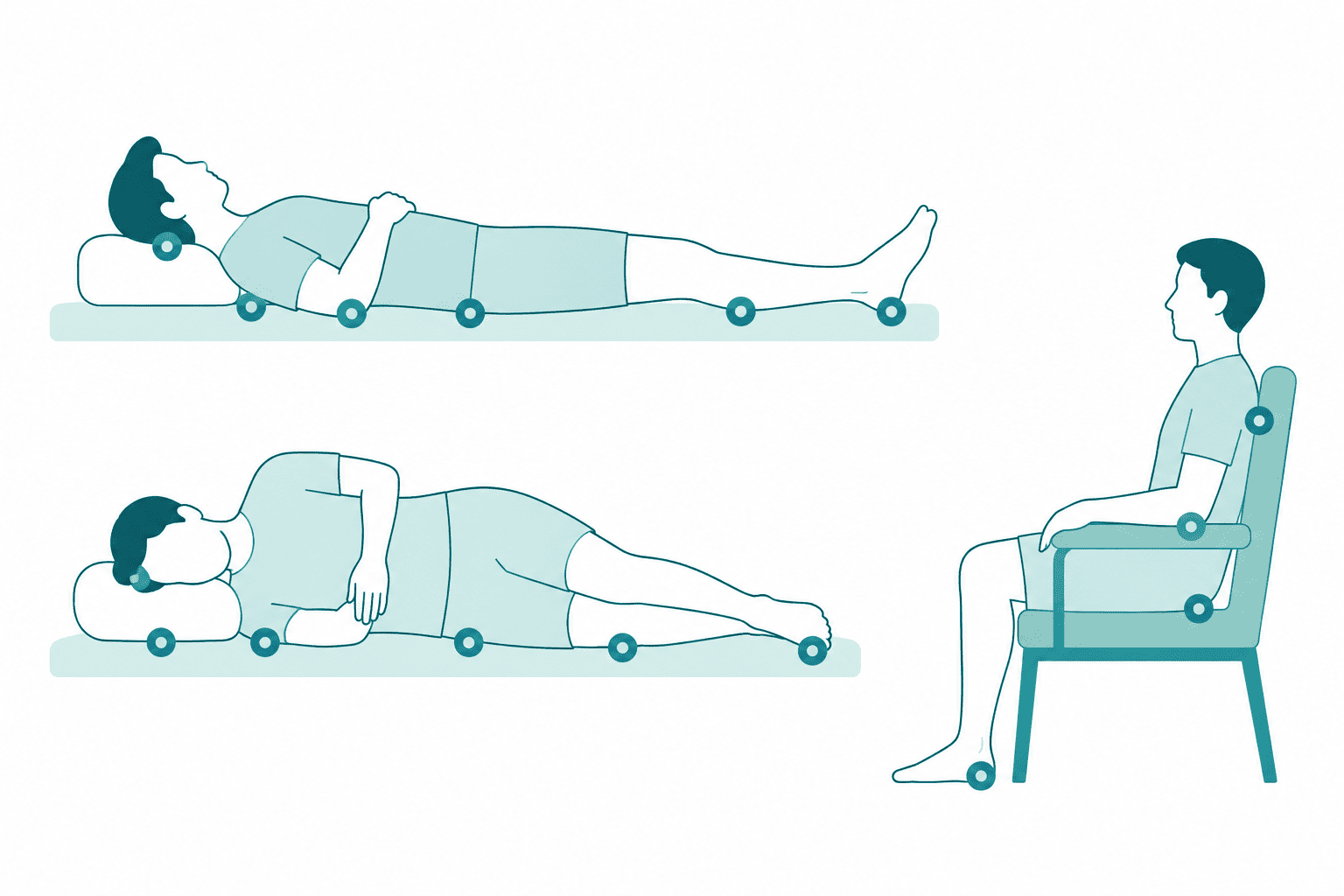
Over bony points with little fat or muscle between bone and skin. The tailbone (sacrum) and the heels account for the majority of pressure sores in bedridden patients, followed by the hips, the sit bones in patients who spend hours in a chair, and the elbows, shoulder blades, ankles, ears and back of the head.[2]
| Site | Highest risk when | What protects it |
|---|---|---|
| Sacrum / tailbone | Lying on the back, especially with the bed head raised above 30 degrees | Regular turning, 30-degree tilt, keeping the bed head low when not eating |
| Heels | Lying on the back with legs flat on the mattress | Pillow lengthwise under the calves so the heels float clear of the bed |
| Hip (greater trochanter) | Rolled fully onto the side at 90 degrees | 30-degree tilt with pillows instead of full side-lying |
| Sit bones (ischial tuberosity) | Sitting upright in a chair or wheelchair for long stretches | Pressure cushion and a position shift every 15 to 30 minutes |
| Elbows | Pushing up on the arms to shift position in bed | Soft padding under the elbows, using a bed remote instead of pushing up |
| Shoulder blades and spine | Long periods flat on the back | Turning schedule and a pressure-redistributing mattress |
| Ankles (outer bone) | Side-lying with legs stacked on top of each other | Pillow between the knees and ankles to separate the legs |
| Back of the head and ears | Unconscious or fully immobile patients, and anyone on a tight mask strap | Head position change, soft pillow, checking under mask and tube straps |
Add one more category that families almost always miss: device-related pressure injuries. Oxygen tubing behind the ears, a nasal cannula on the nostrils, a BiPAP mask on the bridge of the nose, a catheter tube pressing on the thigh, an ID band or a tight splint edge all cause sores in exactly the same way.[3] Check under every device and strap once a day.
Which patients are most at risk?
Anyone who cannot change their own position is at risk, and the risk multiplies with poor nutrition, incontinence, reduced sensation, poor circulation and low body weight. A thin, immobile, tube-fed patient with incontinence is at far higher risk than an immobile but well-nourished, continent one.[2]
| Risk factor | Why it increases risk |
|---|---|
| Immobility | The primary factor. A patient who cannot shift their own weight cannot relieve their own pressure. |
| Loss of sensation | Spinal cord injury, stroke and diabetic neuropathy remove the discomfort signal that normally makes a person move. |
| Poor nutrition and low protein | Skin repair needs protein, calories, fluid, vitamin C and zinc. A poorly fed patient breaks down faster and heals slower. |
| Incontinence or excessive sweating | Constantly damp skin tears under loads that dry skin would tolerate. |
| Very low body weight | Less padding between bone and skin, so the same pressure does more damage. |
| Diabetes and poor circulation | Reduced blood flow means tissue starves sooner and heals worse, especially at the heels. |
| Reduced alertness | Sedated, unconscious or advanced-dementia patients neither move nor complain. |
| A previous pressure sore | Healed pressure ulcer sites remain structurally weaker and break down again more easily. |
Hospitals score this formally using tools such as the Braden Scale.[5] At home, the practical version is simpler: if the patient cannot turn themselves, assume high risk and run the full prevention routine from day one rather than waiting for the first red patch.
How often should a patient be turned, and how?
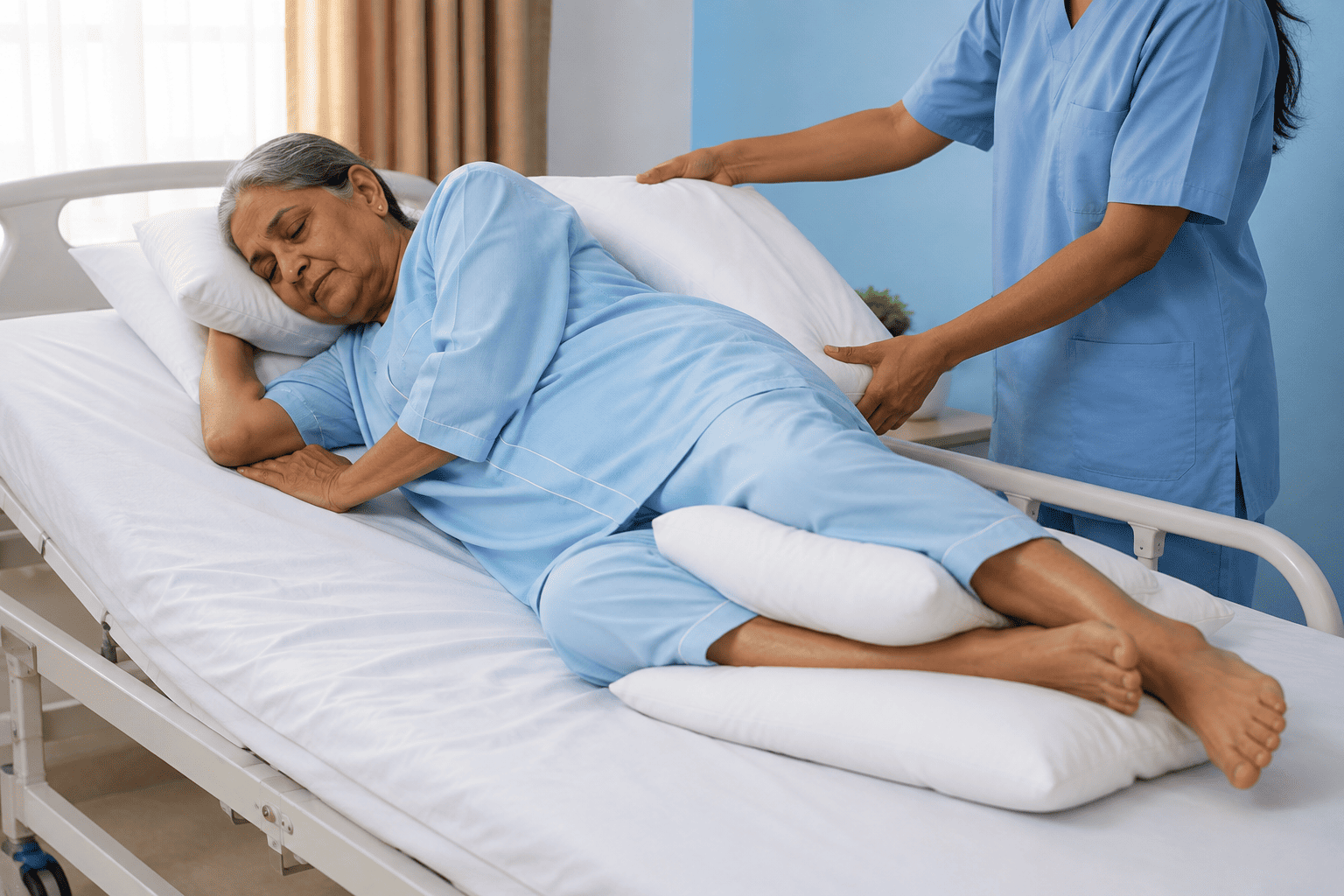
The common standard is a position change roughly every two hours, day and night, adjusted to the patient's skin and the treating team's advice. A pressure-redistributing mattress may allow a slightly longer interval for some patients, but the interval is set by what the skin shows, not by the mattress specification.[2]
The 30-degree tilt, and why 90 degrees is wrong
Rolling a patient fully onto their side sounds like the most complete change of position, and it is the most common mistake. At 90 degrees the entire body weight lands on the hip bone, which is a classic pressure sore site. The correct position is a 30-degree lateral tilt: the patient is turned partly onto the side and supported there with pillows behind the back, so the weight is carried on the fleshy part of the buttock rather than on the hip bone itself.[1]
A workable turning cycle
- Back, with heels floated on a pillow and the bed head low.
- 30-degree tilt to the right, pillow behind the back, pillow between the knees and ankles.
- Back again, heels floated.
- 30-degree tilt to the left, same pillow support.
The rules that matter more than the schedule
- Lift, never drag. Use a draw sheet with two people rather than pulling the patient up by the arms, which shears and grazes skin.
- Float the heels. A pillow lengthwise under the calves, with the knees slightly bent, so the heels touch nothing at all.
- Keep the bed head at or below 30 degrees except during meals and for about 30 minutes after, because a raised head slides the body down and shears the sacrum.
- Separate the legs with a pillow between the knees and ankles in every side position.
- Do not park the patient on a bedpan. A hard rim under the sacrum for twenty minutes is a pressure injury in the making.
- Smooth the sheet every time. A wrinkle, crumb or catheter tube under the hip concentrates pressure onto a single line.
- Turn at night too. The overnight gap is where most home prevention routines quietly fail.
- Log every turn. A sheet of paper by the bed with times and positions is what keeps the routine honest across shifts.
Sitting is higher risk than lying
A seated patient concentrates their entire upper-body weight onto two small sit bones, so pressure per square centimetre is higher in a chair than in bed. If the patient sits out in a wheelchair or armchair, use a pressure-relieving cushion, shift their position every 15 to 30 minutes, and limit unbroken sitting time rather than treating chair time as a rest from pressure care.[2]
Turning a patient in a low, soft double bed is what wrecks a caregiver's back and makes turns get skipped. A hospital bed on rent with height adjustment and side railings raises the patient to the caregiver's waist and gives them something to pull against. Room layout also decides whether one person can manage a turn — see how to set up a patient room at home.
Which mattress prevents bedsores?
For a patient who cannot reposition independently, an alternating pressure air mattress is the usual choice. Its cells inflate and deflate in cycles so no single area of skin carries weight continuously. It reduces risk substantially, but it is a support to the turning routine, not a substitute for it, and sores still develop on good mattresses when patients are left in one position.[2]
| Surface | Best suited for | Limitation |
|---|---|---|
| Normal household mattress | Patients who move and reposition themselves independently | No pressure redistribution; pressure stays on the same points indefinitely |
| High-density foam mattress | Low to moderate risk patients with some independent movement | Spreads load but does not actively change the pressure points |
| Bubble type alternating mattress | Moderate risk, lighter patients, shorter-term use | Smaller cells give less relief than tubular for heavier or high-risk patients |
| Tubular alternating mattress | High-risk, fully immobile patients and long-term bedridden care | Higher cost; needs a working pump and an uninterrupted power supply |
| Pressure-relieving chair cushion | Patients who sit out in a wheelchair or armchair | Only protects while seated; the turning routine still applies in bed |
Getting the mattress right in practice
- Check the pump is actually running every day. A silently failed pump turns a pressure mattress into a flat plastic sheet.
- Set the firmness to the patient's weight using the pump dial rather than leaving it at the delivery setting.
- Use only one thin sheet over it. Layers of blankets and rubber sheets cancel out the pressure relief the mattress provides.
- Do not add a folded quilt or rubber sheet under the hips to catch leaks; use a breathable waterproof protector designed for the purpose.
- Plan for power cuts. An inverter or backup matters, because pressure relief stops the moment the pump does.
How should the skin be cared for daily?
Keep it clean, dry and moisturised, and inspect it every single day. Wash with lukewarm water and a mild cleanser, pat dry without rubbing, apply a plain moisturiser to dry areas, and use a barrier cream where skin meets urine or stool. Change soiled linen and pads immediately rather than at a fixed time.[2]
The daily skin check, and the blanch test
Inspect the pressure points at every position change, and do one thorough head-to-toe check daily in good light — ideally at the morning sponge bath. Look at the tailbone, both heels, both hips, elbows, shoulder blades, ankles, ears and the back of the head, and under every device strap.
When you find a red patch, press it gently with a fingertip for about three seconds and release. If the skin turns pale and then returns to pink, blood flow is intact and the redness is normal pressure response. If it stays red and does not turn pale, that is non-blanchable redness — a Stage 1 pressure injury, and that area must be kept completely off pressure and reported to the treating doctor or nurse. On darker skin tones the colour change may be harder to see, so also feel for an area that is warmer, cooler, firmer, boggier or more painful than the surrounding skin.[3]
What helps, and what to stop doing
| Common home practice | Verdict | Why |
|---|---|---|
| Massaging a red bony area | Stop | Rubbing over a bony prominence can worsen damage in tissue that is already compromised. Relieve the pressure instead.[1] |
| Donut or ring cushion | Stop | The ring concentrates pressure in a circle around the area and restricts blood flow to the very tissue it is meant to protect.[4] |
| Talcum powder on damp skin | Stop | Cakes in skin folds, holds moisture and abrades the surface rather than keeping it dry. |
| Spirit or antiseptic rubbing | Stop | Dries and hardens skin, reducing its ability to withstand pressure. |
| Hot water for washing | Stop | Strips natural oils and leaves skin drier and more fragile. Use lukewarm water. |
| Plain moisturiser on dry skin | Do | Well-hydrated skin tolerates load better. Apply to dry areas, not into open wounds. |
| Barrier cream where skin meets urine | Do | Protects against moisture-associated damage, which is often mistaken for a pressure sore. |
| Prompt pad and linen changes | Do | Time spent damp is the variable families can control most easily. |
Does food make a difference to pressure sores?
Yes, and it is the most underrated part of prevention. Skin repair runs on protein, calories, fluid, vitamin C and zinc. A patient eating half their meals, losing weight and mildly dehydrated will break down sooner and heal slower than one on the same mattress with adequate intake.[1]
- Protein at every meal. Dal, curd, paneer, eggs, chicken, fish, soya or a prescribed supplement. Tube-fed patients need the dietitian's prescribed formula and volume, not a diluted version.
- Enough total calories. A patient losing weight is losing the padding that protects the bones.
- Fluids as advised. Dehydrated skin is less elastic and more fragile. Fluid limits apply in heart and kidney patients, so follow the treating doctor's instruction rather than pushing fluids blindly.
- Fruit and vegetables for vitamin C and zinc, which are directly involved in wound repair.
- Weigh the patient weekly if possible. Falling weight is an early warning that arrives before the skin gives way.
Do not start high-dose supplements on your own. Nutritional supplements and vitamin doses should be advised by the treating doctor or dietitian, particularly for diabetic, kidney and cardiac patients.
What if a sore has already started?
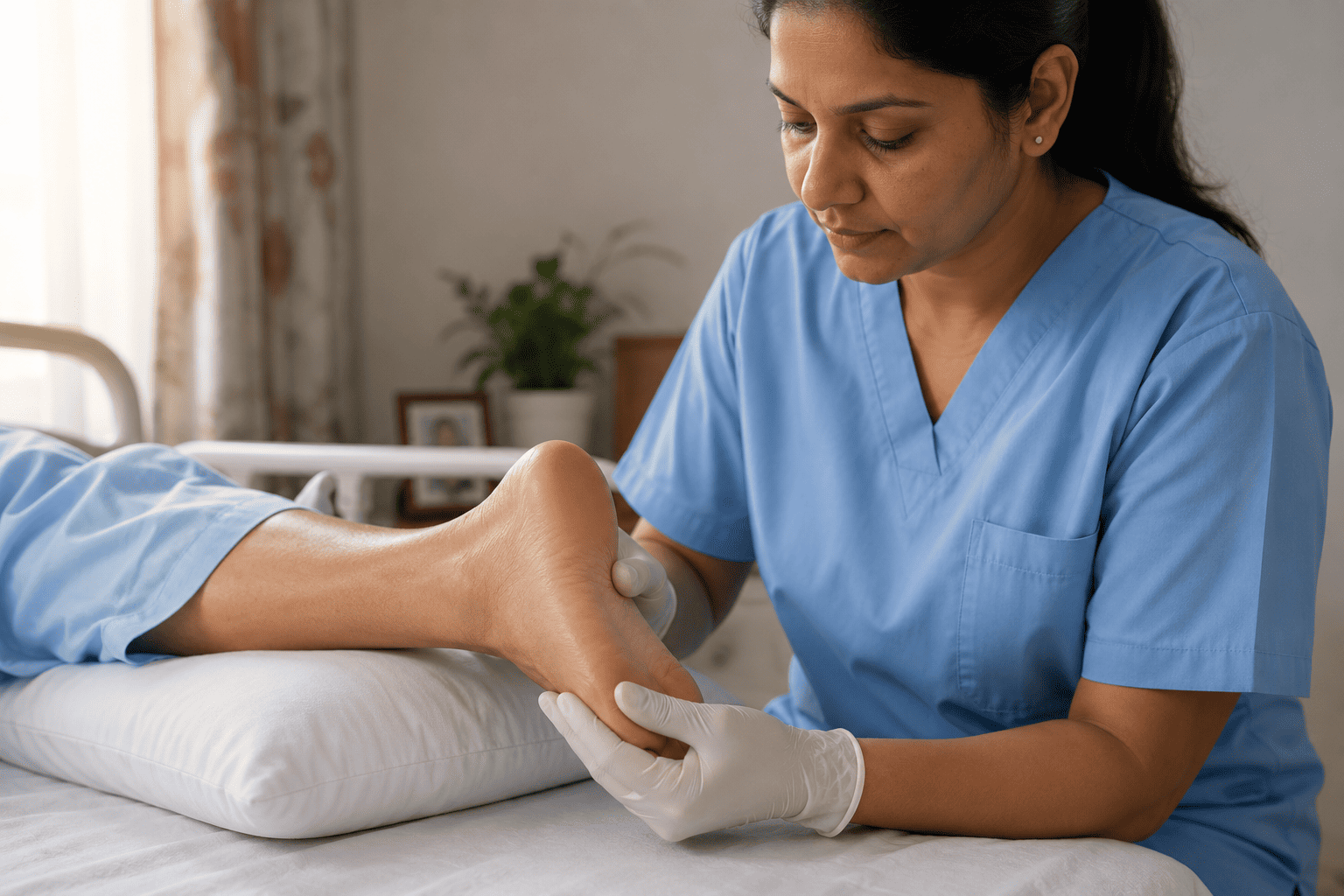
Take all pressure off that area immediately and get it seen. An early, intact-skin Stage 1 patch that comes off pressure quickly often settles. Once the skin is broken, home care alone is not enough: wound assessment, dressing selection and any debridement are clinical decisions for a doctor or trained nurse.
| Stage | What it looks like | What it means at home |
|---|---|---|
| Stage 1 | Intact skin with redness that does not turn pale when pressed. May feel warmer, firmer or more painful. | Off-load that area completely and inform the treating team. Often reversible at this point. |
| Stage 2 | Shallow open sore, graze or blister; the top layers of skin are lost. | Needs a nurse to assess and dress it. Do not use home remedies on an open wound. |
| Stage 3 | Deeper crater through the full thickness of skin into the fat below. | Clinical wound care, nutrition review and often specialist input. |
| Stage 4 | Very deep wound exposing muscle, tendon or bone. | Urgent medical review. Serious infection risk. |
| Unstageable | Base covered by dead yellow or black tissue, so the depth cannot be seen. | Depth is unknown until a clinician removes the dead tissue. Never attempt this at home. |
| Deep tissue injury | Persistent purple or maroon area, or a blood-filled blister, under intact skin. | Damage is below the surface and can worsen fast. Report the same day. |
Staging definitions above follow the NPIAP pressure injury stages.[3]
Call the doctor the same day if you see any of these
- Skin that has broken, blistered or opened over any pressure point.
- A purple, maroon or black area, or a blood-filled blister.
- Pus, foul smell, or discharge from the area.
- Spreading redness, swelling or heat around the wound edge.
- Fever, shivering, new confusion or sudden drop in alertness — possible infection spreading beyond the wound.
- Rapidly increasing pain at the site, or a wound that keeps getting larger despite off-loading.
Do not apply turmeric, oil, toothpaste, antiseptic powder or any home remedy to an open pressure sore, and never cut or peel away dead tissue at home.
The prevention routine in one day
Prevention is not a task, it is a rhythm. The households that avoid pressure sores are the ones where turning, skin checks and hygiene happen at fixed points in the day rather than whenever somebody remembers.
- Morning. Sponge bath, full head-to-toe skin check in good light, moisturiser on dry areas, barrier cream where needed, fresh linen pulled smooth, first turn logged.
- Through the day. Position change roughly every two hours, heels floated in every back-lying position, sheet smoothed at every turn, pads changed the moment they are soiled.
- Meals. Bed head raised for eating and about 30 minutes after, then lowered again so the patient is not sliding down the bed for hours.
- Chair time. Pressure cushion in place, position shifted every 15 to 30 minutes, total sitting time kept sensible.
- Evening. Second skin check, especially heels and tailbone, pump running check, night turning plan confirmed with whoever is on duty.
- Night. Turns continue on schedule. This is where routines break, and where most preventable sores are earned.
Which leads to the part that is not clinical: a single family member cannot do two-hourly turns around the clock for weeks. Sleep-deprived caregivers skip night turns, and skipped night turns are a common reason a sore appears in a household that was otherwise doing everything right. Arranging a night attendant is a prevention measure, not a luxury.
How Healthy Jeena Sikho helps families prevent pressure sores
- The right surface, on rent. Bubble and tubular alternating pressure mattresses matched to the patient's weight and risk level, with the pump set up and demonstrated at home.
- A bed that makes turning possible. Hospital beds with height adjustment and side railings, so one caregiver can turn a patient without wrecking their own back.
- Trained attendants and nurses. 12-hour and 24-hour shifts, including night duty, with staff experienced in two-hourly repositioning, skin checks, catheter and hygiene care.
- Installation and family training. The technician sets the pump firmness, and the family is shown safe turning technique, heel floating and what to look for on the skin.
- Rental-first, so the setup can shrink. Equipment goes back as the patient regains movement instead of sitting unused.
- Delivery and installation across North India. Delhi, Noida, Greater Noida, Gurugram, Faridabad, Ghaziabad, Chandigarh, Mohali, Panchkula, Kharar, Ludhiana, Jalandhar, Bathinda, Jaipur and Lucknow. Equipment sales are available more widely across India, subject to serviceable pin code and stock.
For the full long-term care setup, see bedridden patient care at home, or stroke recovery at home if the immobility follows a brain stroke.
Free home assessment and same-day installation may be available in serviceable locations, subject to stock and service availability.
Frequently Asked Questions About Pressure Sore Prevention
How often should a bedridden patient be turned to prevent bedsores?
The common standard is roughly every two hours, day and night, adjusted according to the patient's skin condition and the treating team's advice. A pressure-redistributing mattress may allow a slightly longer interval for some patients, but the schedule should be set by what the skin shows at each check, not by the mattress alone.
How quickly can a bedsore develop?
Faster than most families expect. In a frail, immobile or poorly nourished patient, unrelieved pressure over a bony point can cause visible damage within a few hours. Damage often begins in the deeper tissue before it shows on the skin, which is why an early red patch should be acted on immediately rather than watched.
Does an air mattress prevent bedsores completely?
No. An alternating pressure mattress substantially reduces risk by shifting the load between cells, but it works alongside repositioning, skin inspection, moisture control and nutrition. Pressure injuries still develop on good mattresses when a patient is left in one position for too long or the pump has stopped working.
How do I know if a red patch is a bedsore?
Press it gently for about three seconds and release. If the skin turns pale and then returns to pink, blood flow is intact. If it stays red and does not blanch, it is a Stage 1 pressure injury and that area must come off pressure immediately. On darker skin the colour change is harder to judge, so also feel for skin that is warmer, cooler, firmer, boggier or more painful than the area around it.
Should you massage a red area to improve circulation?
No. Massaging over a bony prominence that is already showing pressure damage can worsen the injury in tissue that is already compromised. The correct response is to relieve the pressure on that area completely and report it to the treating doctor or nurse.
Are donut or ring cushions useful?
No. A ring cushion concentrates pressure in a circle around the area it is meant to protect and can restrict blood flow to that tissue. Use a proper pressure-relieving cushion for seated patients and a pressure-redistributing mattress in bed instead.
Where do bedsores form most commonly?
The tailbone and the heels account for most pressure sores in bedridden patients, followed by the hips, the sit bones in patients who spend hours in a chair, and the elbows, shoulder blades, ankles, ears and back of the head. Devices cause them too: check under oxygen tubing, mask straps, catheter tubes and splint edges daily.
Can talcum powder or spirit prevent bedsores?
No. Talcum powder cakes in skin folds and holds moisture against the skin, and spirit or antiseptic rubbing dries and hardens skin so it tolerates pressure worse. Wash with lukewarm water and a mild cleanser, pat dry, moisturise dry areas and use a barrier cream where skin is exposed to urine or stool.
What food helps prevent pressure sores?
Adequate protein at every meal, enough total calories to stop weight loss, fluids as advised, and fruit and vegetables for vitamin C and zinc. Dal, curd, paneer, eggs, chicken, fish and soya are practical protein sources. Fluid limits and supplements should follow the treating doctor or dietitian, especially for diabetic, kidney and cardiac patients.
When should a bedsore be shown to a doctor?
The same day, if the skin has broken or blistered, if there is a purple, maroon or black area, if there is pus, foul smell or spreading redness, or if the patient develops fever, shivering or new confusion. Do not apply home remedies to an open sore and never cut or peel away dead tissue at home.
References and further reading
- European Pressure Ulcer Advisory Panel, National Pressure Injury Advisory Panel and Pan Pacific Pressure Injury Alliance. Prevention and Treatment of Pressure Ulcers/Injuries: Clinical Practice Guideline.
- National Institute for Health and Care Excellence (NICE). Pressure ulcers: prevention and management, clinical guideline CG179.
- National Pressure Injury Advisory Panel (NPIAP). Pressure Injury Stages — staging definitions including deep tissue injury and unstageable injury.
- Agency for Healthcare Research and Quality (AHRQ). Preventing Pressure Ulcers in Hospitals: A Toolkit for Improving Quality of Care.
- Braden B, Bergstrom N. Braden Scale for Predicting Pressure Sore Risk — risk assessment tool referenced in most prevention protocols.
Medical disclaimer. This page is general educational information about preventing pressure sores at home. It is not medical advice and does not replace consultation with a qualified physician, nurse or dietitian. Turning schedules, mattress selection, wound assessment, dressing choice, debridement, nutritional supplements and fluid targets must be determined by the treating clinical team, particularly for diabetic, cardiac and kidney patients. Healthy Jeena Sikho supplies, installs and services home medical equipment and arranges nursing and attendant services, and does not diagnose conditions or independently set clinical parameters. If a pressure sore has broken the skin, or you see signs of infection, contact the treating doctor the same day.