
Postpartum Physiotherapy: Recovering Your Body After Childbirth
The short version
- Postpartum recovery is treated as automatic in India. It is not. Where perinatal pelvic health services exist, supervised postnatal rehabilitation is part of the pathway. Here, most mothers are checked once at six weeks and told everything looks fine.
- Guidelines name specific women who should get a supervised programme. NICE suggests considering a three-month supervised pelvic floor programme postnatally after an assisted birth with forceps or vacuum, a birth where the baby was face up, or injury to the anal sphincter.2
- It is not only about the pelvic floor. Abdominal separation, back and neck pain from feeding, wrist pain, caesarean scar problems and pelvic girdle pain are all part of it.
- Do not start crunches or planks to "fix" the tummy. With abdominal separation, those often make the bulge worse rather than better.
- A belly binder is support, not treatment. It may feel comfortable in the early days. It does not restore muscle function.
- Get assessed before returning to running or gym. High-impact activity on an unrecovered pelvic floor and abdominal wall is how short-term problems become long-term ones.
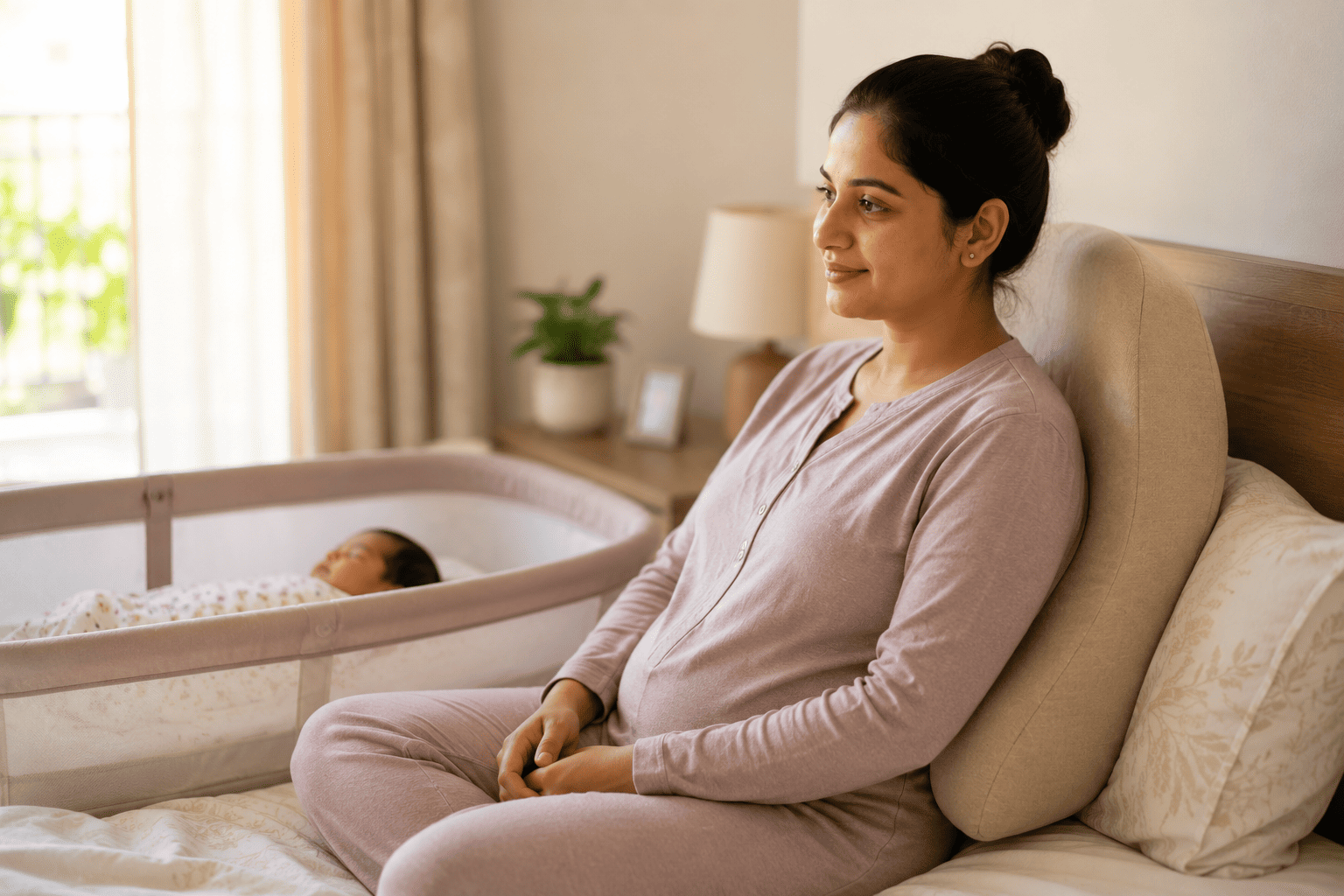
For nine months, a woman's body is monitored constantly. After delivery, attention transfers almost entirely to the baby. The mother gets one six-week check, is told she is fine, and is expected to resume everything — lifting, cooking, carrying, work — with a body that has been structurally altered and never rehabilitated. Postpartum physiotherapy is the missing step. This page explains what it covers, who especially needs it, and when to start.
What is postpartum physiotherapy?
It is structured rehabilitation of the body after childbirth — the pelvic floor, the abdominal wall, the spine and pelvis, and the scar tissue from a caesarean or perineal tear. It is assessment-led, progressed over months, and it covers far more than pelvic floor exercises alone, though those are central to it.
NICE postnatal care guidance says that before a woman leaves the maternity unit she should be given information about the postnatal period and what to expect, the importance of pelvic floor exercises and how to do them, fatigue, and the signs of postnatal physical and mental health problems and how to seek help.1 In practice, in most Indian hospitals, almost none of that conversation happens.
Pelvic floor
Stretched and loaded through pregnancy and delivery. Affects bladder, bowel, support and sexual function.
Abdominal wall
Stretched over months, often separated at the midline, and rarely functioning properly straight after birth.
Spine and pelvis
Changed posture, loosened ligaments, and then months of feeding, lifting and carrying in awkward positions.
Scar tissue
A caesarean incision or perineal tear heals into tissue that can become tight, numb, tethered or painful.
Breathing
The diaphragm is displaced through pregnancy and its coordination with the deep core has to be re-established.
Load capacity
The new mother lifts a growing baby dozens of times a day, with a body that has not been prepared for it.
Who especially should be referred?
Every new mother benefits from guidance. But NICE identifies particular groups where a three-month supervised pelvic floor programme should be considered during postnatal care — women who had an assisted vaginal birth with forceps or vacuum, a vaginal birth where the baby was lying face up, or injury to the anal sphincter.2 If any of those apply to you, this is not optional extra care.
| If this applies to you | Why it matters |
|---|---|
| Forceps or vacuum (assisted) delivery | Named by NICE as a reason to consider a supervised three-month postnatal pelvic floor programme2 |
| Baby delivered lying face up (occipito-posterior) | Also named by NICE as a reason to consider the same supervised programme2 |
| Injury to the anal sphincter (third or fourth degree tear) | Named by NICE, and associated with bowel control problems that respond well to early rehabilitation2 |
| Any leaking, urgency or heaviness | Symptoms already present should be assessed rather than waited out |
| Caesarean delivery | Abdominal wall recovery, scar management and safe return to lifting |
| Ongoing back, neck or pelvic pain | Pain that continues past the early weeks is a treatable problem, not a permanent state |
| A visible gap or doming in the tummy | Abdominal separation needs the right loading, and the wrong exercises make it worse |
| Planning to return to running or the gym | Assessment before high-impact activity prevents avoidable long-term problems |
| Twins, a large baby, or several closely spaced pregnancies | Greater cumulative load on the abdominal wall and pelvic floor |
Had a forceps or vacuum delivery, or a significant tear?
That is a specific reason to be assessed rather than to wait and see. Healthy Jeena Sikho arranges postnatal physiotherapy across Chandigarh, Mohali, Panchkula and Kharar, at home or at our Mohali centre, with a female physiotherapist available on request.
What postpartum physiotherapy treats
| Problem | What it feels like | What treatment involves |
|---|---|---|
| Diastasis recti | A gap or ridge down the midline, doming when sitting up, a tummy that still looks pregnant | Correct loading, breathing and deep core retraining; avoiding the exercises that worsen it |
| Pelvic floor symptoms | Leaking, urgency, heaviness, difficulty emptying, pain | Assessment-led supervised programme over at least three months |
| Pelvic girdle pain | Pain at the pubic bone or back of the pelvis, worse on stairs or turning in bed | Support, movement retraining, load management and strengthening |
| Back and neck pain | Aching between the shoulder blades, neck stiffness, low back pain that started after delivery | Feeding and carrying posture, strengthening, hands-on treatment |
| Wrist and thumb pain | Pain at the base of the thumb when lifting the baby, sometimes called mummy thumb | Lifting technique changes, splinting where needed, graded loading |
| Caesarean scar problems | Tightness, numbness above the scar, a tethered or pulling feeling, an overhang | Scar mobilisation once healed, abdominal retraining, return-to-lifting guidance |
| Perineal scar problems | Pain, tightness, or discomfort with intercourse after a tear or episiotomy | Scar work and pelvic floor downtraining, with consent |
| Coccyx (tailbone) pain | Pain sitting, worse on standing up from a chair | Positioning, cushioning, and targeted treatment |
| Return to exercise | Uncertainty about when running, skipping or gym work is safe | Staged progression based on assessment rather than on how many weeks have passed |
The pelvic floor side of this is covered in depth in pelvic floor physiotherapy, and bladder symptoms specifically in urinary leakage after delivery.
Diastasis recti: the gap that is not really about the gap
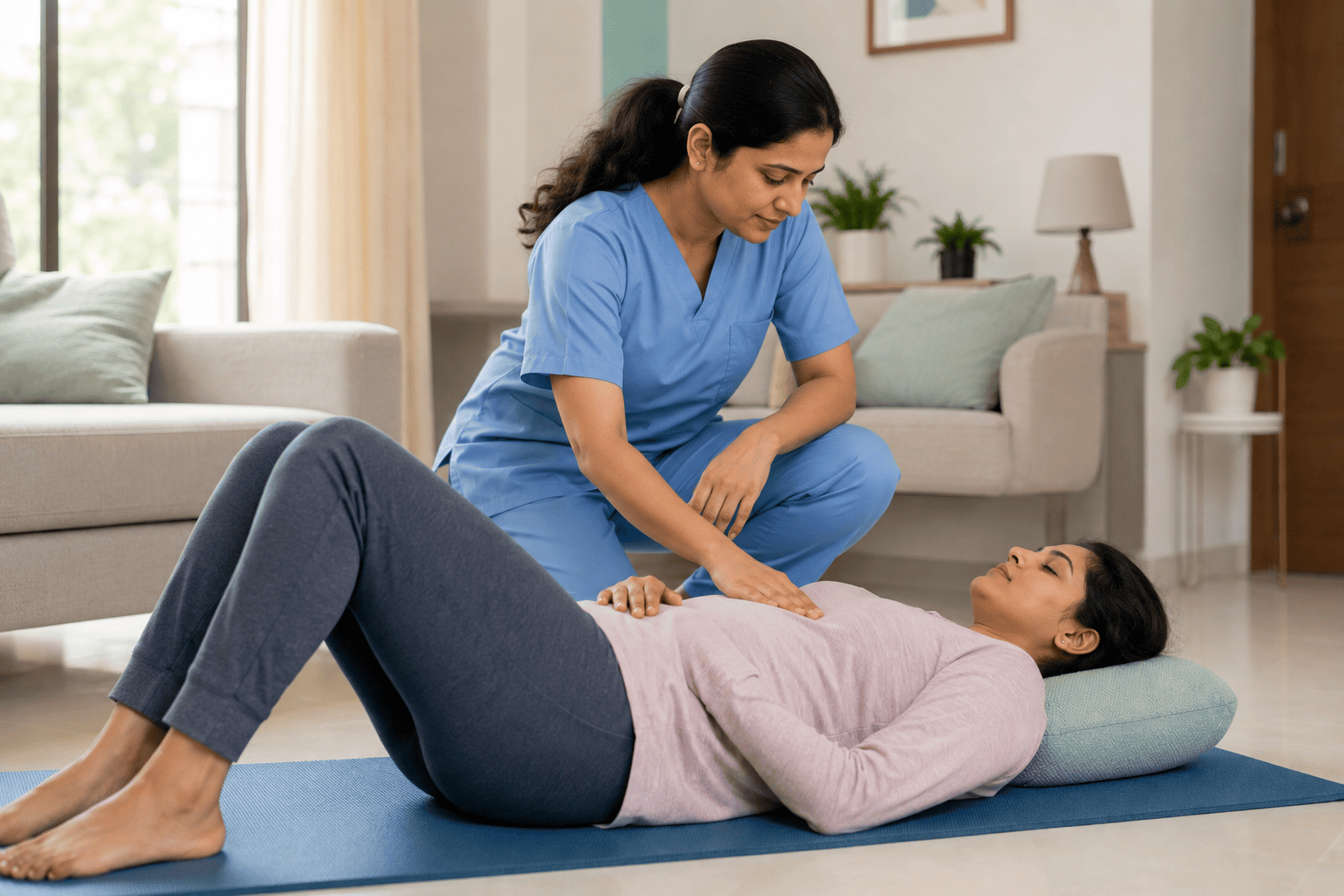
Diastasis recti is the separation of the two halves of the abdominal muscle at the midline. It happens to a great many women in late pregnancy. What matters for recovery is not the width of the gap alone, but whether the tissue between the two halves can generate tension — that is, whether the abdominal wall works when you use it.
This distinction changes the whole approach. Two women can have the same measured gap: one has a flat, functional abdominal wall and no symptoms, the other has a soft midline that domes with every effort and a back that aches by evening. The second needs treatment. Chasing the gap number alone misses the point.
What makes it worse
- Crunches and sit-ups too early, which push the midline outwards rather than drawing it together.
- Planks and heavy core work before the deep system is functioning again.
- Sitting straight up from lying instead of rolling onto the side first.
- Holding the breath during any lift, including lifting the baby.
- Straining with constipation, which pushes outward on an already weakened midline.
- Heavy lifting before it is safe, which in Indian households often begins within days.
What actually helps
- Breathing that coordinates the diaphragm and deep abdominals, which is the foundation and gets skipped.
- Graded loading that progresses only when the midline stays flat under effort.
- Learning to lift and carry without breath-holding or doming, since that happens dozens of times a day.
- Treating the pelvic floor at the same time, because they work as one system.
- Time and consistency. Most improvement happens over months, not weeks.
On belly binders
Binders and postpartum belts are near-universal in Indian households. They can feel supportive and comfortable in the early days, particularly after a caesarean, and there is no harm in short-term use if it helps you move more comfortably. But a binder holds the abdomen in — it does not retrain the muscles. Relying on one for months, without rehabilitation, leaves the underlying problem exactly where it was. Use it as a comfort aid if you like it; do not use it as the treatment.
Recovery after a caesarean
A caesarean is major abdominal surgery, and it is treated in Indian households as the easier option. The abdominal wall has been cut through, the scar heals into tissue that can tether and pull, and the pelvic floor still carried nine months of pregnancy. All three need rehabilitation.
| Stage | What is appropriate | What to avoid |
|---|---|---|
| First days | Gentle breathing, ankle movements, short walks, supported coughing with a pillow, rolling to the side to get up | Sitting straight up from lying, lifting anything heavier than the baby |
| Weeks 1 to 6 | Gradual increase in walking, gentle pelvic floor activation, posture and feeding position work | Abdominal exercises, heavy lifting, driving until cleared |
| From about 6 weeks | Formal assessment, scar mobilisation once fully healed, structured core and pelvic floor programme | Jumping straight into gym or crunches because the six-week check was normal |
| 3 months onwards | Progressive strengthening, graded return towards higher-impact activity if assessment allows | Comparing your progress with someone who had a different delivery |
Scar work
Once the scar is fully healed and your doctor is happy, gentle scar mobilisation can help with tightness, tethering and the pulling sensation, and can reduce the numb patch above the scar over time. It should be shown to you properly rather than guessed at, and it should never be done on a scar that is not fully healed, is red, open, discharging or painful.
Feeding, carrying and the pain nobody warns you about
A new mother feeds eight to twelve times a day, often hunched forward, often at night, often in a chair or bed with no support. Add carrying a baby on one hip and lifting a car seat, and the result is neck, upper back, low back and wrist pain that is entirely predictable and largely preventable.
Bring baby to breast
Not breast to baby. Use pillows to raise the baby to the right height so you are not folding forward for twenty minutes.
Support your back
Back against a solid surface, feet supported on the floor or a low stool, elbows supported rather than hanging.
Change sides and positions
Vary feeding positions rather than using the same one every time, and change which arm carries the baby.
Protect the thumb
Lift with the whole hand under the baby, not with the thumb splayed out. Thumb-base pain is very common and preventable.
Avoid the hip carry
Constantly resting the baby on one hip loads the pelvis and back asymmetrically. Alternate, or use a carrier.
Breathe out on effort
Exhale as you lift the baby or stand up. Holding the breath pushes down on a recovering pelvic floor.
These sound minor. They are the difference between a mother who is comfortable at three months and one who has had daily neck pain since the baby was born and assumes it is now permanent.
When to start, and what to expect when
Gentle work starts within days, formal assessment is usually around six weeks, and structured rehabilitation runs over the following three to six months. NICE guidance is that women should be encouraged to do pelvic floor muscle training before discharge from maternity services and during routine postnatal care.2
| Time | What is usually appropriate | Focus |
|---|---|---|
| Days 1 to 7 | Breathing, ankle movements, short walks, getting in and out of bed safely, gentle pelvic floor activation as comfort allows | Circulation, comfort, avoiding strain |
| Weeks 2 to 6 | Gradually increasing walking, feeding and carrying posture, pelvic floor work, constipation management | Habits and gentle activation |
| Around 6 weeks | Formal postnatal physiotherapy assessment — pelvic floor, abdominal wall, posture, scar, symptoms | Getting an actual plan |
| Weeks 6 to 12 | Structured pelvic floor and core programme, scar mobilisation if healed, strengthening, low-impact activity | Rebuilding function |
| 3 to 6 months | Progressive strengthening, load tolerance, graded return towards higher-impact activity if assessed as ready | Return to full activity |
| 6 to 12 months | Continued strengthening and maintenance, particularly if planning another pregnancy | Long-term protection |
Indicative only. What is appropriate depends on your delivery, any complications and your doctor's advice.
Returning to running and the gym
The most common question, and the one with the least satisfying answer: it depends on assessment, not on how many weeks have passed. High-impact activity loads the pelvic floor and abdominal wall heavily, and returning before they can handle it is how a manageable problem becomes a persistent one. A reasonable progression is walking, then low-impact strengthening, then graded impact once the pelvic floor and abdominal wall have been assessed as ready — commonly somewhere from three months, and often later.
Two useful signs that you have progressed too fast: leaking, or heaviness and dragging in the pelvis, during or after exercise. Neither is something to push through.
When to contact a doctor
Seek medical advice promptly if you have
- Heavy vaginal bleeding, passing large clots, or bleeding that suddenly increases.
- Fever, chills, or foul-smelling discharge.
- A caesarean or perineal wound that is red, swollen, opening, discharging or increasingly painful.
- Severe headache, visual disturbance, or swelling of the face and hands — seek care the same day.
- Chest pain, sudden breathlessness, or pain, swelling and warmth in one calf. These need emergency care.
- Inability to pass urine, or loss of bladder or bowel control that is new.
- Severe or worsening pelvic, abdominal or perineal pain.
- A bulge or heaviness in the vagina — treatable, and worth raising early.
Your mental health counts as postnatal recovery too
Low mood, anxiety, tearfulness that does not lift, difficulty sleeping even when the baby sleeps, or feeling disconnected from your baby are common and treatable. They are not a failing and they are not something to push through quietly. Please tell your doctor how you are feeling, as well as how your body is. If you ever have thoughts of harming yourself or your baby, seek help the same day from your doctor or nearest hospital.
Postnatal myths worth dropping
| Commonly believed | Verdict | What is actually the case |
|---|---|---|
| "The body recovers on its own in 40 days" | Myth | Bleeding settles and the uterus involutes, but muscle function, abdominal separation and pelvic floor strength do not restore themselves on a fixed schedule. |
| "C-section means an easier recovery" | Myth | It is major abdominal surgery. The pelvic floor still carried the pregnancy, and the abdominal wall has been cut through. |
| "Do crunches to reduce the tummy" | Harmful | With abdominal separation, crunches and planks often worsen doming. Loading has to be built up in the right order. |
| "A belly binder will fix the stomach" | Myth | It provides support and comfort. It does not retrain muscles or close a separation. |
| "Leaking is normal after a baby" | Myth | Common, yes. Something to accept permanently, no. It is treatable. |
| "Wait until you stop breastfeeding to exercise" | Myth | Appropriate activity is encouraged during breastfeeding. What changes is the type and progression, not whether you move. |
| "Six weeks means cleared for everything" | Myth | The six-week check is a general medical review. It is not an assessment of pelvic floor or abdominal wall function. |
| "Back pain is just part of motherhood" | Myth | It is usually posture, load and strength — all of which are treatable. |
What happens in a postnatal physiotherapy session
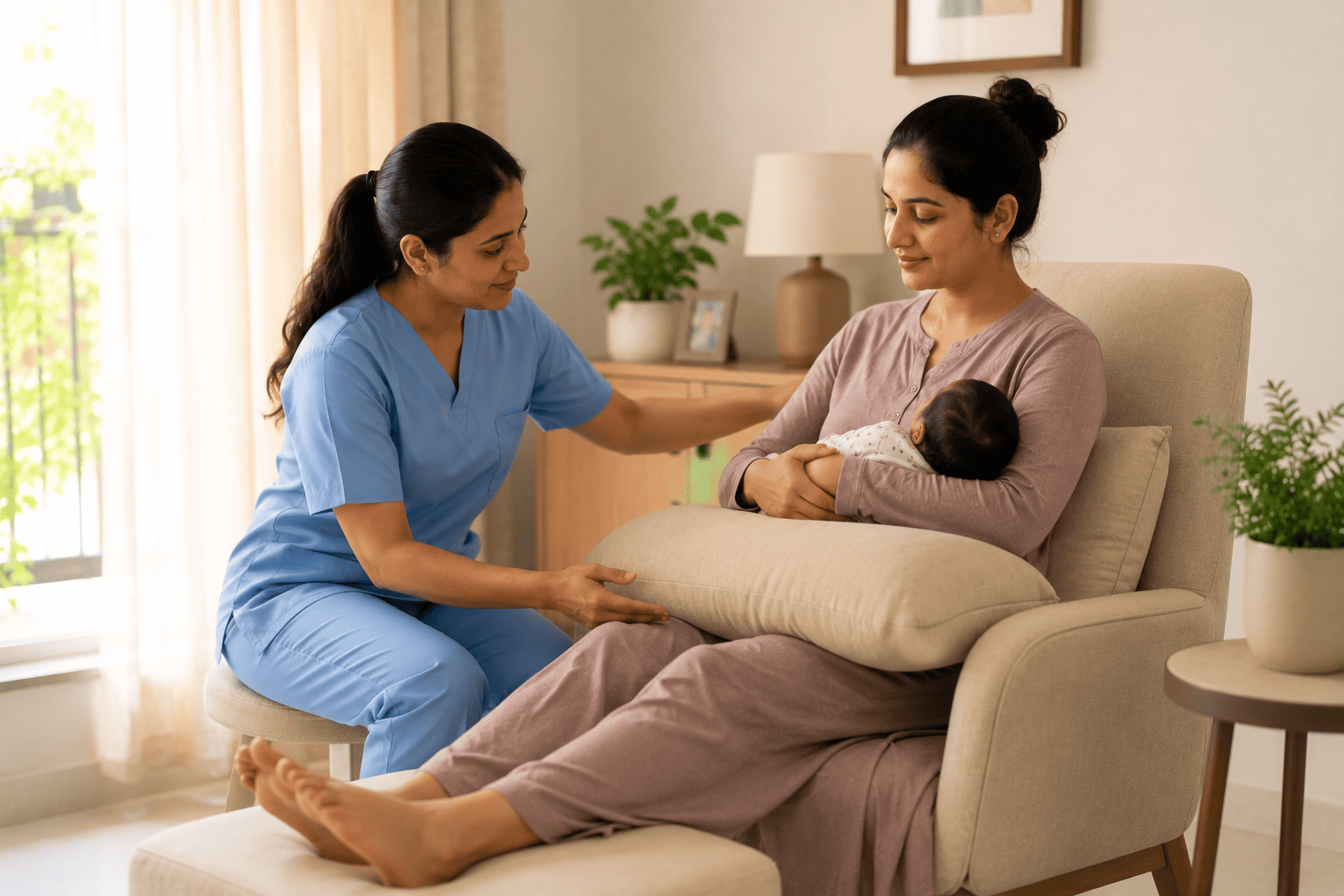
The first session is largely history and assessment: your delivery, symptoms, pain, bladder and bowel function, feeding positions, and what you need to be able to do. Then a physical assessment — posture, breathing, abdominal wall, and with your consent the pelvic floor. You leave with an explanation and a written programme.
- Nothing happens without your consent, and you can decline any part of an assessment at any point.
- A female physiotherapist can be requested without needing to justify it.
- Bring the baby. Sessions are designed around that reality, not disrupted by it.
- Sessions at home mean no travelling with a newborn and complete privacy.
- The programme is written down, with what to do, how often, and what to expect.
- It is reviewed and progressed, not handed over once and forgotten.
Postnatal physiotherapy with Healthy Jeena Sikho
- Whole-body postnatal assessment. Pelvic floor, abdominal wall, posture, scar and symptoms — not pelvic floor exercises handed over in isolation.
- Female physiotherapist on request. Arranged without needing an explanation, subject to availability.
- Sessions at home or at our Mohali centre. No travelling with a newborn, complete privacy, and the baby is welcome in the session.
- Practical, not theoretical. Feeding positions in your actual chair, lifting the baby from your actual cot, and carrying without wrecking your wrist and back.
- A programme progressed over months. Structured and reviewed, including a staged plan for returning to exercise when you are assessed as ready.
- Across Chandigarh, Mohali, Panchkula and Kharar, with a physiotherapy centre in Sector 71, Mohali, and home physiotherapy for those who prefer sessions at home.
Related guides: pelvic floor physiotherapy, urinary leakage after delivery, nutrition during recovery at home, and the recovering at home hub. Equipment for recovery is on the hospital bed on rent and mobility aids pages.
Postnatal physiotherapy across Chandigarh, Mohali, Panchkula and Kharar. Female physiotherapist available on request, subject to availability.
Frequently Asked Questions
What is postpartum physiotherapy?
It is structured rehabilitation of the body after childbirth, covering the pelvic floor, the abdominal wall, the spine and pelvis, and scar tissue from a caesarean or perineal tear. It is assessment-led and progressed over months, and includes practical work on feeding posture, carrying and safe return to activity.
Who especially needs postnatal physiotherapy?
NICE suggests considering a three-month supervised pelvic floor programme during postnatal care for women who had an assisted vaginal birth with forceps or vacuum, a vaginal birth where the baby was lying face up, or injury to the anal sphincter. Beyond that, anyone with leaking, heaviness, ongoing pain, abdominal separation, a caesarean, or plans to return to running should be assessed.
When should postnatal physiotherapy start?
Gentle work — breathing, walking, and pelvic floor activation as comfort allows — starts within days, and NICE guidance is that women should be encouraged to do pelvic floor muscle training before discharge from maternity services and during routine postnatal care. Formal assessment is usually around six weeks, with structured rehabilitation over the following three to six months.
Is a caesarean recovery easier than a vaginal delivery?
No. A caesarean is major abdominal surgery in which the abdominal wall is cut through, and the pelvic floor still carried the full nine months of pregnancy. Recovery involves scar management once healed, abdominal wall retraining, pelvic floor work and careful return to lifting.
What is diastasis recti and how is it treated?
It is separation of the two halves of the abdominal muscle at the midline. What matters is not the width of the gap alone but whether the tissue between can generate tension when you use it. Treatment is coordinated breathing, deep core retraining and graded loading, while avoiding crunches, planks, sitting straight up from lying and breath-holding during lifts, which typically make doming worse.
Do belly binders help after delivery?
They can feel supportive and comfortable in the early days, particularly after a caesarean, and short-term use is not harmful if it helps you move more comfortably. But a binder holds the abdomen in rather than retraining the muscles. Using one for months without rehabilitation leaves the underlying problem unchanged.
When can I start running or going to the gym after delivery?
It depends on assessment rather than on weeks elapsed. A reasonable progression is walking, then low-impact strengthening, then graded impact once the pelvic floor and abdominal wall are assessed as ready — commonly somewhere from three months, and often later. Leaking, or heaviness and dragging in the pelvis during or after exercise, means you have progressed too fast.
Why do I have neck and back pain since having my baby?
Usually feeding and carrying posture combined with a deconditioned trunk. Feeding eight to twelve times a day hunched forward, carrying the baby on one hip, and lifting from a low cot loads the neck, upper back and low back repeatedly. It is predictable and largely preventable with position changes, support and strengthening.
Can physiotherapy help with caesarean scar problems?
Yes. Once the scar is fully healed and your doctor is happy, gentle scar mobilisation can help with tightness, tethering and the pulling sensation, and can reduce the numb patch above the scar over time. It should be demonstrated properly, and never done on a scar that is not fully healed, is red, open, discharging or painful.
Can I bring my baby to the physiotherapy session?
Yes, and sessions are designed around that. At-home sessions remove the need to travel with a newborn entirely and give complete privacy. Feeding, settling and carrying can all be worked on with your actual baby in your actual chair, which is more useful than describing it.
Is it too late if my baby is already a year old?
No. Earlier is easier, but pelvic floor and abdominal wall rehabilitation work at any stage, and many women in India seek help months or years after delivery. If you are planning another pregnancy, strengthening beforehand is particularly worthwhile.
Do you provide postnatal physiotherapy in the Tricity?
Yes. Healthy Jeena Sikho provides postnatal physiotherapy across Chandigarh, Mohali, Panchkula and Kharar, either at home for privacy and convenience or at the physiotherapy centre in Sector 71, Mohali. A female physiotherapist can be requested subject to availability, and assessment is done before any programme is started. Call +91 98769 78488 or message +91 98759 15278 on WhatsApp.
References
- National Institute for Health and Care Excellence. Postnatal care , NICE guideline NG194 — including recommendation 1.1.13 on the information women should be given before transfer from the maternity unit, covering pelvic floor exercises, fatigue, and the signs of postnatal physical and mental health problems.
- National Institute for Health and Care Excellence. Pelvic floor dysfunction: prevention and non-surgical management — Recommendations , NICE guideline NG210 — including recommendation 1.3.11 (encouraging pelvic floor muscle training during and after pregnancy), 1.3.12 (considering a 3-month supervised programme postnatally after assisted vaginal birth, occipito-posterior birth or anal sphincter injury) and 1.3.13 (encouraging training before discharge from maternity services and during routine postnatal care).
- National Institute for Health and Care Excellence. Pelvic floor dysfunction: prevention and non-surgical management — Context , NICE guideline NG210 — the symptoms covered by pelvic floor dysfunction.
- National Institute for Health and Care Excellence. Urinary incontinence and pelvic organ prolapse in women: management — Recommendations , NICE guideline NG123 — including supervised pelvic floor muscle training of at least 3 months as first-line treatment.
- National Institute for Health and Care Excellence. Urinary incontinence in women — Quality statement 4: supervised pelvic floor muscle training , NICE quality standard QS77.
Medical disclaimer. This page is general educational information about physiotherapy after childbirth. It is not medical advice and does not replace assessment by a qualified doctor or physiotherapist. No specific exercise programme is prescribed here deliberately, because what is appropriate depends on your delivery, any complications, whether the pelvic floor is underactive or overactive, and the state of any scar — which is why assessment comes before treatment. Do not begin, change or intensify an exercise programme, do not begin scar work on a scar that is not fully healed, and do not start any medication or supplement, without professional advice, particularly while breastfeeding. Timings given here are indicative only and your doctor's advice takes precedence. Seek medical care promptly for heavy bleeding, fever, a wound that is red, opening or discharging, severe headache or visual disturbance, inability to pass urine, or severe pain, and seek emergency care for chest pain, sudden breathlessness, or pain and swelling in one calf. Healthy Jeena Sikho arranges physiotherapy, nursing and attendant services and supplies home medical equipment, and does not diagnose conditions or independently set clinical parameters.