
Fall Prevention During Recovery: Where, When and Why Patients Fall at Home
The short version
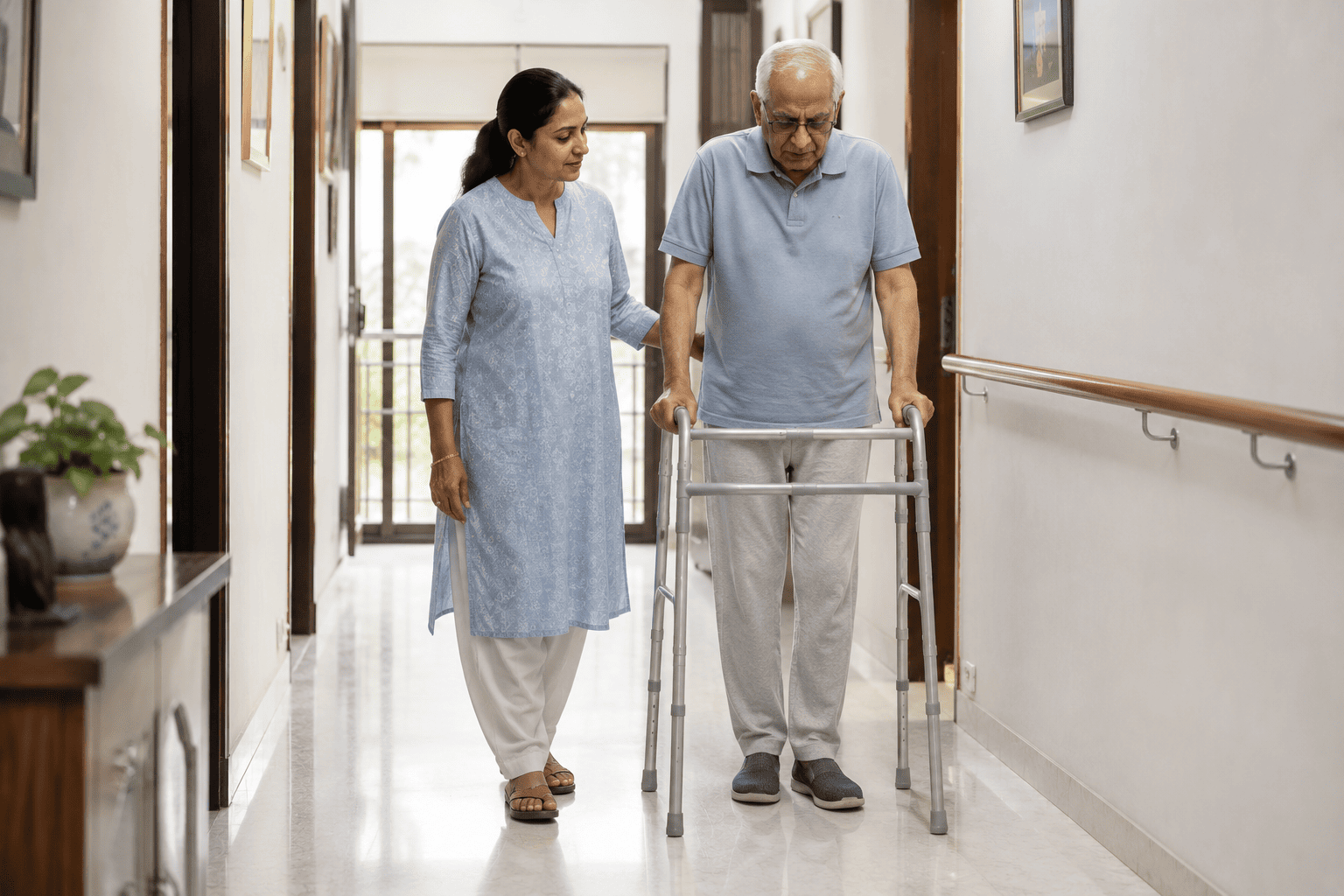
- The dangerous period is when confidence returns before strength. The weeks soon after discharge can carry a high fall risk, because patients begin attempting more activity before strength, balance and endurance have recovered.
- Medicines are an important and overlooked cause of falls. Sleeping tablets, blood pressure medicines, diuretics, sedatives and opioid painkillers all raise fall risk.4 Never stop them at home — ask the doctor for a medication review.
- Night-time trips from the bed to the bathroom are particularly high-risk. Dark, urgent, half-asleep, and undertaken alone because the patient does not want to wake anyone.
- Sit for a minute before standing. Blood pressure drops when someone who has been lying down gets up. Pausing before standing can reduce dizziness caused by a postural drop in blood pressure.
- After a fall, do not lift the patient straight up. Check alertness, pain and limb shape first. A head knock in a patient on blood thinners is an emergency even if they seem fine.
- Report every fall, including the harmless ones. Repeated falls are a medical signal, not clumsiness — they can point to blood pressure, heart rhythm, infection or medication problems.1
Families prepare for the big risks after discharge — infection, wound problems, another admission — and are then blindsided by a fall in the corridor at 3 am. Falls are the complication that undoes recovery fastest: a hip fracture in an elderly patient recovering from something else can be worse than the original illness.2 Most fall risks can be identified in advance, and practical changes to the home, to supervision and to the mobility routine reduce a large part of the avoidable risk.
Why do recovering patients fall?
Because two sets of causes stack together: what has happened inside the patient — weakness, dizziness, poor balance, reduced sensation, medication effects — and what is around them, meaning wet floors, poor lighting, low seats and cluttered routes.1 Removing hazards alone is not enough if the patient stands up too fast on a sedative.
| Cause inside the patient | Why it causes a fall | What helps |
|---|---|---|
| Muscle weakness after bed rest | Legs cannot hold a sudden change of position or a stumble | Physiotherapy started early, and a walker until strength returns |
| Postural drop in blood pressure | Dizziness and greying vision on sitting or standing up | Sit on the edge of the bed for a minute before standing |
| Medication effects | Drowsiness, slowed reactions, low blood pressure, low blood sugar | A medication review by the treating doctor, never a home adjustment |
| Reduced sensation or weakness on one side | The foot catches or the knee gives way without warning, as after a stroke | Splints where advised, supervised gait practice, transfers towards the strong side |
| Poor vision | Steps, thresholds and edges are not seen, especially at night | Correct glasses, better lighting; avoid bifocals on stairs |
| Confusion or delirium | The patient attempts to get up without help or forgets they cannot walk | Medical review, since new confusion often signals infection or medication effects |
| Urgency to reach the toilet | The patient rushes, skips the walker and moves faster than they can control | A commode chair beside the bed, and a timed toileting routine |
| Fear after a previous fall | Activity is restricted, muscles weaken further and the next fall becomes likelier | Supervised graded activity rather than complete rest |
Which medicines increase the risk of falling?
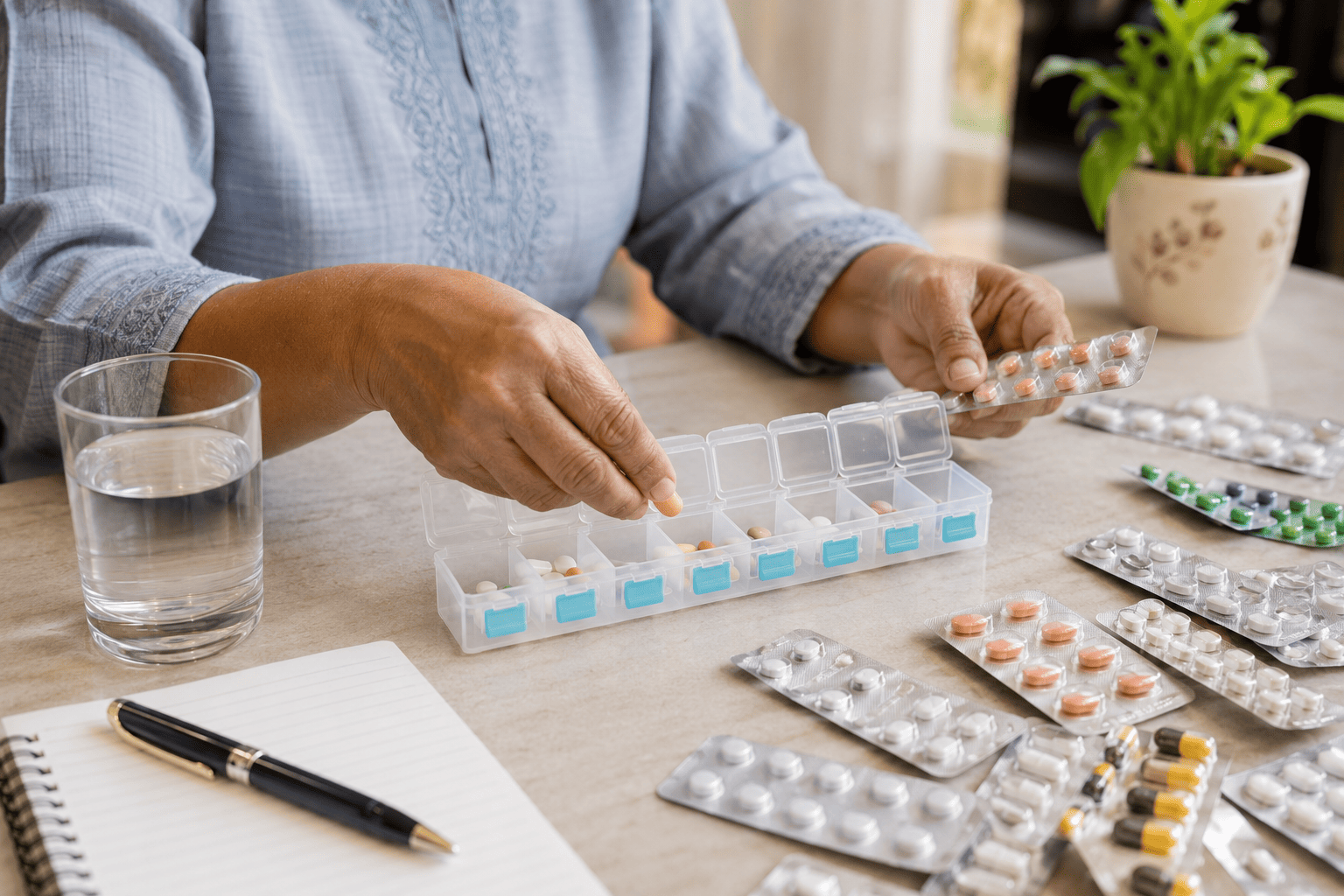
Several common ones, and after a hospital admission most patients come home on more medicines than they went in with. Sedatives and sleeping tablets, blood pressure medicines, diuretics, opioid painkillers, antidepressants and some diabetes medicines all raise fall risk.4 The answer is never to stop them at home — it is to ask the treating doctor for a medication review.
| Medicine group | How it can contribute to a fall |
|---|---|
| Sleeping tablets and sedatives | Drowsiness that persists into the night and the next morning, slowed reactions, unsteadiness on getting up to use the toilet |
| Blood pressure medicines | Blood pressure can drop too far on standing, particularly if the patient is eating and drinking less than usual after discharge |
| Diuretics (water tablets) | More frequent and more urgent toilet trips, including at night, plus dehydration |
| Opioid painkillers | Drowsiness, dizziness and impaired judgement, often at their strongest in the first days at home |
| Antidepressants and antipsychotics | Sedation, postural blood pressure drop and reduced balance reactions |
| Diabetes medicines and insulin | Low blood sugar causes sweating, shakiness, confusion and collapse, especially if meals are being skipped |
| Several medicines together | Risk rises with the number of medicines taken, which is why the post-discharge list is worth reviewing as a whole4 |
Never stop or change a medicine at home
Stopping a blood pressure tablet, a blood thinner or a diabetes medicine without advice can be far more dangerous than the fall risk it was causing. What families should do instead is take the complete medicine list — including anything bought over the counter and any ayurvedic or supplement product — to the next appointment and ask specifically: "Which of these could be making the patient unsteady, and can any be reduced or timed differently?" Timing changes alone, such as moving a diuretic away from bedtime, often help without changing the prescription.
When do falls actually happen?
Falls cluster around specific moments, not random ones: the first standing of the day, night toilet trips, getting off a low seat, the second week after discharge, any sudden rush, and the minutes just after a bath.1 Knowing these lets a family supervise the right minutes rather than hovering all day, which patients resent and families cannot sustain.
The first standing of the day
Blood pressure is lowest, joints are stiffest, and the patient is often in a hurry to reach the bathroom.
Night toilet trips
Dark, urgent, half-asleep, alone by choice. The single highest-risk journey in the house.
Getting off a low seat
Sofas, plastic chairs and Indian-style toilets all demand more strength than a recovering patient has.
Week two after discharge
Confidence returns before strength does. The patient stops using the walker "just for a moment".
Rushing for the phone or door
Any sudden urgency overrides caution. Keep the phone at the bedside and let someone else answer the door.
Just after a bath
Wet feet, wet floor, warm water having lowered blood pressure, and often no one else in the room.
The room-by-room hazard sweep
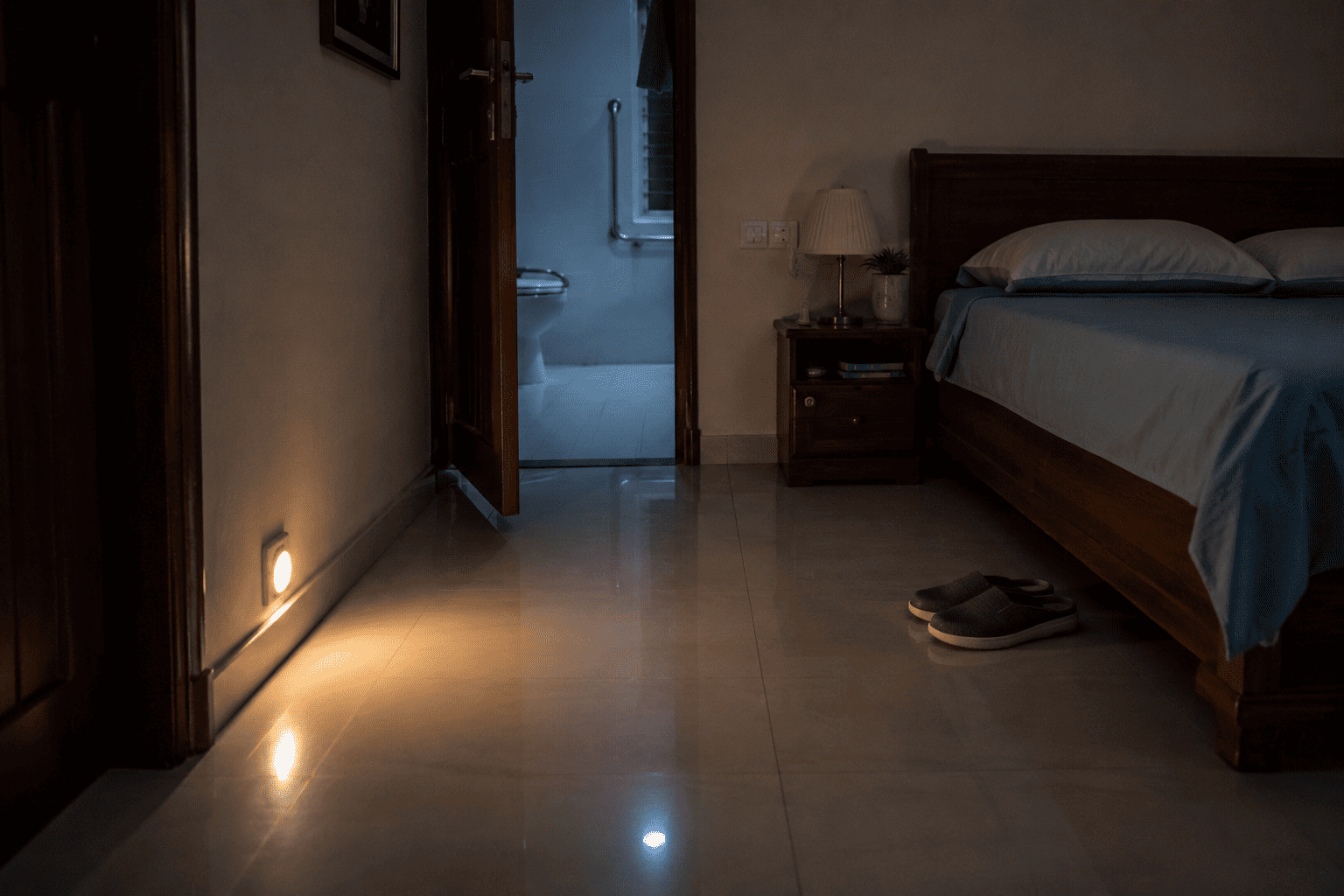
Do this once, properly, before the patient comes home: walk the full route from the bed to the bathroom in the lighting the patient will actually have at night, and remove everything you trip over or reach out for. That single exercise finds more hazards than any checklist, because it reproduces the exact journey the patient will make at 3 am.1
| Area | What to fix | Why it matters |
|---|---|---|
| Bedroom | Bed at the right height, light switch within arm's reach, phone and water on the bedside table, walker parked where it can be reached from the bed | Most falls begin with the patient reaching for something or getting up in the dark |
| Route to the bathroom | Loose rugs, wires, low stools and door mats removed; 90 cm of clear width; night lights along the way | This is the journey that is made most often and in the worst conditions |
| Bathroom | Screw-fixed grab bar, raised seat or commode chair, non-slip mat, floor squeegeed dry, door opening outward with no inside bolt | Wet floor, hard surfaces, low seat and a patient who wants privacy |
| Living room | One firm high chair with armrests, low soft sofas avoided, coffee table moved out of the walking path | Standing up from a low soft seat is one of the hardest movements in recovery |
| Stairs | Avoided entirely in the early weeks; handrail on at least one side, no objects stored on steps, good lighting top and bottom | A stair fall causes far worse injury than a level fall |
| Kitchen | Daily items between waist and shoulder height, no stools used for reaching, spills wiped immediately | Reaching and stretching are how independent patients fall |
| Entrance | Threshold ramped or removed, outdoor step lit, chappals stored off the walking path | Thresholds catch walker legs and dragging feet |
| Lighting everywhere | Working bulbs, switches at both ends of a corridor, low night lights on the bed-to-bathroom route | Poor light is a recognised and easily corrected fall hazard3 |
Footwear, and why bare feet are not safer
- Closed slippers or shoes with a grip sole and a back strap — not loose chappals that slide off.
- No socks on tile or marble. Socks on smooth Indian flooring are one of the most reliable ways to fall indoors.
- No bare feet on wet or polished floors, even for a short trip.
- Check the sole. Worn-smooth footwear grips no better than socks.
- Put footwear on before standing, not after, and keep it beside the bed where it can be reached while seated.
The bathroom is the highest-risk room in the house and has its own set of fixes — grab bar heights, seat height, seated bathing and the door problem — covered in bathroom safety after surgery or stroke. Room layout and clearances are in how to set up a patient room at home.
The daily habits that prevent falls
Environment fixes are one-time. Habits are what carry the risk day to day, and the two that matter most are pausing before standing and never skipping the walking aid, however short the trip.1
- Sit before you stand. One to two minutes on the edge of the bed, feet flat, before standing up. Ask the patient if the room feels like it is moving.
- Use the walker or stick every single time, including for two steps. "Just to the door" is where falls happen.
- Never rush. Phone at the bedside, someone else answers the door, and the patient is told explicitly that nothing is worth hurrying for.
- Plan toilet trips at regular intervals rather than waiting for urgency, and use a bedside commode at night.
- Eat and drink normally unless fluids are restricted, because low intake worsens the blood pressure drop on standing.
- Do the physiotherapy exercises daily. Strength and balance exercises, where they have been prescribed for the patient, are one of the few measures shown to reduce fall risk rather than only avoid it.1
- Someone within calling distance during bathing and toileting, with a bell or phone the patient can actually reach.
- Wear the glasses and hearing aid. Both are balance inputs, and both get left on the table during illness.
The fear-of-falling trap
After one fall, many patients stop moving. It feels sensible and it is the worst possible response: muscles weaken further, balance deteriorates, confidence drops, and the risk of the next fall rises. The correct response after a fall is not complete rest but supervised, graded activity — the same tasks, done with someone present, until confidence is rebuilt. If a patient has become afraid to walk, tell the physiotherapist, because that is a treatable problem in its own right.
What to do immediately after a fall

Do not lift them straight up. Stay calm, keep them still, and check four things first: are they fully alert, is there severe pain, does any limb look wrong, and did the head strike anything. Lifting a patient with a fracture or a head injury makes both worse.
- Stay with them and keep them still. Do not let anyone haul them up in the first seconds.
- Check alertness. Do they know where they are, are they speaking normally, did they black out.
- Ask about pain — hip, back, head, wrist — and look for a limb that is shortened, rotated or oddly angled.
- Ask whether the head was struck, even lightly, and whether they remember the fall itself.
- If any of the above is worrying, call for medical help and keep the patient warm and still where they are.
- If no injury is suspected, let them rest a few minutes, then help them up slowly and in stages — roll to the side, up onto hands and knees, up to a sturdy chair — with two people and a chair beside them.
- Do not attempt a lift alone from the floor. Use two people or a hoist.
- Observe for 24 to 48 hours for new drowsiness, vomiting, confusion, headache or worsening pain.
- Report the fall to the treating doctor, even if nothing seems broken.
Seek emergency care immediately if
- The head was struck and the patient is on blood thinners — this is urgent even if they seem completely fine.
- They lost consciousness, however briefly, or cannot remember the fall.
- There is severe pain in the hip, back, neck or a limb, or a limb looks shortened, twisted or deformed.
- They cannot stand or bear weight afterwards when they could before.
- There is vomiting, a worsening headache, new confusion or increasing drowsiness in the hours after.
- There is new weakness, slurred speech, facial droop or vision loss.
- There is heavy bleeding, or a wound over an operated area.
Falls that repeat are a medical signal
A single fall may be an accident. Two or more falls, or one fall without a clear reason, deserve investigation rather than more caution.1 Recurrent falls in a recovering or elderly patient can point to blood pressure problems, an irregular heart rhythm, a urinary or chest infection, worsening vision, low blood sugar, a neurological change or the medication list itself. In older patients, a urinary infection frequently shows up as new confusion and falls before it shows up as any urinary symptom at all.
Equipment that genuinely reduces fall risk
Not everything marketed for safety helps. The items that reliably reduce falls are the ones that remove a risky movement altogether — a bedside commode removes the night walk, a raised seat removes the hardest stand, a bed at the right height removes the climb down.
| Item | What risk it removes | Worth it when |
|---|---|---|
| Bedside commode chair | Removes the night-time walk to the bathroom entirely | First weeks after any major surgery or stroke, and for anyone unsteady at night |
| Hospital bed with height adjustment | Removes the climb down from a high bed or the struggle up from a low one | Patients who cannot get in and out unaided, or where the caregiver is elderly |
| Walker or quad stick | Widens the base of support and gives something to catch a stumble on | Any patient with reduced balance or leg strength, as advised by the physiotherapist |
| Screw-fixed grab bars | Removes the need to grab a towel rail, basin or door for support | Beside the toilet and in the bathing area, always5 |
| Raised toilet seat | Removes the hardest single movement — standing from a low seat | After hip, knee or spine surgery, and for weak or elderly patients |
| Wheelchair for distance | Removes the exhausted walk that ends in a stumble | When walking endurance is shorter than the distances the patient must cover |
| Night lights and a bedside call bell | Removes movement in the dark and the reluctance to call for help | Every recovering patient, at negligible cost |
| Trained attendant, especially at night | Removes the unsupervised trip that nobody sees until afterwards | High fall risk, confusion, or a single exhausted family caregiver |
Which walking aid, when to use a wheelchair for distance, and how to progress from walker to stick are covered in wheelchair use during recovery and physiotherapy at home after hospitalisation. The full range is on the medical equipment on rent page.
Where Healthy Jeena Sikho delivers and installs
Delhi NCR:Delhi, Noida, Greater Noida, Gurugram, Faridabad and Ghaziabad.
Chandigarh Tricity:Chandigarh, Mohali, Panchkula and Kharar, served from the head office and store in Sector 73, Mohali, Punjab.
Punjab:Ludhiana, Jalandhar and Bathinda.
Rajasthan and Uttar Pradesh:Jaipur and Lucknow.
Equipment sales are available more widely across India. Delivery, installation, home nursing and attendant support are limited to the cities listed above, subject to serviceable pin code and stock. Physiotherapy sessions are currently available in Chandigarh Tricity only. Call +91 98769 78488 or WhatsApp +91 98759 15278.
How Healthy Jeena Sikho helps reduce falls at home
- Home assessment before delivery. The team walks the bed-to-bathroom route, checks bed and seat heights, door widths, thresholds and lighting, and flags what needs changing.
- The equipment that removes risky movements. Height-adjustable hospital beds, bedside commode chairs, walkers, quad sticks, wheelchairs and shower chairs on monthly rent.
- Installed and demonstrated, not dropped off. A technician sets the bed height, positions the commode and walker, and shows the family safe transfer technique.
- Physiotherapy for strength and balance, in Chandigarh Tricity. Home sessions that train the actual stairs and bathroom, because balance work is one of the few measures that reduces risk rather than avoiding it.
- Trained attendants, including night shifts. Night duty covers the exact hours when unsupervised trips happen.
- Equipment delivery across North India. Delhi, Noida, Greater Noida, Gurugram, Faridabad, Ghaziabad, Chandigarh, Mohali, Panchkula, Kharar, Ludhiana, Jalandhar, Bathinda, Jaipur and Lucknow.
For the full setup see recovering at home, or the specific programmes for joint replacement recovery, stroke recovery, after surgery recovery and bedridden patient care at home.
A free home assessment and same-day delivery may be available in serviceable locations, subject to stock and service availability. Call +91 98769 78488 or WhatsApp +91 98759 15278.
Frequently Asked Questions About Fall Prevention
When are recovering patients most likely to fall at home?
In the weeks soon after discharge, when confidence returns before strength does. Within a day, falls cluster around specific moments: the first standing of the morning, night-time trips to the bathroom, getting off a low seat or sofa, rushing for a phone or the door, and the minutes just after a bath. The second week at home is often the riskiest, because that is when patients start leaving the walker behind.
Can medicines cause falls?
Yes. Sleeping tablets and sedatives, blood pressure medicines, diuretics, opioid painkillers, antidepressants and diabetes medicines all raise fall risk, and risk rises further with the number of medicines taken. Never stop or adjust anything at home. Take the full list, including over the counter and ayurvedic products, to the doctor and ask which could be causing unsteadiness and whether any can be reduced or timed differently.
Why does a patient feel dizzy when standing up?
Blood pressure can drop when someone who has been lying down sits or stands, causing dizziness or greying vision. It is more likely after bed rest, on blood pressure medicines or diuretics, and when the patient is eating and drinking less than usual. Sitting on the edge of the bed for a minute before standing can reduce dizziness in patients prone to a postural drop. Repeated dizziness should be reported to the treating doctor.
What should you do immediately after a patient falls?
Do not lift them straight up. Keep them still and check whether they are fully alert, whether there is severe pain, whether any limb looks shortened or twisted, and whether the head was struck. If anything is worrying, call for medical help and keep them warm and still. If no injury is suspected, help them up slowly in stages with two people and a chair beside them, then report the fall to the doctor.
When is a fall an emergency?
Immediately, if the head was struck and the patient is on blood thinners, even when they seem fine. Also if there was any loss of consciousness, severe pain in the hip, back or neck, a limb that looks deformed, inability to stand when they could before, vomiting or worsening headache afterwards, new confusion or drowsiness, or new weakness, slurred speech or facial droop.
Is it safer for a patient to walk barefoot at home?
No. Bare feet and socks on tile or marble are among the most reliable ways to slip indoors. Closed slippers or shoes with a grip sole and a back strap are safer than loose chappals, and worn-smooth soles should be replaced. Footwear should be kept beside the bed and put on while seated, before standing.
Should a patient stop walking after a fall?
No, unless a doctor has said so because of an injury. Stopping activity after a fall feels sensible but weakens muscles further, worsens balance and makes the next fall more likely. The correct response is supervised, graded activity — the same tasks with someone present. If the patient has become afraid to walk, tell the physiotherapist, because fear of falling is treatable in its own right.
What does it mean if a patient falls repeatedly?
Recurrent falls are a medical signal rather than clumsiness. They can point to blood pressure problems, an irregular heart rhythm, a urinary or chest infection, worsening vision, low blood sugar, a neurological change or the medication list itself. In older patients a urinary infection often shows up as new confusion and falls before any urinary symptom appears, so repeated falls deserve a medical review.
Which single change reduces night-time falls the most?
A commode chair beside the bed, because it removes the walk entirely. After that, a light switch within arm's reach of the bed and low night lights along the route, so that if the patient does get up, they are not moving in the dark. Both cost little compared with the injury they prevent.
Do grab bars and walkers actually prevent falls?
They help when they are correctly fitted and actually used. A grab bar must be screw-fixed into solid wall at the height the patient's hand naturally reaches, not a suction-cup type. A walker must be the right height and used for every trip, including short ones. Equipment alone is not enough, though. Strength and balance exercises, where they have been prescribed for the patient, are an important part of reducing fall risk and rebuilding safe mobility.
In which cities does Healthy Jeena Sikho provide this equipment and support?
Delivery, installation, home nursing and attendant support are available in Delhi, Noida, Greater Noida, Gurugram, Faridabad, Ghaziabad, Chandigarh, Mohali, Panchkula, Kharar, Ludhiana, Jalandhar, Bathinda, Jaipur and Lucknow, subject to serviceable pin code and stock. Physiotherapy sessions are currently available in Chandigarh Tricity only. Equipment sales are available more widely across India. Call +91 98769 78488 or WhatsApp +91 98759 15278 to check your location.
References and further reading
- National Institute for Health and Care Excellence (NICE). Falls in older people: assessing risk and prevention, clinical guideline CG161.
- World Health Organization. Falls — fact sheet on the global burden and consequences of falls.
- World Health Organization. Step safely: strategies for preventing and managing falls across the life-course.
- American Geriatrics Society and British Geriatrics Society. Clinical practice guideline for the prevention of falls in older persons, including medication review.
- Bureau of Indian Standards. IS 4963: Recommendations for building and facilities for persons with disabilities — grab bars, door widths and level access.
Medical disclaimer. This page is general educational information about preventing falls during recovery at home. It is not medical advice and does not replace assessment by a qualified physician, physiotherapist or occupational therapist. Medicines must never be started, stopped, reduced or rescheduled without the treating doctor's instruction, and any concern that a medicine is causing unsteadiness should be raised as a medication review request. Weight-bearing status, walking aids, exercise progression and supervision needs must be determined by the treating clinical team, since these differ between patients. Healthy Jeena Sikho supplies, installs and services home medical equipment and arranges nursing, attendant and physiotherapy services, and does not diagnose conditions or independently set clinical parameters. After any fall involving head injury, loss of consciousness, severe pain or a limb that looks deformed, seek emergency medical help immediately.