
C-Section Recovery: A Week-by-Week Guide for Indian Mothers

The short version
- A caesarean is major abdominal surgery, treated in most Indian households as the easy option. Several layers of tissue are cut through. The recovery is a surgical recovery, not just a birth recovery.
- Walk early, and take the pain relief. Early movement reduces clot risk, wind pain and chest problems. Being stoic about pain means you move less, which slows everything.
- Roll onto your side to get up. Never sit straight up. This one habit protects the wound and the abdominal wall for the first several weeks.
- NICE sets out exactly what wound care should include — removing the standard dressing 6 to 24 hours after surgery, monitoring for fever, checking daily for infection or separation, loose clothes and cotton underwear, and gently cleaning and drying the wound each day.2 Your own hospital's instructions come first, since dressing types and timings vary.
- Wind pain in the first days is normal and miserable. It often hurts more than the wound. Walking is the treatment.
- The six-week check is not a fitness clearance. It is a general medical review. The abdominal wall and pelvic floor need separate assessment before you return to gym or running.
In India a caesarean is often described as "operation se hua hai" in a tone that suggests something easier happened. In reality the surgeon cut through skin, fat, the abdominal sheath and the uterus, and the mother is expected to be up feeding a newborn within hours. She then goes home to a household that assumes she is fine because she did not push. This guide covers what recovery actually looks like, week by week, and what needs a phone call rather than patience.
What a caesarean actually involves
The surgeon cuts through skin, fat, the fibrous sheath covering the abdominal muscles, then the abdominal cavity and the uterus. The muscles themselves are usually separated rather than cut, but the sheath that holds them together is divided and takes weeks to regain strength. That sheath is why lifting restrictions exist, and why crunches early on are a bad idea.
Understanding this changes how you treat the first six weeks. It is not that you are being told to rest because you are weak. It is that a structural repair is healing, and load applied too early affects how well it heals.
The wound you can see
The skin incision, usually low and horizontal. It closes first and looks better long before the deeper layers are strong.
The repair you cannot see
The abdominal sheath and the uterine incision. These take weeks to months to regain strength and dictate the restrictions.
The nerves
Small skin nerves are cut, which is why the area above the scar often feels numb. Sensation usually improves over months.
The pelvic floor
Still carried nine months of pregnancy. A caesarean does not protect it, which surprises most women.
Recovery week by week
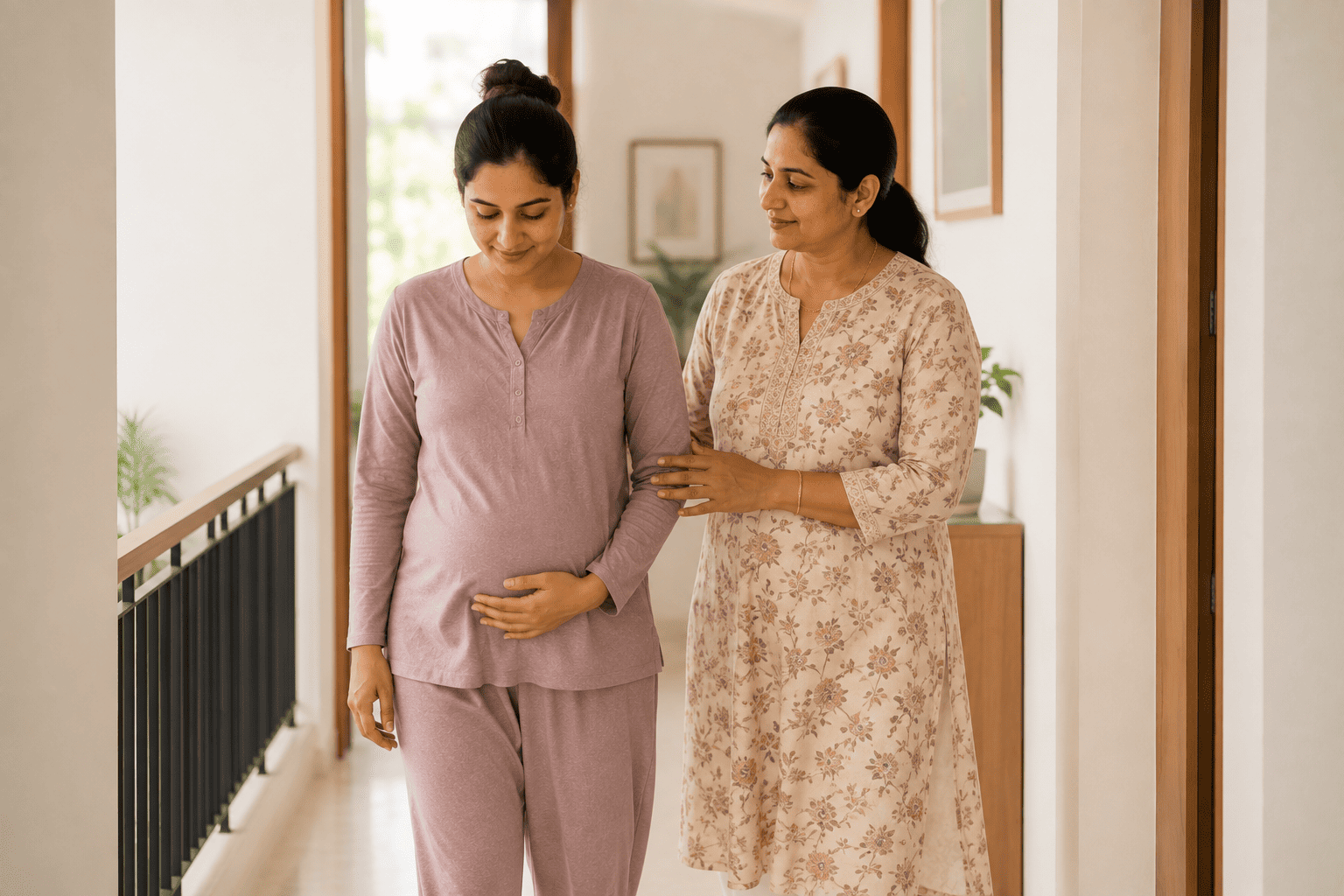
Recovery is faster than most families expect in the first week and slower than most mothers expect at three months. The wound looks healed early; the deeper tissue and the abdominal wall take considerably longer.
Days 0 to 2 — In hospital
Goal: pain controlled, up and walking, wind moving.
- The catheter usually comes out within the first day, after which you will be helped to walk to the toilet.
- Get up and walk as soon as you are allowed. Early walking reduces clot risk, helps trapped wind and clears the chest.
- Take the pain relief on schedule, not only when the pain becomes severe. Controlled pain means you move; uncontrolled pain means you do not.
- Support the wound with a pillow when you cough, laugh or sneeze. It makes it bearable so you actually do it.
- Standard dressings are usually removed 6 to 24 hours after surgery, with the wound then checked daily for infection or separation.2 Some units use other dressing types with longer timings — follow what your hospital tells you.
- Wind pain is common and can be worse than the wound. Walking, warm drinks and gentle movement help more than lying still.
- Ask for help with feeding positions so the baby is not resting on the wound.
Days 3 to 7 — First week home
Goal: safe movement habits, wound care, bowels moving.
- Roll to your side to get in and out of bed. Never sit straight up from lying — this is the single most useful habit of the whole recovery.
- Keep walking short distances around the house, several times a day, rather than one long walk.
- Gently clean and dry the wound daily, wear loose clothing and cotton underwear, and check the wound each day for redness, discharge or separation.2
- Deal with constipation early. Painkillers, reduced movement and low fluid together make it near-certain, and straining is the last thing an abdominal wound needs.
- Do not lift anything heavier than your baby.
- Set up the feeding station properly — pillows, back support, water, everything within reach.
- Expect to feel wiped out. Surgery, blood loss, broken sleep and feeding is a heavy combination.
Weeks 2 to 6 — Building up
Goal: gradually increasing activity without loading the repair.
- Walking distance increases steadily. If pain or bleeding increases afterwards, you have done too much.
- Sutures or clips are removed if needed, per your surgeon's plan.2
- Gentle pelvic floor activation as comfort allows — a caesarean does not exempt you from this.5
- Continue avoiding heavy lifting, pushing heavy doors, and carrying older children.
- Do not start abdominal exercises — no crunches, no planks, no sit-ups.
- Driving is usually deferred until you can perform an emergency stop without hesitation and your doctor and insurer are satisfied.
- Bleeding gradually reduces. A sudden increase, or bright red heavy bleeding, needs a call.
Around 6 weeks — The check, and what it does not cover
Goal: get an actual assessment, not just a clearance.
- The six-week check is a general medical review of healing, bleeding, mood and contraception. It is not an assessment of your abdominal wall or pelvic floor.
- Raise anything you have been putting up with — leaking, heaviness, scar pain, back pain, low mood. Nobody may ask.3
- This is the usual point for a postnatal physiotherapy assessment, covering the pelvic floor, abdominal separation, posture and the scar.
- Scar mobilisation can usually begin once the scar is fully healed and your doctor is happy with it.
- "You are fine to resume normal activity" is not the same as "you are ready to run."
3 to 6 months — Rebuilding
Goal: real strength, and a staged return to exercise.
- Structured core and pelvic floor rehabilitation, progressed properly rather than jumped into.
- Scar softening continues. Numbness above the scar often improves gradually over months.
- Graded return towards higher-impact activity, once assessed as ready — commonly from around three months, and often later.
- Lifting capacity builds up as the abdominal wall regains function.
- Occasional pulling or twinges at the scar during stretching or exertion are common at this stage.
Approaching six weeks, or already past it?
A postnatal physiotherapy assessment covers what the six-week check does not — abdominal separation, pelvic floor function, scar and posture. Healthy Jeena Sikho arranges sessions at home across Chandigarh, Mohali, Panchkula and Kharar, with a female physiotherapist available on request.
How to get in and out of bed without hurting
Roll, then push. Never contract the abdominal muscles to sit straight up from lying. This technique is taught in every hospital and forgotten by almost everybody within two days at home, and it is the difference between a comfortable first fortnight and a miserable one.
- Bend both knees with feet flat on the bed.
- Roll onto your side as one unit, shoulders and hips together, keeping the trunk still rather than twisting.
- Let your legs drop over the edge of the bed as you push up through your lower elbow and then your hand.
- Breathe out as you push up. Holding your breath pushes down on the wound and the pelvic floor.
- Sit for a moment before standing, since blood pressure can drop.
- Reverse the sequence to lie down — sit, lower onto the side, then roll onto the back.
Two related habits worth building at the same time: support the wound with a pillow when you cough or sneeze, and breathe out on any effort — standing up, lifting the baby, getting off a chair.
Wound care and what to watch for
NICE sets out what caesarean wound care should include: removing standard dressings 6 to 24 hours after the birth, specific monitoring for fever, assessing the wound for signs of infection such as increasing pain, redness or discharge, and for separation, encouraging loose comfortable clothes and cotton underwear, gently cleaning and drying the wound daily, and planning removal of sutures or clips if needed.2
One caveat worth knowing: that 6-to-24-hour timing applies to standard dressings. Many units use hydrocolloid or negative pressure dressings that are designed to stay on for several days, and your own hospital may also vary the routine for a raised BMI, diabetes or a wound that needed extra attention. Follow the instructions your hospital gives you and do not remove a dressing early because a website said 24 hours.
- Clean gently and dry thoroughly every day. Moisture trapped under a fold of skin is a common cause of problems, particularly in the Indian summer.
- Loose clothes and cotton underwear, with the waistband above or below the scar rather than sitting on it.
- Look at the wound daily, using a mirror or asking someone. You cannot monitor what you never look at.
- Do not apply oils, turmeric, ghee or any home remedy to a healing wound.
- Do not scrub or pick at scabs or steri-strips.
- Take the temperature if you feel unwell. Fever after a caesarean is reported, not waited out.
- Keep the area dry after washing — pat, do not rub, and let it air briefly if you can.
- Ask before swimming or soaking; showering is usually allowed much earlier than immersion.
Watch the fold, not just the line
In hot, humid weather the tummy fold sits directly over the scar and traps sweat. That warm damp environment is exactly the condition surgical wounds do worst in. Dry the fold carefully after every wash, wear cotton, and if you tend to sweat a lot, lift the fold briefly a few times a day to let air in.6
Pain, wind and the bowels
Three things nobody prepares you for: trapped wind can hurt more than the incision, the first bowel movement is frightening, and being brave about pain slows you down. All three are manageable, and all three are worth planning for rather than enduring.
| Problem | Why it happens | What helps |
|---|---|---|
| Wind pain | The bowel slows down after abdominal surgery and anaesthesia, trapping gas that presses under the ribs and shoulder | Walking, warm drinks, gentle knee movements, avoiding fizzy drinks; ask about medication if severe |
| Wound pain | Cut tissue healing, plus movement pulling on the repair | Regular prescribed pain relief on schedule, pillow support when coughing, correct rolling technique |
| Afterpains | The uterus contracting back down, often stronger during feeding and after a second or third baby | Expected and temporary; pain relief as prescribed |
| Constipation | Painkillers, reduced movement, low fluid, and fear of straining | Fluids, fibre, walking, a low stool under the feet, and asking the doctor about a laxative early rather than late |
| Fear of the first bowel movement | Very common, and it makes people avoid going, which worsens constipation | Support the wound with a pillow or your hand, breathe out rather than straining, do not hold it in |
| Shoulder tip pain | Trapped gas irritating the diaphragm can refer pain to the shoulder | Walking and movement; mention it, since persistent or severe pain needs review |
Take the pain relief
A common pattern in Indian households is refusing painkillers "because of breastfeeding" or because enduring pain is seen as strength. Pain relief after a caesarean is prescribed with feeding in mind, and controlled pain is what lets you walk, feed comfortably, cough properly and sleep — all of which speed recovery. If you are worried about a specific medicine and breastfeeding, ask your doctor rather than quietly stopping it.
Feeding comfortably after a caesarean
The problem is simple: the baby wants to rest exactly where the wound is. The solution is positioning that keeps weight off the abdomen while still supporting your back and arms, since you will be in that position eight to twelve times a day.
- Use pillows generously — under the baby to bring them to breast height, under your arms so they are not hanging, and behind your back.
- Try the underarm or rugby hold, with the baby tucked along your side, which keeps them entirely off the wound.
- Try side-lying for night feeds, which many mothers find the most comfortable position after a caesarean.
- Bring the baby to you, not your body down to the baby. Folding forward for twenty minutes is how neck and upper back pain start.
- Feet supported on the floor or a low stool, back against something solid.
- Everything within reach before you start — water, phone, burp cloth — so you are not twisting to grab things mid-feed.
Feeding posture, carrying technique and the neck, back and wrist problems that follow are covered in postpartum physiotherapy.
The scar: healing, numbness and the overhang

A caesarean scar changes for a year or more. It is usually raised, firm and darker in the early months, then gradually flattens, softens and fades. Numbness above the scar is normal because small skin nerves were cut, and sensation typically returns slowly and incompletely.
| What you may notice | Usual? | What to do |
|---|---|---|
| Numbness above the scar | Very common | Expected; usually improves over months, though a small patch may remain |
| Itching as it heals | Common | Normal healing. Do not scratch; moisturise once fully healed |
| A firm, raised, darker line | Common in early months | Usually flattens and fades over a year or more |
| Tightness or a pulling feeling | Common | Responds well to scar mobilisation once fully healed |
| An overhang above the scar | Common | Partly tissue, partly abdominal wall function; core rehabilitation helps, and keeping the fold dry matters |
| Occasional twinges or pulling on stretching | Common for months | Usually settles; mention it if it is worsening rather than easing |
| A thick, raised scar spreading beyond the line | Less common | May be keloid or hypertrophic scarring; ask your doctor, as there are treatments |
| Increasing pain, redness, discharge or the wound opening | Not normal | Contact your doctor the same day2 |
Scar massage
Once the scar is fully healed and your doctor is happy, gentle scar mobilisation can help with tightness, tethering and the pulling sensation, and may help the numb area over time. It should be demonstrated to you properly rather than guessed at from a video, and it should never be done on a scar that is still open, red, discharging or painful. Most women start somewhere after six weeks, but the timing is your doctor's call.
What is normal, and what is not
| Expected | Not expected — contact your doctor |
|---|---|
| Wound soreness that eases week by week | Pain that increases day on day, or is not controlled by prescribed medication |
| Bleeding that gradually reduces over weeks | Sudden heavy bleeding, large clots, or bleeding that increases again |
| Numbness above the scar | Spreading redness, discharge, foul smell, or the wound opening2 |
| Tiredness and needing to rest often | Fever or chills at any point |
| Constipation in the first days | Severe abdominal pain with a hard swollen abdomen, or vomiting |
| Wind pain and shoulder tip discomfort early on | Chest pain, or sudden breathlessness |
| Mild swelling around the scar line | Pain, swelling or warmth in one calf4 |
| Feeling emotional or tearful at times | Persistent low mood, hopelessness, or feeling disconnected from your baby3 |
Seek urgent medical care if you have
- Chest pain or sudden breathlessness, or coughing up blood.
- Pain, swelling, warmth or redness in one calf.4
- Heavy vaginal bleeding or passing large clots.
- Fever with shivering, or a wound that is hot, spreading red, discharging or opening.
- Severe abdominal pain, a hard swollen abdomen, or persistent vomiting.
- Severe headache, visual disturbance, or swelling of the face and hands.
- Fainting, confusion, or feeling very unwell rapidly.
- Inability to pass urine, or pain and burning with fever.
Returning to lifting, driving and exercise
The honest answer is that these depend on your recovery and your doctor's advice, not on a fixed number of weeks. What follows are common patterns, not permissions — your surgeon's instructions override them.
| Activity | Commonly | What has to be true first |
|---|---|---|
| Walking | From day one, short and frequent | Nothing — this is encouraged early |
| Stairs | Early, slowly and with a rail | Steady on your feet, pain controlled |
| Lifting anything heavier than the baby | Usually avoided for around six weeks | Your doctor's clearance; build up gradually rather than jumping to it |
| Driving | Often around four to six weeks | You can perform an emergency stop without hesitation; doctor and insurer satisfied |
| Pelvic floor exercises | Gentle activation from early on | Comfort allows; a caesarean does not exempt you from these5 |
| Core rehabilitation | Structured work usually after the six-week check | Assessment of abdominal separation and pelvic floor first |
| Swimming | Once the wound is fully healed and bleeding has stopped | Doctor's confirmation that the wound is closed |
| Running and high-impact exercise | Commonly from around three months, often later | Assessed as ready; leaking or pelvic heaviness during exercise means too soon |
| Crunches, planks, sit-ups | Not until assessed and progressed properly | Abdominal separation checked; these often worsen doming if started early |
The lifting rule in an Indian household
"Nothing heavier than the baby" is easy to say and almost impossible to follow when there is a toddler, a water can, and a household that expects the new mother to resume cooking within days. Be specific with your family about what you cannot do — lifting the older child, carrying buckets, pushing heavy doors, moving furniture — because vague requests to "rest" get ignored. This is a surgical restriction, not a preference.
The part that is not physical
Many women carry a quiet sense of failure after a caesarean, especially after an emergency one, and especially when relatives comment that she "did not deliver properly". That feeling is common and it is not a reflection of anything you did. It is also worth saying out loud rather than carrying silently.
If the birth was frightening, or very different from what you had planned, it is normal to keep replaying it. Talking it through — with your doctor, your partner, or someone who will listen without offering opinions about what you should have done — helps more than people expect.
When low mood needs attention
Low mood, anxiety, tearfulness that does not lift, difficulty sleeping even when the baby sleeps, or feeling disconnected from your baby are common after any birth and are treatable.3 They are not a failing and they are not something to push through quietly. Please tell your doctor how you are feeling. If you ever have thoughts of harming yourself or your baby, seek help the same day from your doctor or nearest hospital.
Myths worth dropping
| Commonly believed | Verdict | What is actually the case |
|---|---|---|
| "C-section is the easy option" | Myth | It is major abdominal surgery with a longer physical recovery than an uncomplicated vaginal birth. |
| "Rest completely for 40 days" | Partly | Avoid lifting and strain, yes. Complete immobility increases clot risk, wind pain and stiffness. Walking is part of the treatment. |
| "Do not take painkillers while breastfeeding" | Myth | Pain relief after a caesarean is prescribed with feeding in mind. Ask your doctor about a specific medicine rather than stopping quietly. |
| "A belt will flatten the stomach" | Myth | A binder gives comfort and support. It does not retrain the abdominal wall or close a separation. |
| "Apply oil, turmeric or ghee to the scar" | Harmful | Nothing goes on a healing wound. Once fully healed, ask what is appropriate. |
| "You cannot deliver normally next time" | Myth | Vaginal birth after caesarean is possible for many women. Suitability depends on your history and is decided with your obstetrician.1 |
| "Your pelvic floor is safe because you had a caesarean" | Myth | Pregnancy itself loads the pelvic floor for months. Leakage and heaviness occur after caesareans too. |
| "Six weeks means back to normal" | Myth | The check confirms healing is on track. Strength and abdominal wall function take considerably longer. |
Recovering from a caesarean with Healthy Jeena Sikho
- Postnatal physiotherapy assessment. Abdominal separation, pelvic floor function, posture and scar — the things the six-week check does not cover.
- Scar management, once healed. Proper demonstration of scar mobilisation rather than guessing from a video, at the point your doctor is happy for it to start.
- Practical, in your own home. Getting out of your actual bed, feeding in your actual chair, and carrying your baby without wrecking your back and wrists.
- Female physiotherapist on request. Arranged without needing an explanation, subject to availability. Bring the baby — sessions are designed around that.
- A staged return to activity. Clear guidance on when lifting, core work and exercise are appropriate, based on assessment rather than on weeks elapsed.
- Across Chandigarh, Mohali, Panchkula and Kharar, with a physiotherapy centre in Sector 71, Mohali, and home physiotherapy for those who prefer sessions at home.
Related guides: postpartum physiotherapy, pelvic floor physiotherapy, urinary leakage after delivery, nutrition during recovery at home and the recovering at home hub. Recovery equipment is on the hospital bed on rent and mobility aids pages.
Postnatal physiotherapy across Chandigarh, Mohali, Panchkula and Kharar. Female physiotherapist available on request, subject to availability.
Frequently Asked Questions About C-Section Recovery
How long does it take to recover from a C-section?
The wound is usually comfortable within a few weeks and healing is reviewed at around six weeks, but abdominal wall strength and pelvic floor function take considerably longer — commonly three to six months with proper rehabilitation, and the scar itself continues changing for a year or more. The six-week check confirms healing is on track; it is not a clearance for full activity.
When should the C-section dressing be removed?
NICE recommends removing standard dressings 6 to 24 hours after the caesarean, with the wound then monitored for fever and assessed for signs of infection such as increasing pain, redness or discharge, and for separation. That timing applies to standard dressings; hydrocolloid and negative pressure dressings are designed to stay on for several days, so follow the instructions given by your own hospital rather than removing a dressing early.
How should I get out of bed after a caesarean?
Roll onto your side as one unit with knees bent, let your legs drop over the edge of the bed, and push up through your lower elbow and hand while breathing out. Never sit straight up from lying, which contracts the abdominal muscles directly across the repair. Reverse the sequence to lie down.
Why does wind pain hurt so much after a C-section?
The bowel slows down after abdominal surgery and anaesthesia, trapping gas that presses under the ribs and can refer pain to the shoulder tip. For many women it hurts more than the incision. Walking is the most effective treatment, along with warm drinks, gentle movement and avoiding fizzy drinks. Severe or persistent pain should be reported.
When can I lift things after a caesarean?
The usual advice is nothing heavier than your baby for around six weeks, then building up gradually with your doctor's clearance. The restriction exists because the fibrous sheath covering the abdominal muscles was cut and takes weeks to regain strength. Be specific with family about what you cannot do, since vague requests to rest tend to be ignored.
When can I drive after a C-section?
Commonly around four to six weeks, but the test is functional rather than calendar-based: you must be able to perform an emergency stop without hesitating because of pain, and your doctor and insurer must be satisfied. Check your insurance position as well as your doctor's advice.
Is numbness above the C-section scar normal?
Yes, very. Small skin nerves are cut during the incision, so the area above the scar commonly feels numb or altered. Sensation usually returns gradually over months, though a small numb patch may remain permanently. Numbness combined with increasing pain, redness or discharge is a different matter and needs review.
When can I start C-section scar massage?
Once the scar is fully healed and your doctor is happy, which for most women is somewhere after six weeks. It can help with tightness, tethering and the pulling sensation, and may help the numb area over time. It should never be done on a scar that is still open, red, discharging or painful, and it is worth having it demonstrated properly rather than copying a video.
Can I still have pelvic floor problems after a caesarean?
Yes. Pregnancy itself places months of load on the pelvic floor and softens supporting tissues, so leaking, urgency and heaviness occur after caesarean deliveries too. A caesarean is not protective, and pelvic floor symptoms after one are treated in the same way.
When can I start exercising after a C-section?
Walking from day one, gentle pelvic floor activation early, structured core rehabilitation usually after the six-week check and an assessment, and higher-impact activity such as running commonly from around three months and often later. Crunches, planks and sit-ups are avoided until abdominal separation has been assessed, since they often worsen doming when started too early.
What are the signs of a C-section wound infection?
Increasing pain rather than easing pain, spreading redness, swelling, heat, discharge or pus, a foul smell, the wound edges separating, or fever. NICE specifies monitoring for fever and assessing the wound for these signs as part of routine caesarean wound care. Contact your doctor the same day if you notice any of them.
Do you provide postnatal physiotherapy after a caesarean in the Tricity?
Yes. Healthy Jeena Sikho provides postnatal physiotherapy across Chandigarh, Mohali, Panchkula and Kharar, at home or at the physiotherapy centre in Sector 71, Mohali. Sessions cover abdominal wall and pelvic floor rehabilitation, scar management once healed, feeding and carrying posture, and a staged return to activity. A female physiotherapist can be requested, subject to availability. Call +91 98769 78488 or message +91 98759 15278 on WhatsApp.
References and further reading
- National Institute for Health and Care Excellence. Caesarean birth , NICE guideline NG192 — care before, during and after caesarean birth, including birth options after a previous caesarean.
- National Institute for Health and Care Excellence. Caesarean birth — Recommendations , NICE guideline NG192, section 1.7 on recovery after caesarean birth, including recommendation 1.7.4 on wound care: removing standard dressings 6 to 24 hours after birth, monitoring for fever, assessing for infection or separation, loose clothes and cotton underwear, gently cleaning and drying the wound daily, and planning removal of sutures or clips if needed.
- National Institute for Health and Care Excellence. Postnatal care , NICE guideline NG194 — including the information women should receive before leaving the maternity unit, and postnatal physical and mental health review.
- NHS. Deep vein thrombosis (DVT) — leg symptoms after surgery, and the emergency signs suggesting a clot has travelled to the lungs.
- National Institute for Health and Care Excellence. Pelvic floor dysfunction: prevention and non-surgical management , NICE guideline NG210 — including encouraging pelvic floor muscle training during and after pregnancy.
- National Institute for Health and Care Excellence. Surgical site infections: prevention and treatment , NICE guideline NG125.
Medical disclaimer. This page is general educational information about recovery after a caesarean birth. It is not medical advice and does not replace the instructions of your obstetrician, surgeon or midwife. All timelines given here are indicative only and vary considerably between women; wound care instructions, dressing type and timing, suture or clip removal, pain relief, lifting restrictions, and clearance to drive, swim or exercise must be determined by your own treating team, and their instructions take precedence. Do not begin, change or intensify an exercise programme, do not begin scar work on a scar that is not fully healed, do not apply any substance to a healing wound, and do not start or stop any medication without professional advice, particularly while breastfeeding. Healthy Jeena Sikho arranges physiotherapy, nursing and attendant services and supplies home medical equipment, and does not diagnose conditions or independently set clinical parameters. Seek urgent medical care for chest pain, sudden breathlessness, pain or swelling in one calf, heavy bleeding, fever, a wound that is opening or discharging, severe abdominal pain, or severe headache with visual disturbance.