
Dementia & Elderly Care at Home: Behaviour, Safety & Equipment Guide

The short version
- Sudden confusion is a medical emergency, not dementia progressing. Confusion that appears over hours or days is usually delirium — most often from a urinary infection, dehydration, constipation or a new medicine — and it is often reversible.
- Not all memory loss is dementia. Vitamin B12 deficiency, thyroid problems, depression, poor hearing and certain medicines can all mimic it, and several are treatable. Insist on a proper assessment.
- Do not argue with a false belief. Correcting someone with dementia produces distress without producing memory. Acknowledge the feeling, then redirect.[6]
- Behaviour is communication. Agitation, refusal and restlessness usually mean pain, hunger, a full bladder, fear or overstimulation — not deliberate difficulty.
- The caregiver is the most fragile part of the system. In India this role is largely unpaid, unshared and unrelieved. Planning relief early is part of the medical plan, not a luxury.
- An estimated 8.8 million Indians over 60 live with dementia, and the great majority are cared for entirely at home.[1]
Most Indian families arrive at dementia care without a diagnosis, a plan or a name for what is happening — just a growing list of things that used to work and no longer do. Bills forgotten. A parent who is fine at breakfast and frightened by dusk. An argument every evening about whether the gas was left on. This guide covers what is actually happening, how to respond to the behaviour, how to make the house safe, what equipment helps at each stage, and when a family genuinely needs outside help rather than more willpower.
Is it dementia, or is it normal ageing?
Normal ageing slows recall — forgetting a name and remembering it later, misplacing keys, needing longer to learn something new. Dementia interferes with daily function: losing track of the year, repeating the same question within minutes, getting lost on a familiar route, or being unable to manage money, medicines or cooking that were previously routine. The dividing line is not forgetfulness. It is whether independent daily life is affected.
| Usually normal ageing | Worth getting assessed |
|---|---|
| Forgetting a name and recalling it later. | Not recognising close family members. |
| Occasionally misplacing objects and retracing steps. | Putting objects in illogical places and accusing others of theft. |
| Momentarily forgetting the date, then working it out. | Losing track of the season or the year entirely. |
| Needing help with a new phone or app. | Unable to follow a lifelong routine such as cooking a familiar dish. |
| Sometimes struggling to find a word. | Frequent word substitution that makes conversation hard to follow. |
| Making an occasional error in accounts. | Unpaid bills, repeated payments, or vulnerability to financial fraud. |
| Being tired of social obligations. | Withdrawing from everything, with personality or mood change. |
Ask the doctor to rule out the treatable causes first
Several conditions produce memory and thinking problems that look like dementia and can improve with treatment — vitamin B12 deficiency, thyroid disorder, depression, uncontrolled diabetes, sleep apnoea, untreated hearing loss and the side effects of certain medicines. A proper assessment should include these before memory loss is accepted as irreversible. Hearing loss in particular is frequently mistaken for confusion, and a hearing test costs very little.
Why has the confusion suddenly become much worse?
Because it is probably delirium, not dementia advancing. Delirium develops over hours or days, fluctuates through the day, and usually involves reduced alertness or attention. In older adults the common triggers are urinary infection, chest infection, dehydration, constipation, uncontrolled pain, a new medicine, or an unfamiliar environment such as a hospital ward. It needs medical assessment the same day, and it is frequently reversible once the cause is treated.
| Dementia | Delirium | |
|---|---|---|
| Onset | Gradual, over months or years. | Sudden, over hours or a few days. |
| Course | Slow and relatively steady decline. | Fluctuates markedly, often worse at night. |
| Alertness | Usually normal until late stages. | Reduced, drowsy or unusually agitated; hard to hold attention. |
| Common triggers | Not applicable — it is the underlying disease. | Infection, dehydration, constipation, pain, new medication, hospital admission. |
| What to do | Planned review with the treating doctor. | Same-day medical assessment. Do not wait for it to settle. |
The practical rule for families: if the change happened this week, look for a medical cause. A person with dementia can also develop delirium on top of it — in fact dementia makes delirium far more likely — so a sudden worsening in someone already diagnosed still deserves the same urgency.
How should you respond when someone with dementia says something untrue?

Do not correct them. Arguing with a false belief — that a late spouse is alive, that it is time to go to work, that someone has stolen a purse — causes real distress and does not restore the memory. The approach that works is to respond to the emotion behind the statement, then gently redirect to an activity or a different subject. The aim is not to win the exchange. It is to keep the person calm and safe.[6]
Answer the feeling
"You're missing her" lands better than "She passed away eight years ago." The emotion is real even when the fact is not.
Redirect, don't refuse
"Let's have tea first, then we'll see" moves things forward. A flat "no" usually escalates into an argument.
One idea at a time
Short sentences, one question, one instruction. Multiple choices at once overwhelm and produce refusal.
Approach from the front
Come into view before speaking or touching, make eye contact, and speak slowly at normal volume. Being startled reads as threat.
Look for the missing item
With accusations of theft, searching together works far better than denial — and the item is usually somewhere unexpected.
Leave and return
If a moment turns hostile, step out briefly if it is safe. A different face, or the same face two minutes later, often resets it entirely.
Behaviour is communication
Agitation, shouting, refusing to bathe, pacing or hitting out are almost always attempts to express something that can no longer be said in words. Before treating the behaviour, check the causes underneath it:
- Pain — often untreated in dementia because it is not reported. Arthritis, dental pain, constipation.
- Toilet needs — restlessness and pulling at clothing frequently mean a full bladder.
- Hunger, thirst or fatigue, none of which may be recognised or expressed.
- Overstimulation — a loud television, too many visitors, several people talking at once.
- Fear — being undressed for a bath is frightening if the person does not understand why.
- Infection, which should always be considered when behaviour changes suddenly.
Why does the behaviour get worse in the evening?
This pattern is called sundowning — increased confusion, restlessness, anxiety or agitation in the late afternoon and evening. It is common in dementia and tends to be worsened by fading light, fatigue accumulated through the day, hunger, disrupted sleep and a noisy or unstructured household at exactly that hour.
What reduces sundowning
- Turn the lights on before dusk. Bright, even lighting before the light fades reduces shadows and misinterpretation.
- Keep the day structured and the evening quiet. Activity, sunlight and movement in the morning; low stimulation after four o'clock.
- Front-load the difficult tasks. Bathing, medical visits and outings belong in the morning, not after 5pm.
- Avoid daytime napping late in the afternoon, which worsens night-time restlessness.
- Limit caffeine after midday and give the evening meal early enough that hunger is not adding to it.
- Cover mirrors and reflective windows if reflections are causing fear — a common and easily missed trigger.
- Keep the same faces in the evening where possible. New attendants starting a shift at dusk usually goes badly.
How do you make a home safe for someone with dementia?
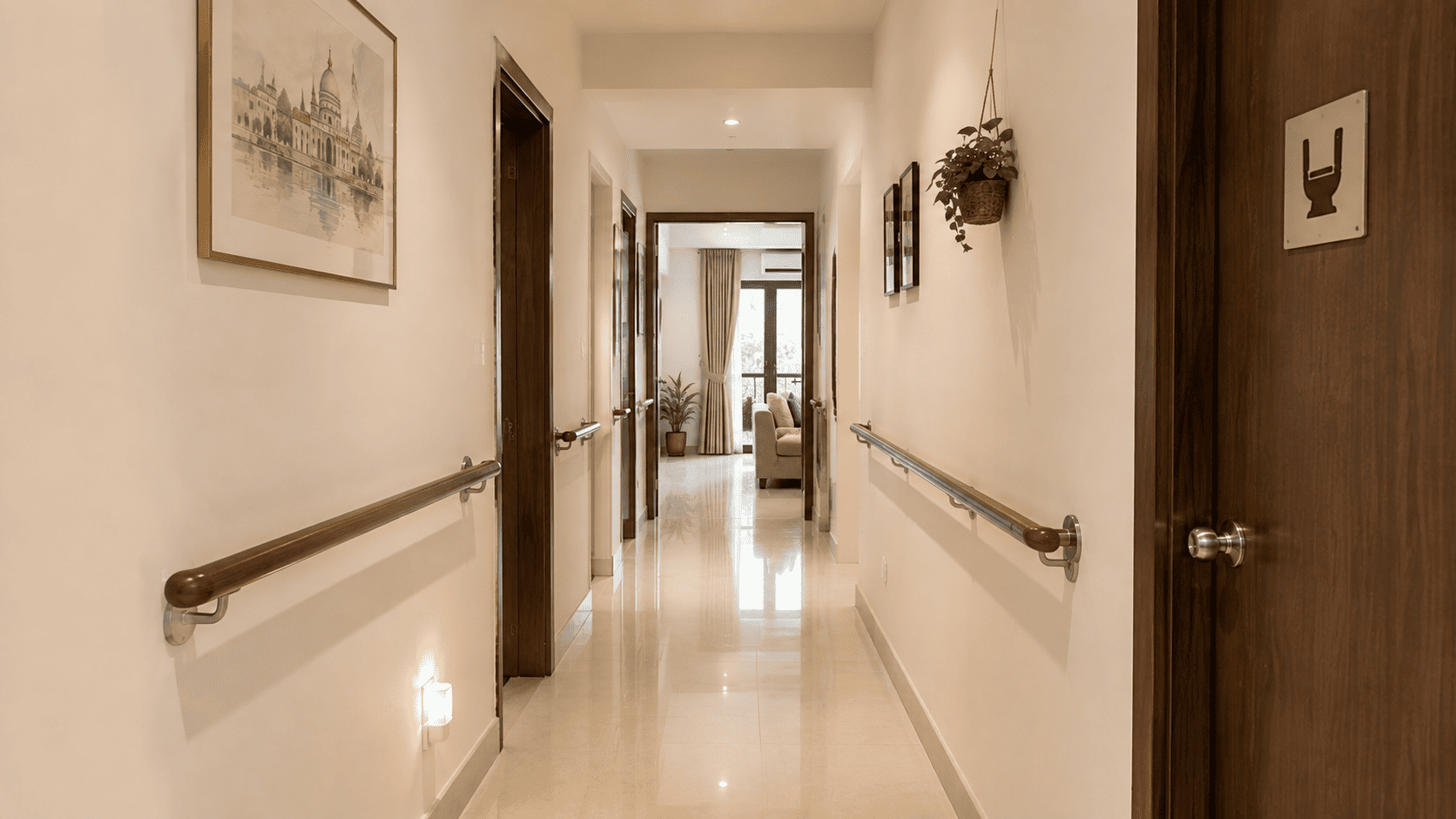
By addressing three risks together: falls, wandering, and household hazards the person can no longer judge — gas, hot water, medicines, electrical points. The goal is a home that is safe without feeling like a locked ward, because visible restriction usually increases agitation.
| Area | The risk | What to change |
|---|---|---|
| Front door and gate | Walking out and becoming lost, often at dusk or at night. | A latch placed high or low out of the usual line of sight, a door chime or sensor, an ID card with a phone number in every pocket and bag. |
| Kitchen | Gas left on, burns, eating spoiled food. | Gas knob cover or valve turned off between uses, clear the fridge regularly, keep sharp items out of casual reach. |
| Bathroom | Falls on wet floors, scalding, locking oneself in. | Grab bars, shower chair, non-slip mat, geyser temperature reduced, remove the inside lock or keep a spare key. |
| Bedroom | Night-time falls when getting up to the toilet. | Motion-sensor night light, commode beside the bed, clear path, bed at a height where feet reach the floor. |
| Floors and stairs | Rugs, thresholds, poor depth perception, low light. | Remove loose rugs and clutter, handrails on both sides, contrast tape on step edges, bright even lighting throughout. |
| Medicines | Double dosing or missed doses, accidental ingestion. | Lockable storage, a weekly organiser filled by one responsible person, never left on the bedside table. |
| Whole house | Confusion about which room is which. | Simple picture labels on the toilet and bedroom doors, familiar objects kept in familiar places, avoid rearranging furniture. |
Room-by-room measurements, socket planning and access are covered in more detail in our guide to setting up a patient room at home.
If wandering is a real risk
- Keep a recent photograph on your phone, ready to share immediately.
- Stitch or print an ID label with a contact number into regularly worn clothing.
- Tell the neighbours, the guard and the local shopkeepers. In Indian neighbourhoods this informal network is often what brings someone home.
- Note the direction and destination of previous episodes — people usually head to a former home or workplace.
- Wandering often has a reason: boredom, needing the toilet, pain, or looking for someone. Meeting the underlying need reduces it more than locking a door.
Same-day delivery may be available in selected Delhi NCR and Tricity locations, subject to stock and service availability.
What equipment does dementia and elderly care at home need?
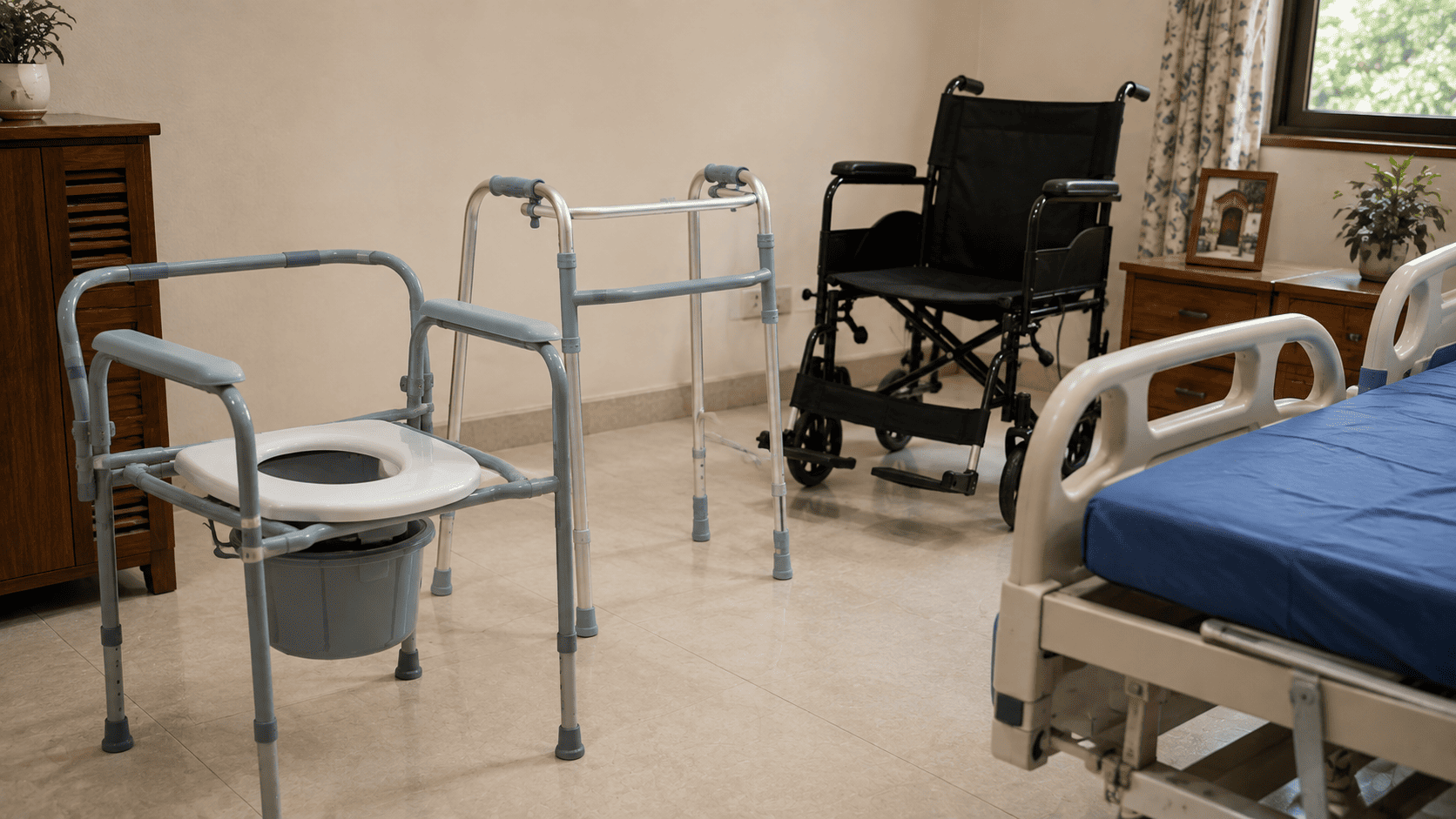
Less than families expect in the early stage, and more than they expect in the late one. Early dementia needs safety modifications rather than medical equipment. The middle stage is dominated by bathroom and mobility support. The advanced stage brings a hospital bed, a pressure-relieving mattress and full assistance with transfers, feeding and continence.
| Stage | Usually needed | Why |
|---|---|---|
| Early — independent with prompting | Grab bars, non-slip mats, night lights, pill organiser, BP monitor, large-face clock with the date | The risks are falls, medication errors and disorientation, not immobility. |
| Middle — needs help with bathing and dressing | Shower chair, raised toilet seat, commode chair, walker, bed rail, waterproof mattress protector | Bathroom transfers become the highest-risk activity of the day. |
| Reduced mobility, frequent falls | Wheelchair, adjustable hospital bed, transfer belt, pulse oximeter, non-slip footwear | Safe transfers protect both the person and the caregiver's back. |
| Advanced — largely bed-bound | Hospital bed with rails and backrest, alpha or air mattress, positioning pillows, patient lift, suction machine if secretions build | Pressure injury and chest infection become the two main threats to life. |
| Feeding or swallowing affected | Bed with backrest elevation, feeding support as prescribed, suction machine, pulse oximeter | Aspiration pneumonia is a leading cause of hospital admission in advanced dementia. |
| Continence affected | Commode chair, waterproof protector, absorbent products, skin care supplies | Skin protection and dignity are managed together, and both depend on routine. |
Healthy Jeena Sikho supplies the mobility and bedside items on this list across Delhi NCR and Tricity — see hospital beds on rent, the full medical equipment on rent range, and the walker range. Once a person is spending most of the day in bed, read pressure sore prevention at home and how to move and transfer a patient safely.
How do you manage eating, hydration and continence?
With routine rather than persuasion. People with dementia frequently stop eating and drinking not from lack of appetite but because they no longer recognise food, cannot manage cutlery, are distracted, or find the plate visually confusing. Dehydration and constipation are among the most common avoidable causes of sudden deterioration in older adults.
Eating
- Use a plain plate in a contrasting colour. Food on a patterned plate can be genuinely hard to see.
- Serve one item at a time rather than a full thali, which can overwhelm.
- Offer finger foods — paratha pieces, idli, cut fruit, boiled egg — when cutlery becomes difficult.
- Eat together. Copying others is a preserved ability long after instructions stop working.
- Keep mealtimes at the same hour and place, with the television off.
- Watch for swallowing difficulty — coughing at meals, a wet voice, food held in the mouth — and ask for an assessment rather than switching to liquids on your own.
Hydration and continence
- Offer fluids on a schedule, not on request. Thirst perception fades with age.
- Do not reduce daytime fluids to prevent accidents — that causes infection and confusion.
- Take the person to the toilet at fixed intervals — roughly every two to three hours — rather than waiting to be asked.
- Make the toilet obvious: door open, light on, a picture sign, an unobstructed path.
- Treat constipation actively with the doctor's guidance; it is a frequent, under-recognised cause of agitation and delirium.
- Check skin daily in anyone with incontinence or reduced mobility, and act on redness that does not fade.
When does a family need a trained attendant or home nurse?
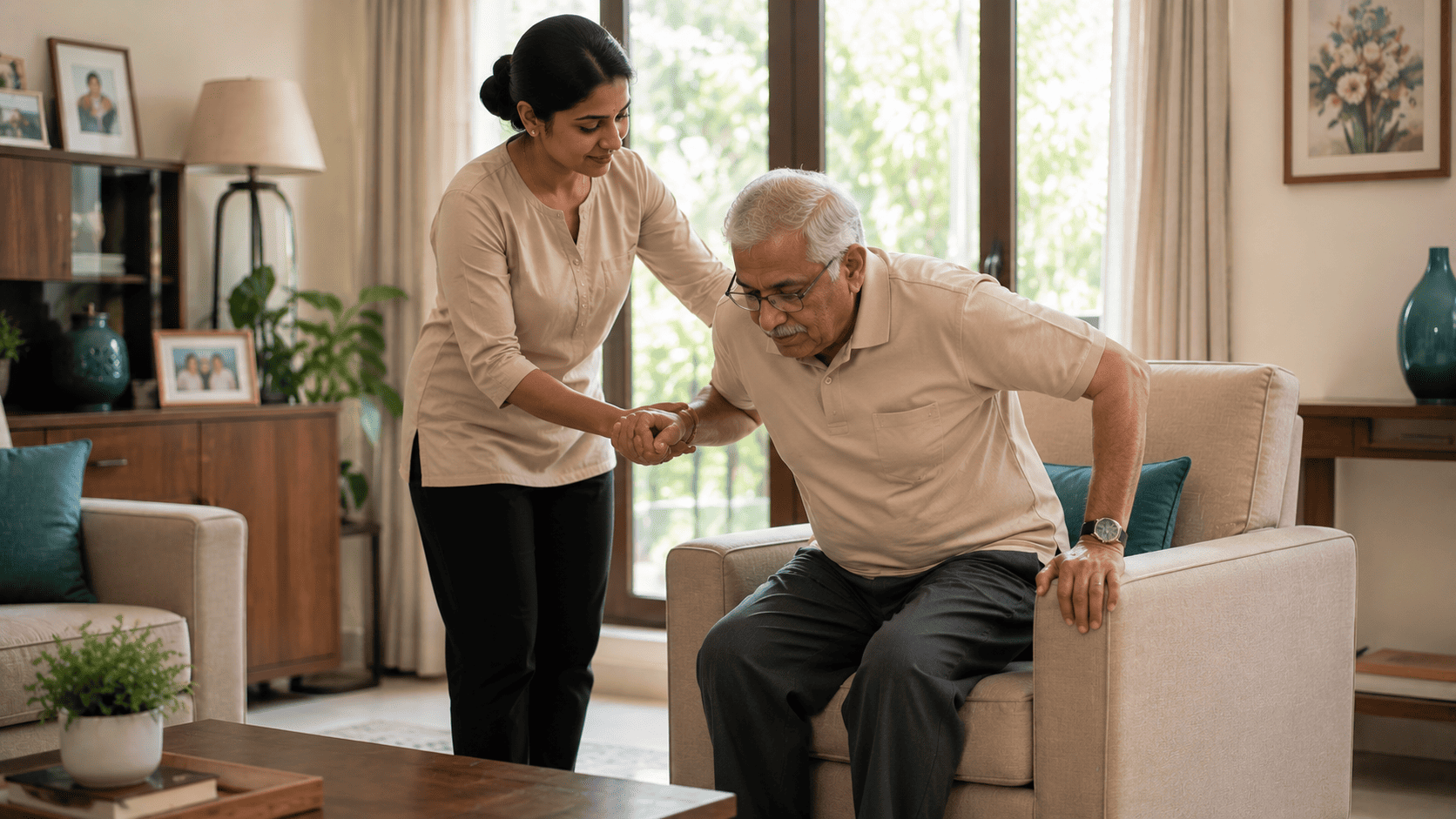
Earlier than most families ask. The usual triggers are night-time wandering that no one can safely cover, transfers that need two people, incontinence care, feeding assistance, wound or catheter care, or a primary caregiver who is ill, employed full time or no longer sleeping. Bringing in help is not a failure of duty — it is what keeps care sustainable and keeps the older person at home rather than in hospital.
Honest signals that the household needs support
- The main caregiver has not slept through the night for weeks.
- Transfers are being done alone that clearly need two people.
- Someone has stopped their job, treatment or medication to manage the caregiving.
- The caregiver is frequently angry, tearful or numb — all recognised features of caregiver strain, not character flaws.
- No one else in the family knows the medicines, the routine or the doctor's name.
- Wound care, catheter care or feeding-tube care is being improvised without training.
Healthy Jeena Sikho provides trained patient attendants and home nursing alongside equipment across Delhi NCR and Tricity, on shift or full-time arrangements. Where mobility and strength are the issue rather than supervision, home physiotherapy and our panel of rehabilitation and pain-management doctors can help maintain walking and independence for longer.
How common is dementia in India, and why is home care the default?
Because there is very little else. India has few dementia-specific residential facilities, limited geriatric services outside major cities, and a strong cultural expectation that ageing parents are cared for at home. Almost the entire burden therefore falls on families — usually on one woman in the household — with little training and no formal relief.
The Longitudinal Aging Study in India, the first nationally representative study of its kind, estimated dementia prevalence at 7.4% among adults aged 60 and over — about 8.8 million people — and found it more common among women than men, and in rural areas than urban ones. The same analysis projects a rise to 16.9 million by 2036 as the population ages.[1] The share of Indians aged 60 and above is projected to roughly double between 2020 and 2050.[2]
Globally, the World Health Organization reports more than 55 million people living with dementia, with around 60% of them in low- and middle-income countries.[3] The 2024 Lancet Commission on dementia identified 14 modifiable risk factors — including hearing loss, untreated vision loss, high blood pressure, high LDL cholesterol, diabetes, smoking, physical inactivity, social isolation, depression and air pollution — estimated to account for around 45% of dementia cases worldwide.[4]
What this means for families in Punjab and Delhi NCR
- Diagnosis is often very late. Early symptoms are widely attributed to age, temperament or stubbornness, so families frequently present only in the middle stage.
- Hearing and vision are the cheapest interventions available. Correcting them improves communication, reduces isolation and reduces confusion — and both now sit on the Lancet Commission's risk list.
- Blood pressure, diabetes and cholesterol are worth treating properly even after diagnosis, because they affect the course and the person's day-to-day function.
- Winter and summer both matter. Cold months bring immobility, chest infections and more time in bed; peak summer brings dehydration, which is a leading trigger of delirium in older adults.
When should you call the doctor urgently?
Seek medical assessment the same day if you see any of these
- Confusion that is clearly worse than usual and came on within hours or days — the single most important sign on this page. Assume delirium and look for an infection.
- Fever, burning or foul-smelling urine, a new cough, or reduced urine output.
- Sudden drowsiness, or difficulty waking the person.
- A fall with a head injury, or any fall in someone on blood thinners — even if they seem fine afterwards.
- New weakness on one side, facial droop or slurred speech — treat as a possible stroke and call an ambulance.
- Choking or coughing at meals, or a new rattling chest after a period of poor feeding.
- Refusing all food and fluids for more than a day, or signs of dehydration.
- Broken, blistered or discoloured skin over the tailbone, heels or hips.
- New or escalating aggression, or distress that the usual approaches no longer settle — this often has a treatable physical cause.
Should you rent or buy elderly care equipment?
Dementia care differs from a recovery: the requirement grows steadily over years and rarely reverses. Items used daily from the moment they are needed are usually worth buying. Items belonging to a later stage — a hospital bed, a pressure mattress, a patient lift — are better rented, partly because the right specification only becomes clear in use, and partly because families often do not know how long that stage will last.
| Item | Usually better to | Reasoning |
|---|---|---|
| Grab bars, shower chair, raised toilet seat, night lights | Buy | Low cost, used every day for years, no benefit to returning them. |
| Walker or walking stick | Buy if used daily | Becomes personal equipment, fitted to the individual's height and gait. |
| Commode chair | Either | Buy if continence is already affected; rent if it is for a temporary phase. |
| Wheelchair | Rent first | Often needed only for outings at first, and the required type changes as posture and head control change. |
| Hospital bed | Rent | The specification that suits the patient and the room usually becomes clear only after a few weeks of use. |
| Air / alpha mattress, patient lift, suction machine | Rent | Advanced-stage equipment; servicing and replacement are covered during the rental period. |
Related home care guides
Pressure Sore Prevention
Turning schedules, the 30-degree tilt and daily skin checks.
Moving and Transferring Safely
Bed to wheelchair transfers, and the handling mistakes that injure carers.
Bedridden Patient Care
Daily hygiene, positioning and routines when mobility is largely lost.
Setting Up a Patient Room
Measurements, socket planning and access before equipment arrives.
Stroke Recovery at Home
Overlapping ground on positioning, transfers and rebuilding mobility.
Medical Equipment on Rent
The full rental range, from beds and mattresses to wheelchairs and commodes.
How Healthy Jeena Sikho supports elderly and dementia care at home
- Equipment and people in one arrangement. Hospital beds, mattresses and mobility aids alongside trained patient attendants and home nursing — rather than sourcing each separately.
- Rental that scales with the stage. Move from a commode and walker to a hospital bed and air mattress without a fresh purchase at each step.
- The full home care list in one place. Hospital beds, air and alpha mattresses, wheelchairs, walkers, commode and shower chairs, suction machines and nebulisers.
- Home physiotherapy to preserve mobility. Keeping an older person walking safely for longer is one of the highest returns available in elderly care.
- Delivery across Delhi NCR and Tricity. Service availability includes Delhi, Gurugram, Noida, Faridabad, Ghaziabad, Chandigarh, Mohali and Panchkula.
- Home installation and demonstration. Our team sets up the bed and mattress and demonstrates safe operation, transfers and basic maintenance.
Frequently Asked Questions About Dementia & Elderly Care at Home
Is memory loss always dementia?
No. Normal ageing slows recall without disrupting daily life. Several treatable conditions also mimic dementia, including vitamin B12 deficiency, thyroid disorder, depression, sleep apnoea, untreated hearing loss and the side effects of certain medicines. A proper medical assessment should rule these out before memory loss is accepted as permanent.
Why has my parent suddenly become far more confused?
A change over hours or days is usually delirium rather than dementia progressing. The common causes in older adults are urinary infection, chest infection, dehydration, constipation, uncontrolled pain and newly started medicines. It needs same-day medical assessment and is frequently reversible once the cause is treated.
Should you correct someone with dementia when they say something untrue?
No. Correcting a false belief causes distress without restoring the memory, and it commonly escalates into an argument. Respond to the emotion behind the statement, then redirect to another activity or subject. Keeping the person calm and safe matters more than establishing the facts.
What is sundowning and how do you manage it?
Sundowning is increased confusion, restlessness or agitation in the late afternoon and evening, common in dementia. It is reduced by switching lights on before dusk, keeping mornings active and evenings quiet, scheduling bathing and outings earlier in the day, avoiding late afternoon naps and caffeine, and keeping the same familiar people present in the evening.
How do you stop a person with dementia from wandering?
Address the reason as well as the exit. Wandering often reflects boredom, needing the toilet, pain or searching for someone. Practically: place door latches outside the usual line of sight, use a door chime or sensor, keep identification with a contact number in worn clothing, keep a recent photograph on your phone, and inform neighbours and the local guard.
Why does someone with dementia refuse to bathe?
Usually fear rather than stubbornness — being undressed and having water poured over you is frightening when the reason is not understood. Bathing earlier in the day, keeping the room warm, explaining each step before doing it, allowing the person to hold a towel, and accepting a shorter or partial wash on difficult days all help more than insistence.
Does an elderly person with dementia need a hospital bed at home?
Not in the early or middle stages. A hospital bed becomes useful when the person cannot get in and out of bed safely, cannot reposition themselves, or needs assistance with feeding and continence in bed. Backrest elevation, height adjustment and side rails are what make one-caregiver care manageable, and a pressure-relieving mattress is added when independent movement in bed is lost.
How often should a bedridden elderly person be repositioned?
A common recommendation is a position change roughly every two hours, day and night, adjusted to the person's skin condition and the treating team's advice. An air or alpha mattress reduces risk but does not remove the need for repositioning and daily skin inspection over the tailbone, heels, hips and elbows. The full routine is in pressure sore prevention at home.
When should a family hire a home attendant or nurse?
Common triggers are night-time wandering that no one can safely cover, transfers that require two people, incontinence or feeding assistance, wound or catheter care, and a primary caregiver who is unwell, employed full time or no longer sleeping. Arranging help earlier generally keeps the older person at home for longer and reduces hospital admissions.
How quickly can elderly care equipment be delivered?
Delivery time depends on location, stock and service availability. Across Delhi NCR and Tricity, same-day delivery may be available in selected locations. For a planned hospital discharge, sharing the date a day in advance allows the bed and mattress to be installed before the person reaches home. Call +91 98769 78488 or message +91 98759 15278 on WhatsApp.
References and further reading
- Lee J, Meijer E, Langa KM, et al. Prevalence of dementia in India: national and state estimates from a nationwide study . Alzheimer's & Dementia 2023;19(7):2898–2912.
- Lee J, Banerjee J, Khobragade PY, et al. Design and methodology of the harmonized diagnostic assessment of dementia for the Longitudinal Aging Study in India (LASI-DAD): Wave 2 . Journal of the American Geriatrics Society 2024.
- World Health Organization. Dementia fact sheet .
- Livingston G, Huntley J, Liu KY, et al. Dementia prevention, intervention, and care: 2024 report of the Lancet standing Commission . Lancet 2024;404(10452):572–628.
- India State-Level Disease Burden Initiative Neurological Disorders Collaborators. The burden of neurological disorders across the states of India: the Global Burden of Disease Study 1990–2019 . Lancet Global Health 2021;9(8):e1129–e1144.
- National Institute for Health and Care Excellence (NICE). Dementia: assessment, management and support for people living with dementia and their carers, NICE guideline NG97 .
Medical disclaimer. This page is general educational information about home care for older adults and people living with dementia. It is not medical advice and does not replace assessment by a qualified physician, geriatrician, psychiatrist or physiotherapist. Diagnosis, medication, behaviour management and decisions about feeding, continence and mobility must be guided by the treating clinical team, and medicines must never be started, changed or stopped at home. Healthy Jeena Sikho supplies, installs and services home medical equipment and arranges nursing, attendant and therapy services; we do not diagnose conditions or independently set clinical parameters. If confusion worsens suddenly, or an infection or injury is suspected, seek medical assessment the same day.