
Diastasis Recti: Why the Gap Is Not the Whole Story

The short version
- It is not muscles tearing. It is connective tissue stretching. The linea alba — the fibrous band down the midline — thins and widens, so the two halves of the six-pack muscle sit further apart.2
- Recovery runs over the first year, not the first two months. In a study following first-time mothers, separation was present in 60% at 6 weeks, 45% at 6 months and 33% at 12 months after birth.3 Still having a gap at eight weeks is normal, not a failure.
- The width of the gap is not the outcome that matters. What matters is whether the midline can generate tension — whether the abdominal wall actually works when you use it.
- Doming is the sign to watch. A ridge or peak down the midline when you sit up, lift or strain means the load is going through the weak point.1
- Crunches, planks and sit-ups usually make it worse early on. So do breath-holding while lifting, chronic straining and constipation.1
- A binder is comfort, not treatment. It holds the abdomen in. It does not restore the function of the abdominal wall.
Most women meet this problem as a cosmetic one: the tummy still looks pregnant months after the baby arrived, so they start doing crunches and buy a belt. Both usually make it worse. Diastasis recti is a function problem, not a shape problem, and the treatment looks nothing like the abdominal exercises people expect. This page explains what is actually happening, how to tell whether yours needs attention, and what genuinely helps.
What is diastasis recti?
Diastasis rectus abdominis — also called abdominal muscle separation or divarication of recti — is the thinning and widening of the connective tissue in the midline of the abdominal wall, which allows the two halves of the rectus abdominis muscle to separate. It is associated with laxity of the abdominal wall as a whole.2
The muscles themselves are not torn or damaged. The band they attach to — the linea alba — has stretched. During pregnancy this is a normal and necessary adaptation: the abdominal wall has to accommodate a growing uterus, and the hormones progesterone and relaxin make the connective tissue more elastic to allow it.1
The linea alba
The fibrous band running from the breastbone to the pubic bone, where the abdominal muscle layers all attach.
What stretches
That band thins and widens under months of pressure from inside, letting the two muscle halves drift apart.
Why it matters
The abdominal wall works as a single unit. A slack midline means load transfers poorly between the two sides.
What you see
A gap you can feel, a midline ridge or dome on effort, and a tummy that still looks pregnant.
Why the gap width is the wrong thing to measure

Because two women with an identical gap can have completely different problems. One has a firm midline that resists pressure and no symptoms at all. The other has a soft midline that sinks and domes with every effort, a back that aches by evening and a core that feels absent. The number is the same. The function is not.
This is the single most useful idea on this page, and it changes what success looks like. The aim is not to close a gap to a particular width. The aim is a midline that can transmit force — so that when you lift, cough, laugh or stand up, the abdominal wall behaves as one connected sheet rather than two halves with a slack strip between them.
| What people focus on | What it actually tells you | What matters more |
|---|---|---|
| How many fingers fit in the gap | Roughly how wide the separation is, measured inconsistently by hand | Whether the midline springs back or your fingers sink in |
| Whether the gap has "closed" | Little on its own; some narrowing happens naturally and some does not | Whether you can load your abdomen without doming |
| How the tummy looks | Partly the abdominal wall, partly skin, fat and posture | Whether it functions during real tasks — lifting the baby, standing up, coughing |
| Comparing with another mother | Nothing useful; the range of normal is wide and varies with number of pregnancies | Your own symptoms and your own progress over weeks |
How to check yourself at home
A simple self-check gives you a rough idea and tells you whether to seek an assessment. It is not a diagnosis — hand measurement is unreliable, and what a physiotherapist adds is judging the quality of the tissue and how your abdomen behaves under load.
- Lie on your back with knees bent and feet flat on the floor or bed.
- Place your fingertips just above the navel, pointing down towards your feet, pressing gently into the midline.
- Lift your head and shoulders slightly, as if starting to look at your knees. Do not do a full sit-up.
- Feel for the edges of the muscle on either side of your fingers, and note roughly how many fingers fit between them.
- Now notice the depth. Does the tissue under your fingers feel firm and springy, or do your fingers sink in easily? This tells you more than the width does.
- Repeat above and below the navel, since the separation is often widest at or just above it.
- Watch for doming — a ridge or peak rising along the midline as you lift your head. That is the important sign.
What doming means
A visible ridge along the midline when you increase pressure inside the abdomen — sitting up from lying, doing a sit-up, lifting or straining — means the load is being pushed through the weakest point rather than managed by the abdominal wall.1 If you see doming during an exercise, that exercise is currently too much for your abdomen, whatever the internet says about it.
Symptoms beyond the appearance
Diastasis recti affects abdominal wall strength and function, and can create the appearance often described as a "mummy tummy", which affects many women's confidence in their post-pregnancy body.1 But the functional symptoms are what usually bring women to physiotherapy.
| Symptom | What it feels like |
|---|---|
| Doming or coning | A ridge or peak down the midline when sitting up, lifting or straining |
| A tummy that still looks pregnant | Persistent rounding months after delivery that does not change with weight |
| Feeling weak through the middle | A sense that there is nothing supporting you when you lift or get up |
| Low back pain | Aching by the end of the day, especially after carrying the baby |
| Pelvic girdle pain | Discomfort at the pubic bone or back of the pelvis on walking or stairs |
| Poor posture | Ribs flared, pelvis tipped forward, difficulty standing tall without effort |
| Pelvic floor symptoms | Leaking or heaviness, which some women experience alongside abdominal separation |
| Bloating and digestive discomfort | Reported by some women, particularly by the end of the day |
On back pain: the evidence is mixed
Back pain and abdominal separation often turn up in the same women, but whether one causes the other is not settled. One longitudinal study found no difference in lumbopelvic pain between women with and without separation at 12 months after birth,3 while a more recent cohort found worse back pain in women with persistent separation at the same point.4 The practical position is unchanged: if you have back pain and a soft midline, both are worth assessing, but do not assume closing a gap will fix your back.
Because the abdominal wall and pelvic floor work together, leaking and heaviness are usually assessed alongside the separation rather than separately — see pelvic floor physiotherapy and urinary leakage after delivery.
What makes it persist
Some separation is universal in late pregnancy and much of it settles over the first year. The risk factors commonly named for it continuing to be a problem are pregnancy especially with twins, chronic straining from cough, vomiting or constipation, a family history, poor lifting technique such as holding the breath while lifting heavy items, and excessive abdominal loading through exercise.1
| Factor | Why it matters | What to do |
|---|---|---|
| Twins or a large baby | Greater stretch on the linea alba over a longer period | Expect a longer recovery and start rehabilitation properly rather than informally |
| Chronic constipation and straining | Repeated outward pressure on the weakest point, several times a week | Treat constipation actively — fluids, fibre, movement, correct toilet posture |
| Persistent cough | Sharp repeated rises in abdominal pressure | Get the cough treated; support the abdomen while coughing meanwhile |
| Breath-holding while lifting | Pushes pressure downward and outward rather than managing it | Breathe out on effort — every lift, every time you stand up |
| Excessive abdominal loading in exercise | Crunches, planks and heavy core work before the wall can handle them | Progress from breathing and deep core work; add load only when doming stops |
| Closely spaced pregnancies | Little time for the abdominal wall to recover between loads | Strengthen deliberately between pregnancies where possible |
| Family history | Connective tissue quality varies between individuals | Not preventable, but worth knowing so you start rehabilitation early |
| Sitting straight up from lying | Loads the midline directly, dozens of times a day in early postnatal life | Roll to your side and push up instead |
Seeing doming, or still rounded months later?
An assessment tells you whether the midline is generating tension and what loading is safe for you now. Healthy Jeena Sikho arranges postnatal physiotherapy across Chandigarh, Mohali, Panchkula and Kharar, at home or at our Mohali centre, with a female physiotherapist available on request.
What to stop doing
| Common approach | Verdict | Why |
|---|---|---|
| Crunches and sit-ups | Stop, for now | They load the midline directly and typically produce visible doming, which is the load going through the weak point |
| Planks | Stop, for now | High abdominal pressure before the deep system is working. They come back later, once you can hold the midline flat |
| Sitting straight up from lying | Stop | The same movement as a sit-up, done unconsciously many times a day. Roll to your side instead |
| Holding your breath to lift | Stop | Traps pressure inside the abdomen and pushes it outward through the midline |
| Straining on the toilet | Stop | One of the most repeated pressure loads in daily life, and entirely avoidable |
| Heavy lifting too early | Delay | Particularly after a caesarean, where the abdominal sheath was cut |
| Deep backbends and intense twists | Modify | Positions that stretch the abdominal wall hard can increase doming. A physiotherapist can adapt your practice |
| Wearing a binder as the treatment | Reconsider | Support and comfort are fine short-term. Relying on it for months instead of rehabilitation changes nothing underneath |
None of these are banned forever
Planks, loaded core work and even sit-ups are reasonable goals for many women later on. The point is sequence. They are what you build towards once the abdominal wall can manage pressure, not what you start with while it cannot. The test is simple: if a movement makes the midline dome, it is too much right now.
What actually helps
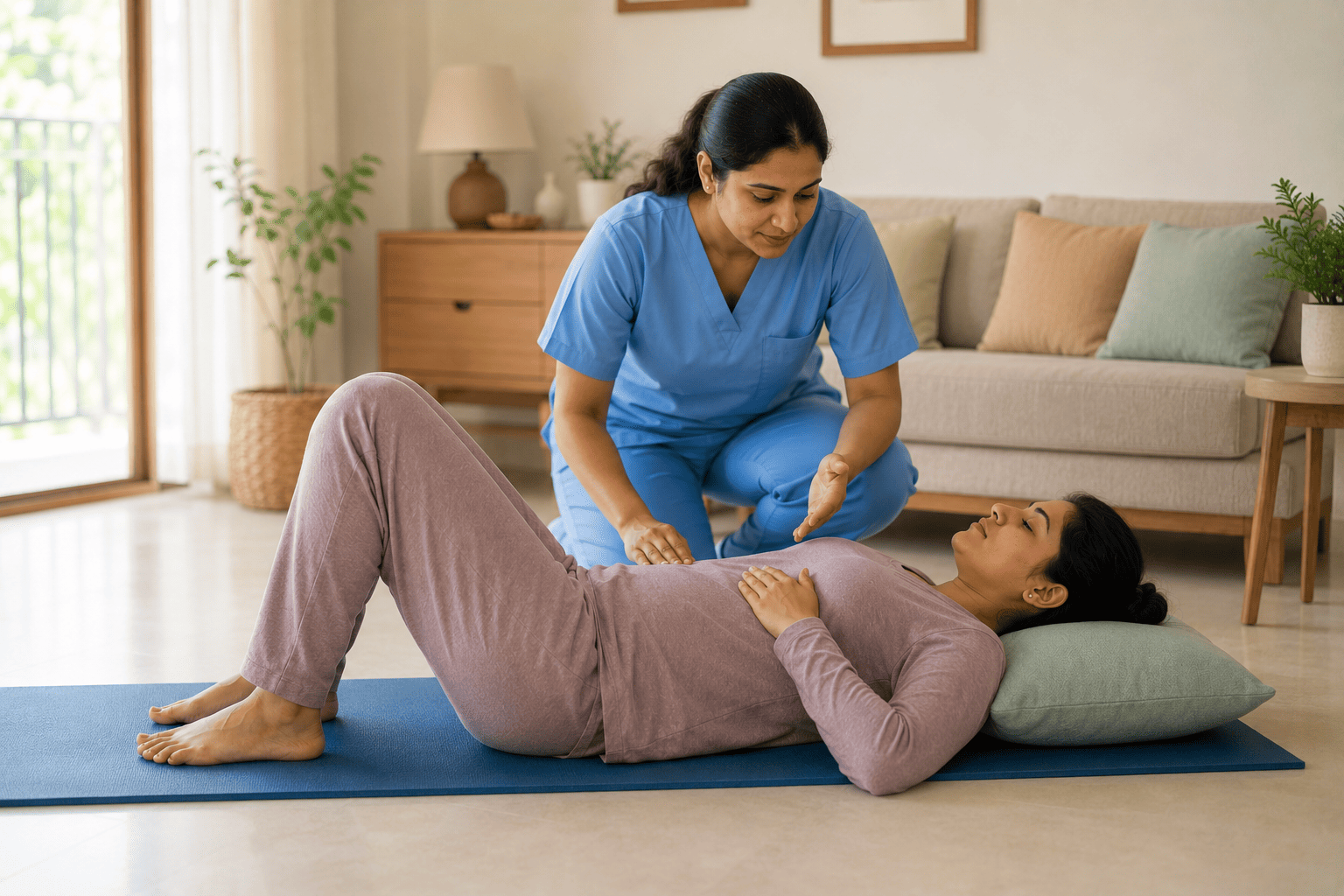
Rehabilitation runs in a particular order: breathing and pressure management first, then deep core activation, then graded loading, with the pelvic floor trained alongside throughout. Skipping to the loading stage is what produces months of effort with no change.
| Stage | What it involves | Why it comes here |
|---|---|---|
| 1. Breathing and pressure | Coordinating the diaphragm with the deep abdominals and pelvic floor; learning to exhale on effort | Without this, every later exercise pushes pressure outward through the midline |
| 2. Deep core activation | Waking up the deep abdominal layer that wraps the trunk, rather than the six-pack | This layer creates the tension across the midline that the linea alba needs |
| 3. Daily movement retraining | How you get out of bed, lift the baby, stand up, carry, cough | These happen dozens of times a day and outweigh any exercise session |
| 4. Graded loading | Progressively harder work, advancing only while the midline stays flat | Tissue adapts to load. It just has to be the right amount at the right time |
| 5. Return to full activity | Gym work, running and higher-impact activity, reintroduced in stages | Once the abdominal wall and pelvic floor can manage the pressure |
An honest note on the evidence: reviewers have concluded that the scientific evidence for any specific exercise programme in postpartum diastasis is currently of very low quality.5 What is well established is the mechanism — that pressure has to be managed rather than forced through the midline — and that is what the sequence above is built on. It is a reason to be assessed and progressed individually rather than to follow a routine off the internet.
This page deliberately does not give you a numbered exercise routine. Not because the exercises are secret, but because the right starting point depends on what your abdomen is doing now — and a programme that suits a woman at eight weeks with mild doming is wrong for a woman at eight months with a soft midline and back pain. That is what an assessment establishes.
How long does it take?
Longer than most women are told. In a study following first-time mothers from pregnancy to a year after birth, separation was present in 60% at 6 weeks, 45% at 6 months and 33% at 12 months after delivery.3 In other words, natural recovery continues right across the first year, and a gap at two or three months is the norm rather than a warning sign.
| Time | What is typical | What to do |
|---|---|---|
| Late pregnancy | Some degree of separation in virtually all women — a normal adaptation | Avoid straining, learn to roll to your side, breathe out on effort |
| 6 weeks | Still present in roughly 60% of first-time mothers3 | Gentle breathing and deep core work; no crunches or planks |
| 3 to 6 months | Around 45% at six months; natural narrowing is still happening | Get assessed if there is doming, a soft midline or symptoms — and start structured work |
| 12 months | Around one third of women still have measurable separation | If it is still there with symptoms, this is the group rehabilitation is for |
| Beyond a year | Change is slower, but strength and function continue to improve with work | Keep going; focus on what you can do rather than the gap width |
| Years later | Rehabilitation still works, though progress may be slower | Worth starting, particularly before another pregnancy |
Indicative only. Individual recovery varies considerably, and the prevalence figures above come from one cohort of first-time mothers.
It is not only a postnatal condition
Diastasis recti can affect men and women of any age. It is most often seen after pregnancy, but it also occurs in infants, in people with abdominal obesity, and in those whose work involves heavy lifting.6
- Men in physically demanding jobs — repeated heavy lifting with breath-holding loads the midline in exactly the same way.
- People with significant abdominal obesity, where sustained internal pressure stretches the linea alba over years.
- Anyone with a chronic cough, including long-standing smokers and people with chronic respiratory conditions.
- People with long-standing constipation and habitual straining.
- Gym-goers who progressed too fast on heavy loaded core work with poor pressure management.
The rehabilitation principles are the same: manage pressure, retrain the deep system, correct the daily habits, then load progressively.
Hernia, and when surgery is considered
Diastasis recti is a stretched midline, not a hole. A hernia is a defect through which tissue can push out, and the two can occur together. That distinction matters, because a hernia needs a surgical opinion while a diastasis usually does not.
See a doctor promptly if you notice
- A distinct lump or bulge, particularly at or near the navel, that appears on standing or straining.
- A bulge that becomes painful, tender, firm or discoloured, or that will not push back in — seek urgent care.
- Bulging with vomiting, severe abdominal pain, or inability to pass wind or stool — seek emergency care.
- Increasing abdominal pain rather than the usual postnatal soreness that eases.
- A caesarean scar that is opening, red, discharging or increasingly painful.
Surgical repair
Surgery for diastasis recti — usually abdominoplasty with repair of the midline — is generally considered only where a proper trial of conservative rehabilitation has not resolved symptoms, and where the woman has completed her family, since a further pregnancy can undo the repair. It is a decision for a surgeon after assessment, and it is not the first step. Most women improve substantially without it.
Myths worth dropping
| Commonly believed | Verdict | What is actually the case |
|---|---|---|
| "The muscles have torn" | Myth | The muscles are intact. The connective tissue between them has thinned and widened. |
| "Do more crunches to close the gap" | Harmful | Crunches load the midline directly and usually produce doming, which is the problem rather than the fix. |
| "A binder will close it" | Myth | It provides support and comfort. It does not restore tension or function in the abdominal wall. |
| "If it has not gone by two months, something is wrong" | Myth | Around 60% of first-time mothers still have separation at six weeks. Recovery continues across the first year.3 |
| "It only happens to women who gained a lot of weight" | Myth | It occurs across body types, and is influenced by pregnancy factors, connective tissue and habits rather than weight alone. |
| "Only surgery can fix it" | Myth | Most women improve substantially with structured rehabilitation. Surgery is considered only after a proper conservative trial. |
| "A caesarean protects you from it" | Myth | The stretch happens during pregnancy, not delivery. A caesarean adds a cut abdominal sheath on top of it. |
| "It is purely cosmetic" | Myth | It affects abdominal wall strength and function, and often occurs alongside back pain and pelvic floor symptoms. |
Diastasis recti rehabilitation with Healthy Jeena Sikho
- Assessment first, always. Not just the width of the gap — how the midline behaves under load, whether there is doming, and how the pelvic floor is functioning alongside.
- The right stage, not a generic routine. Breathing and pressure management, deep core activation, movement retraining, then graded loading — progressed only when the midline holds.
- Daily habits, not just exercises. Getting out of bed, lifting the baby, standing up and carrying — the things that happen dozens of times a day and matter more than any single session.
- Pelvic floor treated together. The abdominal wall and pelvic floor work as one system, and treating one without the other limits results.
- Female physiotherapist on request. Arranged without needing an explanation, subject to availability. Bring the baby — sessions are designed around that.
- Across Chandigarh, Mohali, Panchkula and Kharar, with a physiotherapy centre in Sector 71, Mohali, and home physiotherapy for those who prefer sessions at home.
- Trusted since 2015. ISO 9001:2015 certified home healthcare, operating across North India.
Related guides: postpartum physiotherapy, C-section recovery, pelvic floor physiotherapy, urinary leakage after delivery and the recovering at home hub. Recovery equipment is on the hospital bed on rent and mobility aids pages.
Postnatal physiotherapy across Chandigarh, Mohali, Panchkula and Kharar. Call +91 98769 78488 or WhatsApp +91 98759 15278. Female physiotherapist available on request, subject to availability.
Frequently Asked Questions About Diastasis Recti
What is diastasis recti?
It is the thinning and widening of the connective tissue in the midline of the abdominal wall — the linea alba — which allows the two halves of the rectus abdominis muscle to separate, and is associated with laxity of the abdominal wall. The muscles themselves are not torn; the band they attach to has stretched.
How common is diastasis recti after pregnancy?
Some degree of separation occurs in virtually all women towards the end of pregnancy, and it is a normal adaptation. In a study following first-time mothers, separation was present in about 60% at six weeks after birth, 45% at six months and 33% at twelve months — so recovery continues across the whole first year, and around one third of women still have measurable separation at a year.
Does the size of the gap matter?
Less than most people assume. Two women with the same measured gap can have completely different function: one with a firm midline and no symptoms, another with a soft midline that domes with every effort. What matters is whether the midline can generate tension and transmit force, not the number of fingers that fit in it.
How do I check for diastasis recti at home?
Lie on your back with knees bent, place your fingertips in the midline just above the navel, and lift your head and shoulders slightly. Feel for the muscle edges either side, note roughly how many fingers fit, and importantly notice whether the tissue feels firm and springy or whether your fingers sink in. Also watch for a ridge or dome rising along the midline. This is a rough guide, not a diagnosis.
What is doming and why does it matter?
Doming or coning is a visible ridge or peak along the midline when pressure inside the abdomen increases — sitting up from lying, doing a sit-up, lifting or straining. It means the load is being pushed through the weakest point rather than managed by the abdominal wall. If an exercise produces doming, it is currently too much for your abdomen.
Should I do crunches or planks for diastasis recti?
Not in the early stages. Crunches, sit-ups and planks load the midline directly and typically produce doming, and excessive abdominal loading through exercise is commonly named as a risk factor for the separation persisting. They can become appropriate later, once the abdominal wall can manage pressure without doming — it is a question of sequence rather than a permanent ban.
Do belly binders help close diastasis recti?
They provide support and comfort, particularly in the early days after a caesarean, and short-term use is not harmful. But a binder holds the abdomen in rather than restoring tension or function in the abdominal wall. Used for months in place of rehabilitation, it leaves the underlying problem unchanged.
What makes diastasis recti worse?
Risk factors commonly named for ongoing problems include pregnancy especially with twins, chronic straining from cough, vomiting or constipation, a family history, poor lifting technique such as holding the breath while lifting heavy items, and excessive abdominal loading through exercise. Sitting straight up from lying, done unconsciously many times a day, adds to it.
Can diastasis recti cause back pain?
The evidence is mixed. One longitudinal study found no difference in lumbopelvic pain between women with and without separation at twelve months after birth, while a more recent cohort found worse back pain in women with persistent separation. The two often occur together, so both are worth assessing — but closing a gap should not be assumed to fix a back.
How long does diastasis recti take to recover?
Natural recovery continues across the first year rather than finishing at two months: separation was present in about 60% of first-time mothers at six weeks, 45% at six months and 33% at twelve months in one cohort. Where it persists with symptoms, structured rehabilitation is the approach, though reviewers note the evidence for any specific exercise programme is currently of very low quality — which is why assessment and individual progression matter more than following a routine.
Does diastasis recti need surgery?
Usually not. Most women improve substantially with structured rehabilitation. Surgical repair is generally considered only where a proper trial of conservative treatment has not resolved symptoms and the woman has completed her family, since a further pregnancy can undo the repair. A distinct lump or bulge, particularly near the navel, may indicate a hernia and needs a surgical opinion rather than exercises.
Can men get diastasis recti?
Yes. It can affect men and women of any age, and also occurs in infants, in people with abdominal obesity, and in those whose work involves heavy lifting. The rehabilitation principles are the same: manage abdominal pressure, retrain the deep system, correct daily habits, then load progressively.
Where does Healthy Jeena Sikho provide diastasis recti rehabilitation?
Postnatal physiotherapy for diastasis recti is available across Chandigarh Tricity — Chandigarh, Mohali, Panchkula and Kharar — either at home or at the Healthy Jeena Sikho physiotherapy centre in Sector 71, Mohali. A female physiotherapist is available on request, subject to availability. Call +91 98769 78488 or WhatsApp +91 98759 15278 to arrange an assessment.
References and further reading
- Royal United Hospitals Bath NHS Foundation Trust. Diastasis Rectus Abdominis: abdominal muscle separation — patient information leaflet, including the role of the linea alba, doming on increased abdominal pressure, and risk factors for ongoing problems.
- East Sussex Healthcare NHS Trust. Pelvic Health Physiotherapy: diastasis of rectus abdominis muscles postpartum — definition as thinning and widening of the midline connective tissue with associated abdominal wall laxity.
- Sperstad JB, Tennfjord MK, Hilde G, Ellström-Engh M, Bø K. Diastasis recti abdominis during pregnancy and 12 months after childbirth: prevalence, risk factors and report of lumbopelvic pain . British Journal of Sports Medicine 2016;50(17):1092–1096 — prevalence of 33.1% at gestation week 21, 60.0% at 6 weeks, 45.4% at 6 months and 32.6% at 12 months postpartum, and no difference in lumbopelvic pain between women with and without separation at 12 months.
- Prevalence of Symptomatic Established Rectus Diastasis of Parity in Primiparous Women: A Prospective Cohort Study From Early Pregnancy to 1-Year Postpartum — 30.3% had rectus diastasis at 12 months and reported worse back pain than those without.
- Primiparous women's knowledge of diastasis recti abdominis, concerns about abdominal appearance, treatments, and perceived abdominal muscle strength 6–8 months postpartum — noting that the evidence for associations with impaired abdominal strength is weak, and that there is currently very low-quality evidence to recommend specific exercise programmes for postpartum diastasis.
- Szymańska A, et al. Immediate Effects of Kinesio Taping on Rectus Abdominis Diastasis in Postpartum Women — Preliminary Report . Journal of Clinical Medicine — background noting that rectus abdominis diastasis can affect both women and men of any age, and occurs in infants, people with abdominal obesity and those whose jobs involve heavy lifting.
- National Institute for Health and Care Excellence. Pelvic floor dysfunction: prevention and non-surgical management , NICE guideline NG210 — including encouraging pelvic floor muscle training during and after pregnancy.
- National Institute for Health and Care Excellence. Postnatal care , NICE guideline NG194.
Medical disclaimer. This page is general educational information about diastasis recti. It is not medical advice and does not replace assessment by a qualified doctor or physiotherapist. The self-check described here is a rough guide only and is not a diagnosis; hand measurement is unreliable and cannot distinguish a diastasis from a hernia. Prevalence figures quoted here come from published cohorts of first-time mothers and will not predict any individual's recovery. No specific exercise programme is prescribed here deliberately, because the appropriate starting point depends on how your abdominal wall behaves under load and on your pelvic floor function, which is what an assessment establishes. Do not begin, change or intensify an abdominal exercise programme without professional guidance, particularly after a caesarean or other abdominal surgery. Seek medical advice promptly for a distinct lump or bulge, especially near the navel, and seek emergency care for a bulge that is painful, tender, firm, discoloured or cannot be pushed back in, or for severe abdominal pain, vomiting, or inability to pass wind or stool. Healthy Jeena Sikho arranges physiotherapy, nursing and attendant services and supplies home medical equipment, and does not diagnose conditions or independently set clinical parameters.