
Multiple Sclerosis Care at Home: Heat, Fatigue, Relapses & Equipment Guide

The short version
- Heat is the single most underrated factor in Indian MS care. Many people with MS temporarily lose function as body temperature rises — a North Indian summer can look exactly like a relapse without being one.
- Learn the difference between a relapse and a pseudo-relapse. A urinary infection, fever or heat can cause old symptoms to flare temporarily. Treating the trigger often restores function within days.
- Fatigue is the most disabling symptom for most people with MS, and it is not ordinary tiredness. It responds to pacing and planning, not to pushing harder.
- MS mostly affects working-age adults, and women about twice as often as men.[1] The home setup has to fit a job, children and a household — not a hospital routine.
- Equipment needs come and go. A wheelchair may be essential during a relapse and unused three months later. That pattern makes MS the strongest rental case of any condition we support.
- Exercise is recommended, not restricted — with cooling built in. The old advice to rest and avoid exertion has been replaced.[5]
Multiple sclerosis is not a condition you set a house up for once. It fluctuates — week to week, and often hour to hour within a single hot afternoon. A person may drive to work in April and need a wheelchair for a fortnight in June, then walk unaided again by August. Care at home therefore means building a system that flexes: for heat, for fatigue, for relapses, and for the long stretches in between when very little help is needed at all.
What does multiple sclerosis actually do day to day?
MS damages the insulating coating around nerves in the brain and spinal cord, so signals travel slowly, weakly or not at all. Which symptoms appear depends on where the damage is. That is why two people with the same diagnosis can have completely different problems — one with vision and balance, another with bladder and leg weakness — and why generic advice so often misses.
| Symptom area | How it shows up at home | What helps |
|---|---|---|
| Fatigue | Overwhelming exhaustion unrelated to effort or sleep; worst in the afternoon and in heat. | Energy planning, rest before exhaustion, cooling, task prioritising. |
| Walking and balance | Legs feel heavy, foot catches on the floor, unsteadiness when tired. | Physiotherapy, foot-drop support if prescribed, a stick or rollator during flare periods. |
| Spasticity and stiffness | Tight, gripping muscles, night cramps, difficulty straightening the legs. | Daily stretching, correct positioning, medical review if it worsens. |
| Bladder and bowel | Urgency, frequency, incomplete emptying, constipation. | Continence assessment, bladder routine, prompt treatment of infections. |
| Vision | Blurring, pain on eye movement, double vision — often the first symptom of all. | Urgent medical review for any new visual change. |
| Numbness, tingling, nerve pain | Bands of tightness around the trunk, burning or pins-and-needles in the limbs. | Medical review; nerve pain responds to different medicines than ordinary pain. |
| Thinking and memory | Word-finding difficulty, slowed processing, losing track mid-task. | Written lists, one task at a time, doing demanding work at the best hour of the day. |
| Mood | Low mood and anxiety, which are common and frequently under-treated. | Raise it explicitly with the neurologist rather than absorbing it as inevitable. |
Several of these are invisible symptoms. A person with MS who looks entirely well may be managing severe fatigue, pain or bladder urgency. That gap between appearance and experience is one of the most common sources of friction inside families, and naming it usually helps.
Why does heat make MS symptoms suddenly worse?
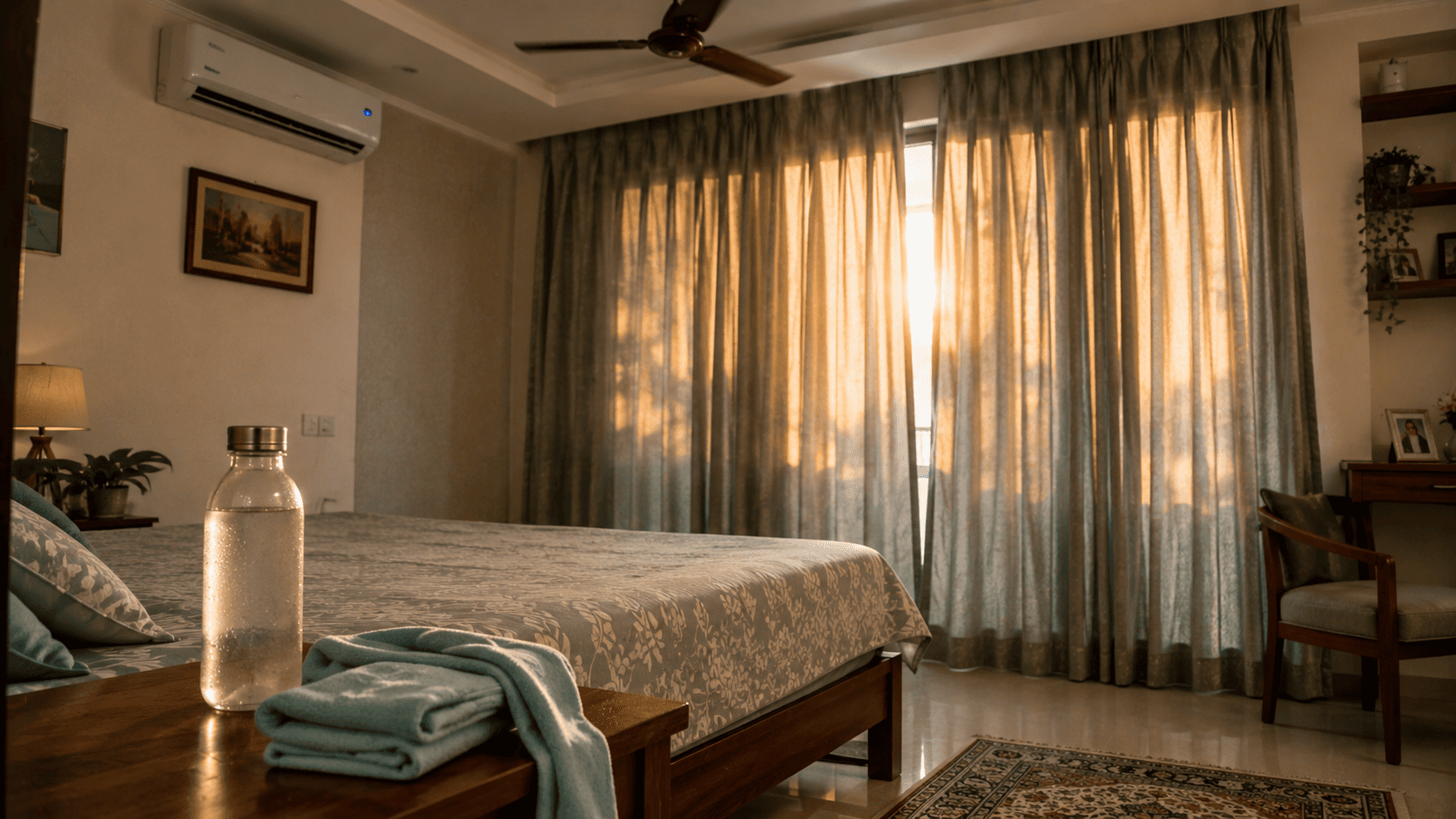
Because damaged nerves conduct signals poorly when body temperature rises even slightly. This is called Uhthoff's phenomenon. A hot afternoon, a fever, a hot bath or hard exercise can temporarily bring back old symptoms — blurred vision, heavy legs, worse fatigue. It is temporary and reversible: cooling down restores function, usually within minutes to hours. It does not mean new nerve damage.
For families in Punjab, Delhi NCR and the rest of North India, this is not a footnote. Peak summer temperatures reliably produce months of reduced function that have nothing to do with disease progression, and that get misread as deterioration by patients, employers and sometimes by families themselves.
A practical heat plan for the Indian summer
Shift the day
Move errands, exercise and physiotherapy to early morning or after sunset. Treat 11am to 5pm in summer as indoor time by default.
Cool the room, not the house
One reliably cooled room the person can retreat to is more useful and cheaper than trying to cool everything.
Cool from outside in
Cold water on wrists, neck and feet, damp towels, and cooling scarves lower core temperature faster than fans alone.
Drink cold fluids
Cold drinks before and during activity blunt the temperature rise. Keep a cold bottle within reach rather than across the room.
Lukewarm baths
Hot baths and long hot showers frequently trigger symptoms. Lukewarm water avoids the flare with no loss of hygiene.
Plan for power cuts
An extended summer outage is a genuine functional risk. Have a backup plan — inverter fan, cooling towels, a nearby cooler location.
Heat worsening is not automatically a relapse — but fever is not automatically heat
If symptoms worsen on a hot day and improve within hours of cooling down, that is heat sensitivity. If there is fever, burning urine, a cough or symptoms that do not improve with cooling, the cause is more likely an infection, and it needs medical assessment. Do not simply wait it out.
How do you tell a relapse from a pseudo-relapse?
A relapse is new or worsening neurological symptoms lasting more than 24 hours in the absence of fever or infection, usually developing over days and persisting. A pseudo-relapse is a temporary return of old symptoms triggered by something else — heat, infection, fever, exhaustion, stress or dehydration — which settles once the trigger is treated. The distinction matters because the treatment is completely different.[5]
| Relapse | Pseudo-relapse | |
|---|---|---|
| Symptoms | Often new, or clearly worse than the usual baseline. | Usually old, familiar symptoms returning. |
| Duration | More than 24 hours, typically days to weeks. | Hours to a few days; resolves as the trigger resolves. |
| Trigger | No identifiable fever or infection. | Heat, fever, urinary or chest infection, exhaustion, stress. |
| Response to cooling or rest | Little or none. | Often marked improvement. |
| What is usually done | Neurology review; treatment decided by the treating team. | Treat the underlying trigger — the neurological symptoms follow. |
The practical rule for families: before assuming the MS has worsened, check for an infection. A urinary tract infection is the commonest hidden trigger, and it can present with almost no urinary symptoms at all in someone with MS — sometimes only as sudden weakness or confusion.
What to record when symptoms change
- What exactly is different, and whether it is new or a familiar symptom returning.
- The date and time it started, and whether it came on over hours or days.
- Temperature reading, and whether there is burning urine, a cough or loose motions.
- Ambient temperature and what the person had been doing beforehand.
- Whether it improves after an hour of cooling and rest.
That short record is what turns a worried phone call into a useful neurology consultation.
How do you manage MS fatigue at home?
By treating energy as a budget rather than a willpower problem. MS fatigue is a neurological symptom, not deconditioning or laziness, and it is consistently reported as one of the most disabling parts of the condition. The approach that works is planning, pacing and prioritising — resting before exhaustion, not after it.[5]
The four practical rules
- Prioritise. Decide the two or three things that genuinely matter each day. Everything else is negotiable or delegated.
- Plan. Put the demanding tasks in the person's best hours, which for most people with MS means morning, before heat and fatigue accumulate.
- Pace. Short bursts with planned rests beat one long effort. A rest taken before it is needed costs far less than a crash.
- Position. Sit rather than stand wherever possible — chopping vegetables, folding clothes, bathing, ironing. A perching stool in the kitchen saves more energy than most people expect.
Two things worth ruling out with the doctor before accepting fatigue as purely MS: disturbed sleep (often from bladder urgency, spasms or pain) and low mood. Both are common, both amplify fatigue, and both are treatable.
What equipment does a person with MS need at home?
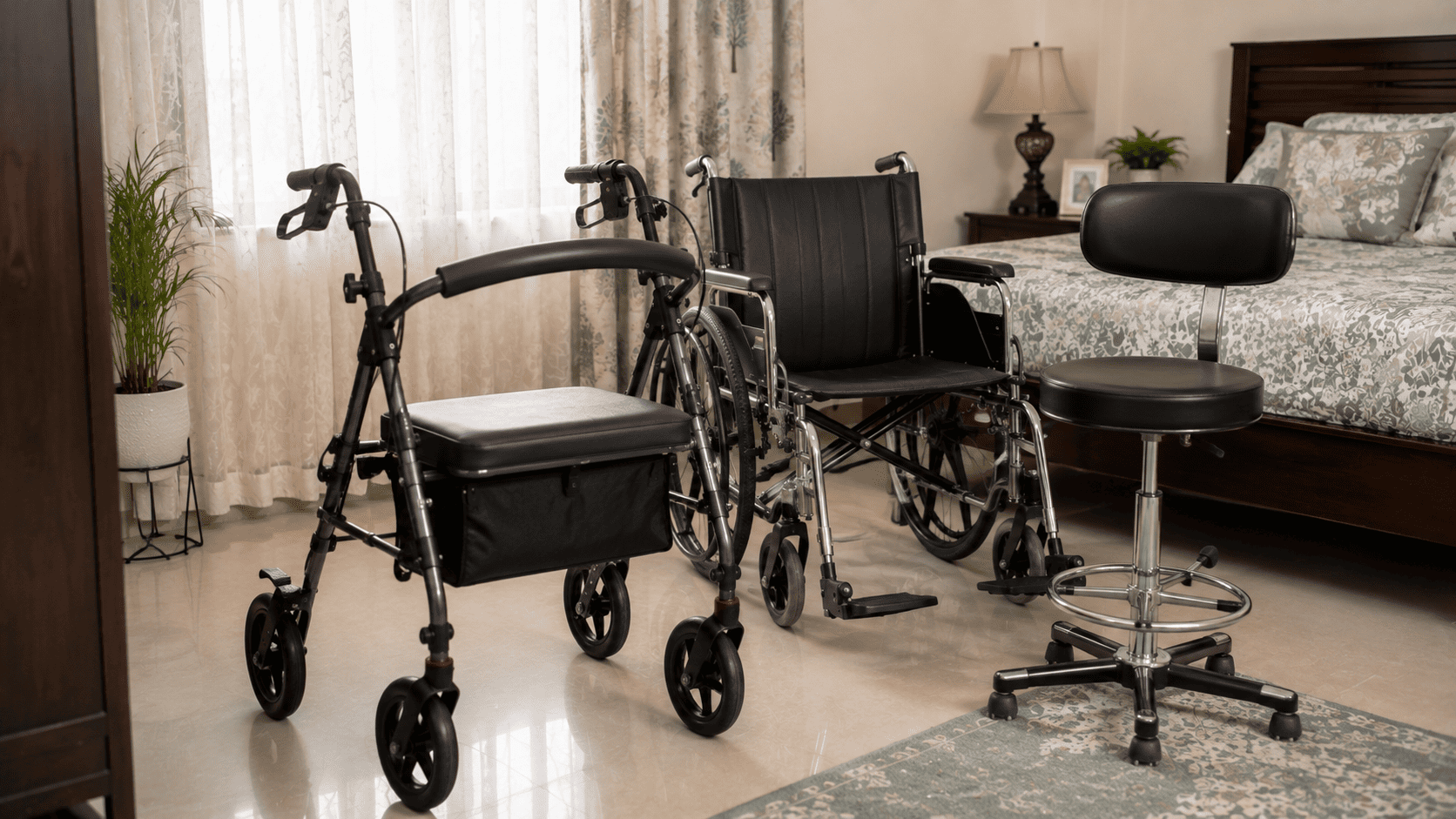
Only what the current phase requires. MS equipment planning differs from every other condition because the need fluctuates: a person may need a wheelchair for six weeks during a relapse and none for the following year. The goal is to have the right thing available quickly when a flare starts, rather than owning a room full of aids for a level of disability that may not arrive for a decade.
| Phase | Usually needed | Why |
|---|---|---|
| Stable, walking normally | Cooling aids, a perching stool, bathroom grab bars, home physiotherapy | Energy conservation and heat management do more here than any mobility aid. |
| Walking affected when tired or hot | Walking stick, four-wheeled rollator with a seat, shower chair, foot-drop support if prescribed | A rollator with a seat extends range by providing a rest point rather than replacing walking. |
| During a relapse | Wheelchair, commode chair beside the bed, transfer aids, bed rail | Function can drop sharply for weeks and then recover. Short-term equipment protects safety without permanent purchase. |
| Progressive weakness, limited standing | Wheelchair for daily use, hospital bed, pressure-relieving mattress, transfer board or patient lift | Transfers and skin protection become daily concerns rather than occasional ones. |
| Largely bed or chair based | Adjustable hospital bed, alpha or air mattress, positioning cushions, wheelchair with pressure cushion and headrest | Reduced sensation plus reduced movement is the highest-risk combination for pressure injury. |
| Bladder or bowel affected | Commode chair, waterproof mattress protector, catheter supplies as prescribed by the treating team | Continence management protects skin, sleep and independence at the same time. |
Small aids with outsized returns
- A perching stool for kitchen and bathroom tasks — the cheapest meaningful item on this page.
- A rollator with a seat and brakes, which turns a 200-metre limit into a 600-metre one with two rests.
- Cooling towels, a cooling scarf and cold water bottles, kept where they will actually be used.
- Bathroom grab bars and a shower chair, because bathing is both a fall risk and a heat trigger.
- A bed rail or bed pole when night-time turning or getting up becomes difficult.
- A satin bedsheet, which reduces friction and preserves independent turning in bed.
Healthy Jeena Sikho supplies the mobility and bedside items on this list across Delhi NCR and Tricity — see hospital beds on rent, medical equipment on rent, and the walker range. If the person is spending long periods in bed during a relapse, read pressure sore prevention at home and how to move and transfer a patient safely.
Same-day delivery may be available in selected Delhi NCR and Tricity locations, subject to stock and service availability.
Should someone with MS exercise, or does it make things worse?
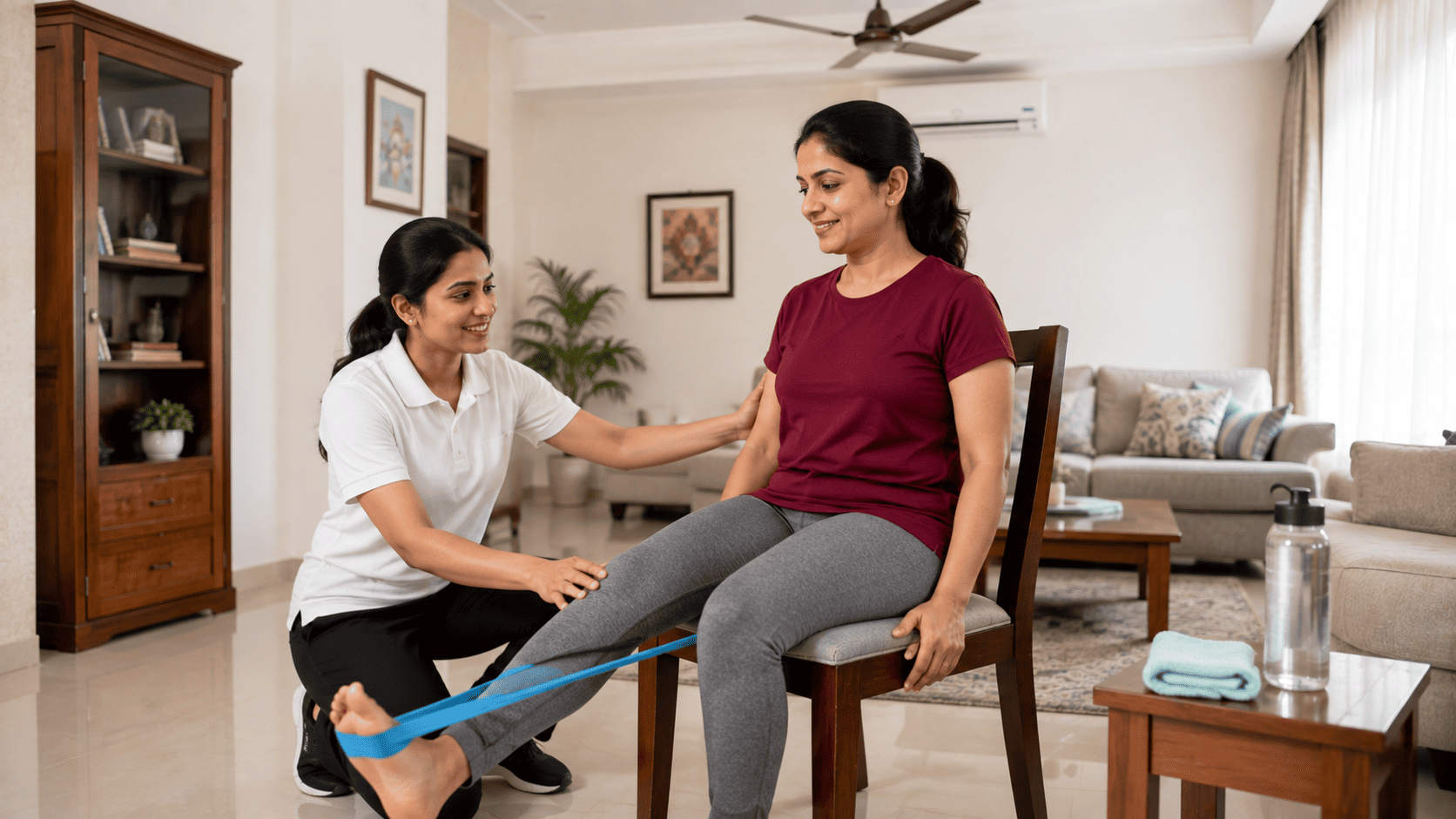
Exercise is recommended in MS. The older advice to rest and avoid exertion has been replaced: structured aerobic and resistance exercise improves strength, walking, fatigue and mood in people with MS.[5] The one adaptation that matters is temperature — exercise in a cool environment, keep cold fluids at hand, and stop for cooling rather than pushing through a heat-related flare.
| Component | What it targets | Practical form at home |
|---|---|---|
| Aerobic work | Fatigue, endurance, mood. | Stationary cycle or short walks, in a cooled room or early morning. |
| Strength | Standing from a chair, stairs, transfers. | Sit-to-stand repetitions, resistance bands, leg and core work. |
| Balance | Falls and unsteadiness when tired. | Supervised balance drills near a wall or stable surface. |
| Stretching | Spasticity, night cramps, joint range. | Daily calf, hamstring and hip flexor stretches, held slowly. |
| Pelvic floor | Bladder urgency and continence. | Guided exercises taught by a physiotherapist, done consistently. |
Programmes should be built by a physiotherapist around the individual's symptoms and current phase, and revised after a relapse. Healthy Jeena Sikho provides home physiotherapy, a panel of rehabilitation and pain-management doctors, and a physiotherapy centre in Mohali.
Why do infections matter so much in MS?
For two reasons. First, an infection can trigger a pseudo-relapse, temporarily undoing months of function. Second, many disease-modifying treatments for MS work by damping the immune system, so infections can be more frequent, more serious, and less obvious. Fever in someone on MS treatment is a reason to contact the treating team, not to wait and watch.
- Urinary infections are the commonest culprit, particularly where the bladder does not empty completely. Recurrent infections deserve a proper urology or continence assessment rather than repeated courses of antibiotics.
- Take the treatment schedule to every consultation. Any doctor prescribing for something unrelated needs to know which MS therapy the person is on.
- Do not stop disease-modifying treatment independently. Some therapies carry a risk of symptoms rebounding if discontinued without a plan. Stopping is a neurologist's decision.
- Discuss vaccination with the neurologist, because timing relative to certain MS treatments matters and some vaccine types may not be suitable.
- Watch for silent signs. In MS, an infection may show up as sudden weakness, worsened spasticity or confusion before it shows up as fever or pain.
How common is multiple sclerosis in India?
MS is considerably less common in India than in Europe or North America, and is often described as a rare disease here — but reported prevalence has been rising worldwide, and Indian estimates are widely regarded as uncertain because of limited access to MRI and specialist diagnosis. In practice, this means Indian families frequently face long delays to diagnosis and very little local support infrastructure once they have it.
The third edition of the Atlas of MS estimated that 2.8 million people worldwide live with MS, a global prevalence of 35.9 per 100,000, and reported that prevalence had increased in every world region since 2013.[1] It also found that females are about twice as likely to live with MS as males, with a mean age at diagnosis of 32 years.[1,2]
Indian prevalence estimates are far lower and vary between studies. A review of MS epidemiology cites evidence from urban areas in southern India indicating a prevalence of around 8.3 per 100,000, and notes that given India's population of nearly 1.4 billion, such rates may be underestimated or uncertain because large-scale epidemiological studies are lacking.[3] The India State-Level Disease Burden Initiative reported multiple sclerosis among the neurological disorders more prevalent in females than males in India.[4]
What this means for families here
- Diagnosis is often delayed. Early symptoms — a blurred eye, a numb leg, unexplained exhaustion — are commonly attributed to something else for months or years.
- Specialist follow-up is concentrated in metros. Most of the year is managed at home, which raises the value of a good symptom record.
- Summer is the planning season. Heat management should be arranged in March, not improvised in June.
- Another condition can look similar. Neuromyelitis optica spectrum disorder is relatively more frequently reported in Asian populations, can resemble MS, and is treated differently — which is one reason a specialist diagnosis matters rather than a presumed one.
When should you contact the doctor urgently?
Seek medical advice promptly if you see any of these
- New neurological symptoms lasting more than 24 hours without fever — new weakness, new numbness, new double vision or a new balance problem.
- Any new visual change, particularly blurring with pain on eye movement.
- Fever in someone on disease-modifying treatment, or any infection that is not settling.
- Burning urine, cloudy or foul urine, or a sudden change in continence — possible urinary infection.
- Inability to pass urine, or a sudden increase in abdominal discomfort with reduced output.
- Symptoms that worsen and do not improve after cooling and rest.
- A fall with injury, or repeated falls that are new for that person.
- Broken or discoloured skin over a pressure point in anyone spending long periods seated or in bed.
- Choking or coughing at meals, or a new change in speech or swallowing.
Should you rent or buy MS equipment?
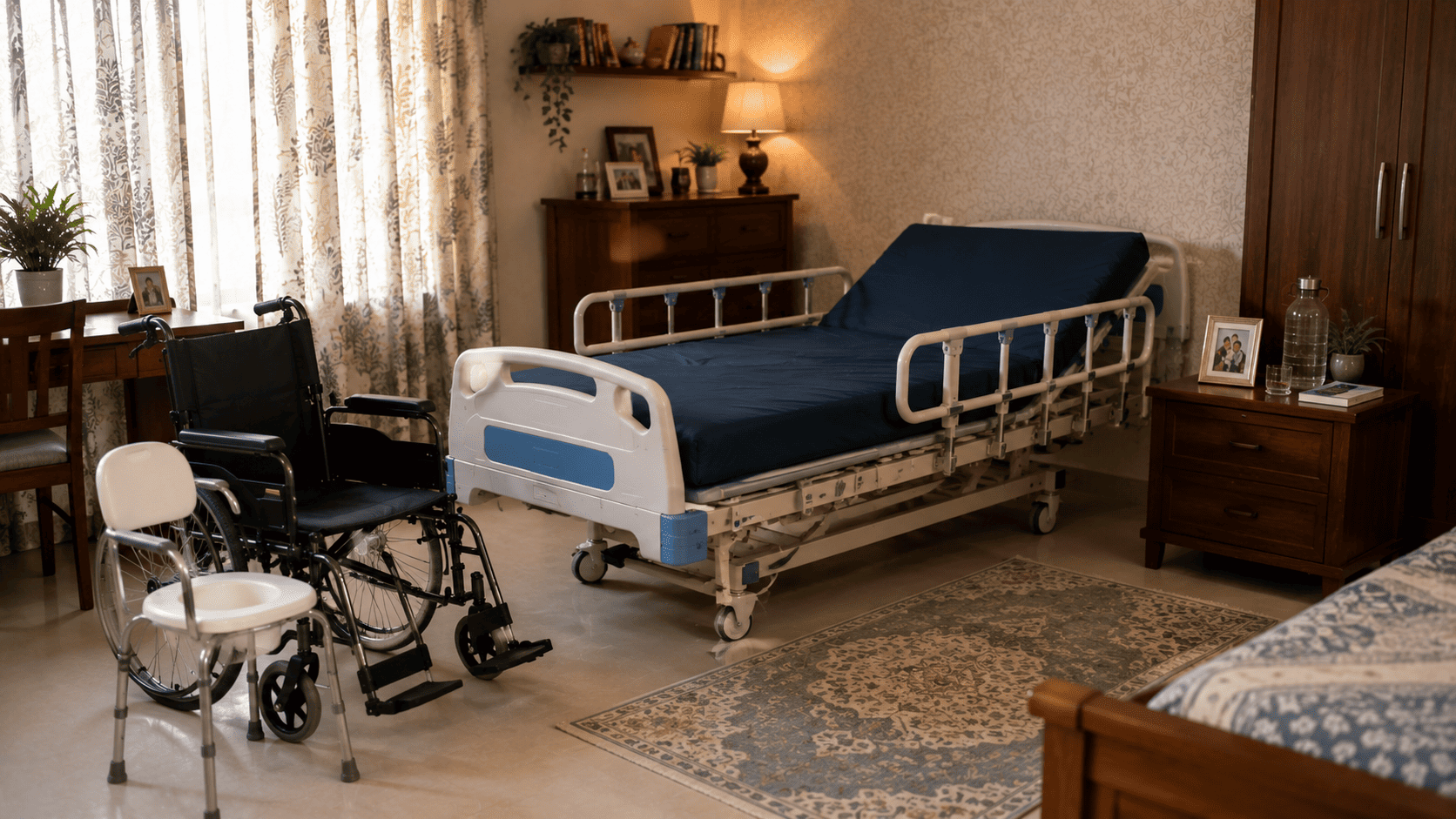
MS is the clearest case for renting of any condition we support, because the requirement is episodic rather than linear. Equipment needed during a relapse is often unnecessary once recovery happens. Items used every day regardless of phase are worth buying; anything tied to a flare, or likely to be outgrown as the picture changes, is better rented.
| Item | Usually better to | Reasoning |
|---|---|---|
| Perching stool, shower chair, grab bars, cooling aids | Buy | Used daily in every phase, low cost, no benefit to returning them. |
| Walking stick or rollator | Buy if used regularly | Once needed most days it becomes personal equipment, fitted to the individual. |
| Wheelchair | Rent | Frequently needed only during relapses or for long outings; requirements change as posture and strength change. |
| Hospital bed | Rent | Often needed for a defined period during a relapse or a progressive phase, and specification is best confirmed in use. |
| Air / alpha mattress | Rent | Needed when time in bed increases; servicing and pump support are covered during the rental period. |
| Commode chair, transfer aids | Rent first | Requirement may be temporary, and the right type depends on how transfers actually go at home. |
A practical approach many MS families use: keep a short list of what to arrange the moment a relapse starts, with a supplier who can deliver within a day. Deciding what is needed while function is dropping is far harder than deciding it in advance.
Related home care guides
Pressure Sore Prevention
Turning schedules, the 30-degree tilt and heel floating during a relapse.
Moving and Transferring Safely
Bed to wheelchair transfers, and the handling mistakes that injure carers.
Bedridden Patient Care
Daily hygiene, positioning and skin checks when mobility drops sharply.
Setting Up a Patient Room
Room measurements, socket planning and access before equipment arrives.
Stroke Recovery at Home
Overlapping ground on positioning, transfers and neurological rehab.
Medical Equipment on Rent
The full rental range, from beds and mattresses to wheelchairs and commodes.
How Healthy Jeena Sikho supports families living with MS
- Rental built for a fluctuating condition. Take equipment for a relapse, return it when function recovers, and arrange it again if it is needed later.
- Fast turnaround when a flare starts. Same-day delivery may be available in selected Delhi NCR and Tricity locations, subject to stock and service availability.
- The full home care list in one place. Hospital beds, air and alpha mattresses, wheelchairs, walkers, commode and shower chairs, and bedside support equipment.
- Home physiotherapy alongside the equipment. Physiotherapy and rehabilitation support, so exercise programmes and equipment are one arrangement rather than two.
- Delivery across Delhi NCR and Tricity. Service availability includes Delhi, Gurugram, Noida, Faridabad, Ghaziabad, Chandigarh, Mohali and Panchkula.
- Home installation and demonstration. Our team sets up the bed and mattress and demonstrates safe operation, transfers and basic maintenance.
Frequently Asked Questions About MS Care at Home
Why do MS symptoms get worse in summer?
Damaged nerves conduct signals less efficiently when body temperature rises, so heat can temporarily bring back symptoms such as blurred vision, heavy legs and fatigue. This is known as Uhthoff's phenomenon. It is temporary and reversible — cooling down usually restores function within minutes to hours — and it does not indicate new nerve damage.
What is the difference between a relapse and a pseudo-relapse?
A relapse is new or worsening neurological symptoms lasting more than 24 hours without fever or infection. A pseudo-relapse is a temporary return of existing symptoms triggered by heat, fever, infection, exhaustion or stress, which settles once the trigger is treated. Because the treatment differs completely, a temperature check and a urine test are usually the first steps.
Is MS fatigue the same as normal tiredness?
No. MS fatigue is a neurological symptom that can appear without exertion and is not reliably relieved by sleep. It is one of the most commonly reported disabling symptoms of MS. It responds to energy planning, pacing and cooling rather than to pushing through, and disturbed sleep or low mood should be ruled out as additional contributors.
Can someone with MS still exercise?
Yes. Structured aerobic and resistance exercise is recommended in MS and improves strength, walking, fatigue and mood. The important adaptation is temperature control — exercise in a cool environment, keep cold fluids available, and stop to cool down rather than working through a heat-related flare. Programmes should be set by a physiotherapist.
Does everyone with MS end up in a wheelchair?
No. MS varies enormously between individuals, and many people never require a wheelchair for daily use. Some use one only during relapses or for long distances. Because the picture changes over time, renting rather than buying is often the more practical approach for wheelchairs and beds.
Why does a urinary infection make MS symptoms worse?
Infection and the associated rise in body temperature interfere with nerve conduction, which can temporarily worsen existing MS symptoms. In someone with MS a urinary infection may show up as sudden weakness, increased spasticity or confusion rather than typical urinary symptoms, which is why it should be checked whenever function drops unexpectedly.
Can MS medication be stopped if the person feels well?
No. Disease-modifying treatments work to reduce future relapses and damage, so feeling well does not mean the treatment is unnecessary. Some therapies also carry a risk of disease activity rebounding if stopped without a plan. Any change is a decision for the treating neurologist.
Does a person with MS need a hospital bed at home?
Not usually in the early years. A hospital bed becomes useful when turning in bed or getting up unaided is difficult, or during a relapse when function drops sharply. Because that need is often temporary, renting for the duration of the relapse is frequently more sensible than buying.
What should be arranged first when a relapse begins?
Contact the neurology team, check for fever and infection, and arrange whatever mobility and bathroom support the person needs for safety — commonly a wheelchair, a commode chair beside the bed and help with transfers. Having a written list ready in advance makes this far easier than deciding while function is dropping.
How quickly can equipment be delivered during a flare?
Delivery time depends on location, stock and service availability. Across Delhi NCR and Tricity, same-day delivery may be available in selected locations. For a fluctuating condition like MS, it is worth identifying a supplier before a relapse rather than searching during one. Call +91 98769 78488 or message +91 98759 15278 on WhatsApp.
References and further reading
- Walton C, King R, Rechtman L, et al. Rising prevalence of multiple sclerosis worldwide: insights from the Atlas of MS, third edition . Multiple Sclerosis Journal 2020;26(14):1816–1821.
- GBD 2016 Multiple Sclerosis Collaborators. Global, regional, and national burden of multiple sclerosis, 1990–2016: a systematic analysis for the Global Burden of Disease Study 2016 . Lancet Neurology 2019;18(3):269–285.
- Multiple sclerosis: an overview of epidemiology, risk factors and serological biomarkers. Acta Neurologica Scandinavica 2024 .
- India State-Level Disease Burden Initiative Neurological Disorders Collaborators. The burden of neurological disorders across the states of India: the Global Burden of Disease Study 1990–2019 . Lancet Global Health 2021;9(8):e1129–e1144.
- National Institute for Health and Care Excellence (NICE). Multiple sclerosis in adults: management, NICE guideline NG220 .
- Multiple Sclerosis International Federation. Atlas of MS and global MS resources .
Medical disclaimer. This page is general educational information about home care for multiple sclerosis. It is not medical advice and does not replace consultation with a qualified neurologist, physician or physiotherapist. Diagnosis, disease-modifying treatment, relapse management, exercise progression and continence care must be determined by the treating clinical team, and medication must never be started, changed or stopped at home. Healthy Jeena Sikho supplies, installs and services home medical equipment and arranges therapy services; we do not diagnose conditions or independently set clinical parameters. If new neurological symptoms appear, or an infection is suspected, contact your treating team or nearest hospital promptly.