
Home Care After Hospital Discharge: Checklist, Equipment & the First 30 Days
The short version
- The first 30 days at home are the risky window, not the hospital stay. In a study of 400 patients discharged home from a general medical service, 19% experienced an adverse event in the roughly three weeks after discharge — and about three in five of those events were judged preventable or able to have been made less severe.[1,2]
- Most of those problems are medicine problems. In the same study, adverse drug events were 66% of all adverse events — by far the largest category — and systematic reviews report that medication errors and unintended discrepancies after discharge are common.[1,3] Reconciling the old prescription against the new one is the highest-value 30 minutes a family will spend.
- Discharge is a handover, not an ending. Leave the hospital with the discharge summary, a reconciled medicine list, the follow-up date, wound or tube instructions, and a written list of warning signs.[5]
- Equipment is decided by how the patient moves, not by the diagnosis. Walking, transferring with help, or unable to move in bed — those three answers decide almost the whole list.
- Set the room up before the patient arrives, not after. Bed installed, mattress on, path to the bathroom cleared, oxygen or suction tested.
- Rent first. The requirement in week one is usually the largest it will ever be, so most families should rent while the picture is still changing and buy only what turns out to be permanent.
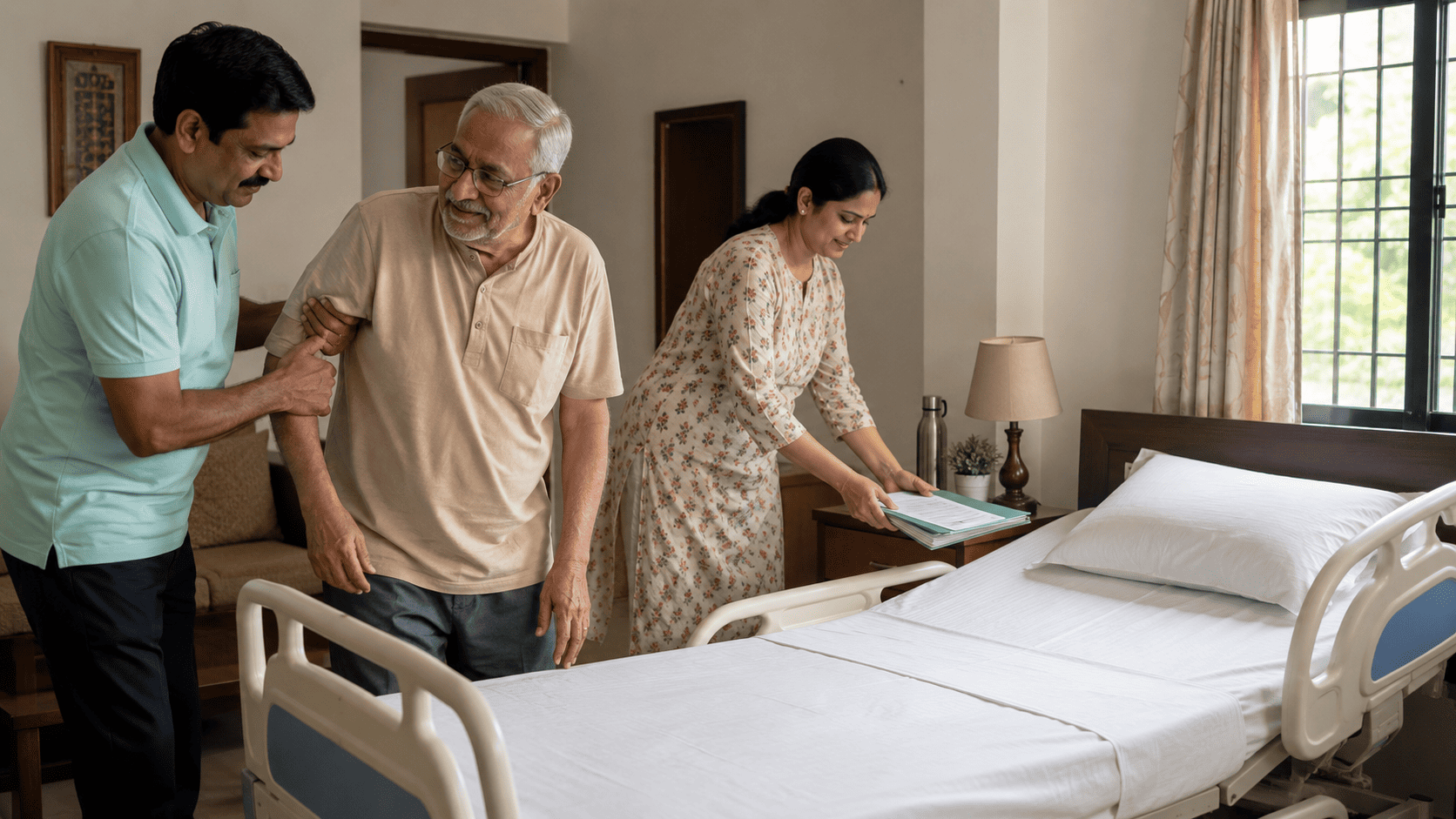
Discharge day looks like relief and behaves like a shift change. The hospital hands over a file, a bag of medicines and a person who is better than they were but not yet independent — and the family becomes the nursing staff, the pharmacist, the physiotherapy assistant and the equipment department all at once, usually with no handover training. This guide covers what to secure before you leave the ward, what to install at home, how to run the first 30 days, and the warning signs that mean the hospital again rather than a wait-and-watch.
What does home care after hospital discharge actually involve?
Five jobs, running at the same time: giving medicines correctly, keeping the patient positioned and moving safely, feeding and hydrating them, watching for the specific complications their condition carries, and getting to the follow-up appointment. Equipment, nursing help and physiotherapy exist to make those five jobs possible — they are not the plan by themselves.
The mistake most families make is treating home care as "keeping the patient comfortable until the next OPD visit". The recovery period is active work with a schedule. The families who do well are the ones who write the schedule down on day one and stick it on the wall next to the bed, so that any relative or attendant in the room knows what happens next without asking. Our broader guide to recovering at home covers the same routine for recoveries that did not start with a hospital admission.
Medicines
One reconciled list, fixed timings, a pill organiser, and a rule that nobody adds or stops anything without the doctor.
Movement and position
Position changes, sitting out of bed, transfers done the way the physiotherapist showed you — not improvised.
Feeding and fluids
Upright meals, the prescribed texture, and a rough count of how much is actually going in each day.
Wound, tube and device care
Dressings, catheter, feeding tube, tracheostomy or drain — each needs a named person and a written instruction.
Monitoring
Temperature, blood pressure, pulse, oxygen saturation and sugar as advised, logged rather than remembered.
Follow-up
The next appointment, the reports to carry, and the phone number to call when something changes at 2 a.m.
What should you ask the hospital before the patient is discharged?
Ask for everything in writing before you sign the discharge papers: the discharge summary, a reconciled medicine list with doses and timings, what to stop, the follow-up date and department, wound or device instructions, diet and swallow instructions, activity limits, and the specific warning signs for this patient. Also ask the one question most families forget — what equipment will we need at home, and can it be delivered before we reach?[5]
| Ask for | The specific question | Why it matters |
|---|---|---|
| Reconciled medicine list | "Which of the medicines taken before admission continue, which stop, and which are new?" | Old and new prescriptions running together is the commonest post-discharge error. |
| Timing and food rules | "Which of these are before food, which after, and which must never be crushed?" | Crushing the wrong tablet or wrong timing changes how the drug works. |
| Blood thinner instructions | "Is the patient on a blood thinner, for how long, and what tests are needed?" | Bleeding risk and monitoring requirements need to be known at home from day one. |
| Mobility status | "Can the patient walk, transfer with one person's help, or not at all right now?" | This single answer decides the whole equipment list. |
| Swallow and diet | "Is the swallow safe? What texture and fluid consistency, and in what position?" | Unsafe feeding is one of the fastest routes back to hospital. |
| Wound / device care | "Who changes the dressing, how often, and what does a bad wound look like?" | Catheters, drains, feeding tubes and wounds each need a named routine. |
| Oxygen requirement | "Does the patient need oxygen at home, at what flow, and for how many hours?" | Determines whether a concentrator is arranged before discharge, not after. |
| Therapy plan | "When should physiotherapy start at home, and how many sessions a week?" | The gap between discharge and the first home session is where recovery time is lost. |
| Follow-up | "Which department, which date, which reports do we carry, and who do we call before then?" | A missed first follow-up often means the next visit is an emergency one. |
| Red flags | "For this patient specifically, what should bring us straight back?" | Generic advice is ignored; a named list of signs is acted on. |
Photograph the discharge summary before you leave the hospital
Take clear photos of the discharge summary, prescription and reports, and send them to a family group. Paper files get lost in the first week, and the summary is the document every doctor, nurse, physiotherapist and equipment provider will ask for. Keep the original in one labelled folder, and carry it to every follow-up.
What equipment do you need at home after hospital discharge?
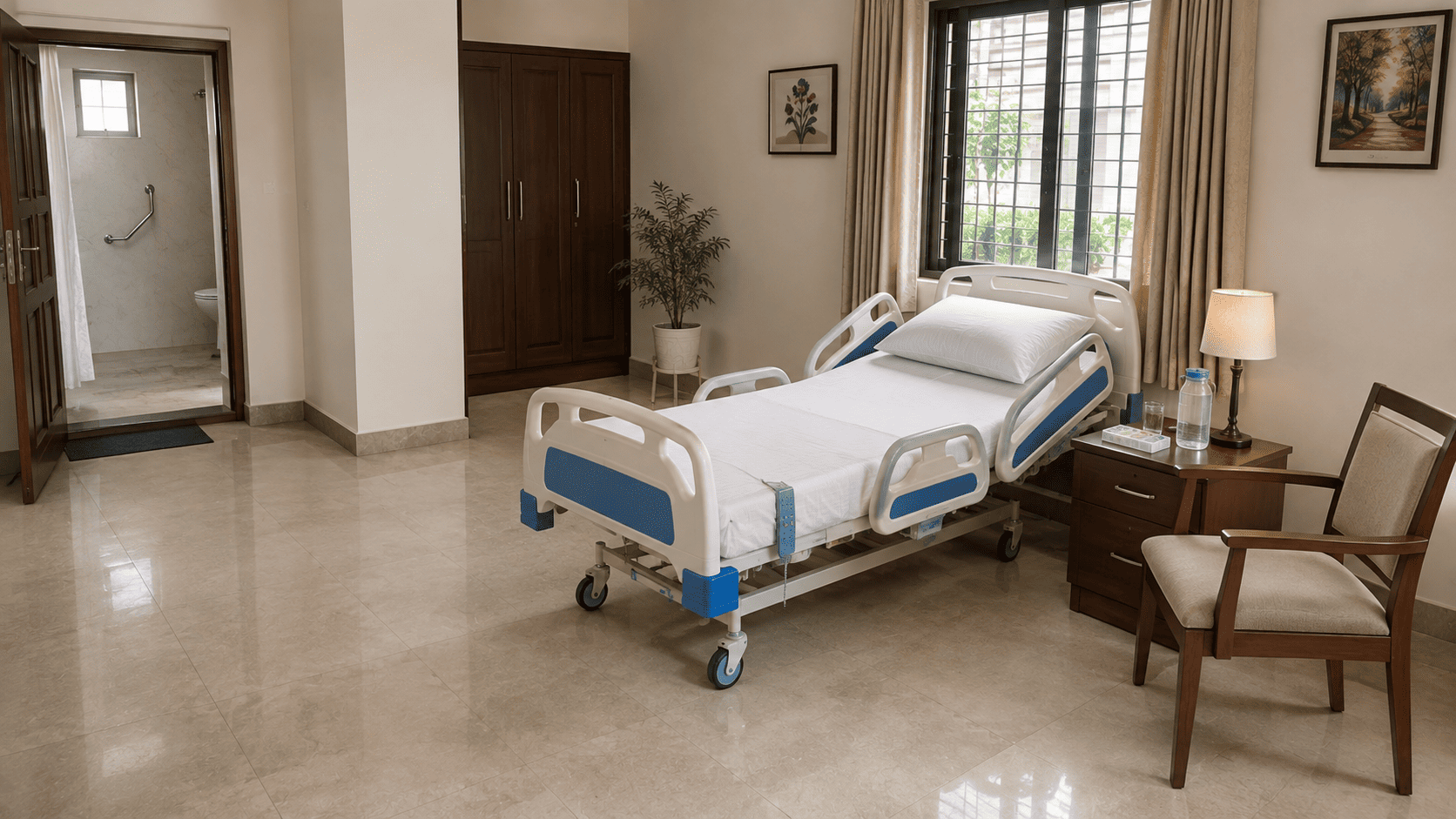
Match the equipment to the patient's level of function, not to the diagnosis on the discharge summary. Someone discharged after the same surgery may walk out on a stick or arrive home unable to reposition themselves. The list below is an orientation tool for the discharge conversation; the final list should be confirmed by the treating team or a physiotherapist who has seen the patient.
| Level of function | Usually needed at home | Why |
|---|---|---|
| Walking independently, tires easily | Walking stick, bathroom grab bars, non-slip mat, BP monitor, thermometer, pulse oximeter | The dominant risk is a fall in the bathroom, not immobility. See the bathroom safety guide. |
| Walks short distances with support | Walker, commode chair, shower chair, wheelchair for outdoor distance, home physiotherapy | A wheelchair for distance preserves outings and follow-up visits without exhausting the patient. |
| Transfers bed to chair with one person's help | Hospital bed with side rails, wheelchair, commode chair, air mattress, transfer belt | Adjustable height and rails make a one-person transfer safe for both people. |
| Bedbound, cannot reposition independently | Electric hospital bed, alpha or air mattress, positioning pillows, patient lift or transfer board, wheelchair with headrest | Skin protection and safe handling become the daily priority.[6] |
| On home oxygen | Oxygen concentrator at the prescribed flow, backup cylinder, pulse oximeter, tubing and humidifier | Flow rate and duration are prescribed — a concentrator must match the prescription, not the price. |
| Breathing support at night / post-ICU | CPAP or BiPAP as prescribed, correct mask size, pulse oximeter | Pressure settings are set by the treating doctor or a sleep study, never at home. |
| Weak cough, secretions, tracheostomy | Suction machine with catheters, nebuliser if prescribed, pulse oximeter, chest physiotherapy | Chest infection is among the commonest reasons a discharged patient is readmitted. |
| Tube feeding | Bed with backrest elevation, feeding stand and sets as prescribed, syringes, suction if advised | Upright positioning during and after feeds reduces the risk of fluid entering the lungs. |
| Bladder or bowel control affected | Commode chair, waterproof mattress protector, absorbent products, trained nursing for catheter care | Skin stays healthier with a commode routine than with prolonged wetness. |
Same-day delivery may be available across Delhi NCR, Chandigarh Tricity, Ludhiana, Jalandhar, Bathinda, Jaipur and Lucknow, subject to serviceable pin code and stock. Also available on rent: oxygen concentrators and CPAP / BiPAP machines.
If the discharge follows a specific diagnosis, the condition guide is more precise than any general list — see after-surgery recovery, stroke recovery, joint replacement recovery or post-ICU care at home.
How do you prepare the room before the patient reaches home?
Pick the room closest to a bathroom, on the ground floor if possible, with space to walk on both sides of the bed. Install the bed and mattress before the ambulance arrives, clear the floor of rugs and wires, put a chair and a light within reach, and test any oxygen, suction or nebuliser equipment while there is still time to swap a faulty unit.
The room checklist
- Bed placed with access on both sides where possible, so turning and transfers do not have to be done from one fixed side.
- Clear path to the bathroom — no rugs, no loose wires, no door mats, nothing to step over at night.
- Light within reach of the bed, plus a night light on the route to the bathroom. Most home falls happen in the dark.
- A stable chair beside the bed for sitting out, and a side table for water, medicines and the phone.
- Bathroom fitted with grab bars, a non-slip mat and a shower chair before the first bath, not after the first slip.
- Power points checked if a concentrator, air mattress pump, suction machine or BiPAP will run continuously, and a plan for power cuts.
- One labelled folder holding the discharge summary, prescriptions, reports, and the monitoring log.
- Emergency numbers written on paper and stuck on the wall: treating doctor, nearest hospital, ambulance, equipment provider, nursing agency.
How do you manage medicines safely in the first month?
Build one list and destroy every competing list. Sit down with the discharge prescription and the medicines the patient was taking before admission, and mark each old medicine as continue, stop, or changed dose — with the hospital doctor or your own doctor, not by guesswork. Then use a weekly pill organiser, fixed alarms, and a written log of what was actually given.[7]
Medication-related events are the largest single category of problems after discharge — adverse drug events accounted for 66% of all adverse events in one prospective study — and reviews of the transition from hospital to home report high rates of medication errors and unintended discrepancies.[1,3] The mechanism is mundane: the old strip is still in the cupboard, the new prescription has a similar-looking name, and two family members each give a dose.
| Do this | Because |
|---|---|
| Remove old strips from the house | Anything marked "stop" should physically leave the medicine box, not sit next to the new ones. |
| Use one weekly pill organiser | It converts "did we give it?" from memory into something anyone in the room can see. |
| One named person fills it | Shared filling is how double doses happen. One filler, everyone else only gives. |
| Keep a giving log | A ruled notebook with date, time, medicine and initials settles every dispute in ten seconds. |
| Ask before crushing anything | Some tablets must not be crushed or opened. Ask the pharmacist, not the internet. |
| Carry the box to every follow-up | Doctors change more confidently when they can see exactly what is being taken. |
| Report side effects instead of stopping | Stopping a blood thinner, a heart medicine or a steroid at home can be more dangerous than the side effect. |
Never start, stop or change a dose at home
This includes stopping a medicine because the patient "feels fine now", restarting an old medicine that was deliberately withdrawn in hospital, adding a painkiller for a patient on blood thinners, or halving a dose because a reading looked normal. Every one of these is a doctor's decision. If something looks wrong on the prescription, call and ask — questioning a prescription is normal and welcomed.
Which complications send discharged patients back to hospital?
A short and repetitive list: infection (chest, urine or wound), medication problems, falls, pressure sores, dehydration and poor intake, clots in the legs, and constipation or urinary retention. Almost all of them announce themselves a day or two before they become emergencies, which is why daily observation matters more than any single machine.[4]
| Complication | Early warning at home | What reduces the risk |
|---|---|---|
| Chest infection / aspiration | New cough, fever, fast breathing, falling oxygen saturation, wet voice after meals. | Upright feeding, prescribed texture, oral hygiene, sitting out of bed, chest physiotherapy. |
| Urinary infection | Fever, burning, cloudy or foul urine, sudden confusion in an older patient. | Hydration as advised, avoiding unnecessary prolonged catheterisation, early review. |
| Wound infection | Increasing pain, redness spreading, discharge, odour, fever after day three. | Dressing done as instructed, hand hygiene, keeping the wound dry, reporting early. |
| Pressure injury (bedsore) | Redness over tailbone, heels or hips that does not fade after pressure is relieved. | Two-hourly repositioning routine, pressure-redistributing mattress, dry skin, protein-adequate diet.[6] |
| Falls | Usually just as the patient starts moving again and overestimates ability. | Supervised transfers, clear floors, bathroom rails, proper footwear, night lighting. See fall prevention during recovery. |
| Deep vein thrombosis | Swelling, warmth or pain in one calf; sudden breathlessness or chest pain. | Early mobilisation and any preventive measures prescribed by the treating team. |
| Dehydration and weight loss | Dark urine, dry mouth, dizziness on standing, meals left unfinished for days. | Counting intake rather than assuming it, offering small frequent feeds, weighing weekly. |
| Constipation / urinary retention | No stool for days, abdominal discomfort, restlessness, no urine passed for hours. | Mobility, fluids and fibre as advised, and reporting rather than self-medicating. |
| Low mood and confusion | Withdrawal, refusing therapy, disturbed sleep, sudden change in alertness. | Raise it with the doctor. New confusion in an older adult is a medical sign, not a mood. |
Do you need a nurse, an attendant, or can the family manage?
It depends on whether the daily tasks are clinical or supportive. Injections, catheter care, tracheostomy suctioning, wound dressing and tube feeding need a trained nurse. Bathing, feeding, positioning, toileting and mobility support can be done by a trained attendant or by family members who have been taught the technique. Most households end up with a mix that changes over the first month.
| Option | Best suited to | Watch out for |
|---|---|---|
| Family only | Mobile patient, oral medicines, no wounds or devices, short recovery expected. | Burnout and back injury if transfers are heavy. Learn the technique before discharge. |
| Patient attendant / caregiver | Bathing, feeding, toileting, repositioning, company and supervision through the day. | Attendants are not nurses — clinical tasks should not be handed to them. |
| Home nurse (visit or shift) | Injections, dressings, catheter and tube care, tracheostomy, monitoring after ICU. | Confirm what the visit includes and who is called when something changes at night. |
| Home physiotherapy | Regaining strength, standing, walking, chest clearance and joint mobility. | Starting late. The first weeks are the highest-yield weeks for recovery. |
| Doctor visit at home | Patients who cannot be moved for review, or complex medication adjustment. | Home visits supplement, but do not replace, the scheduled follow-up. |
For families in the Tricity and Punjab, Healthy Jeena Sikho arranges home physiotherapy and access to a panel of rehabilitation and pain-management doctors.
What do the first 30 days at home look like?
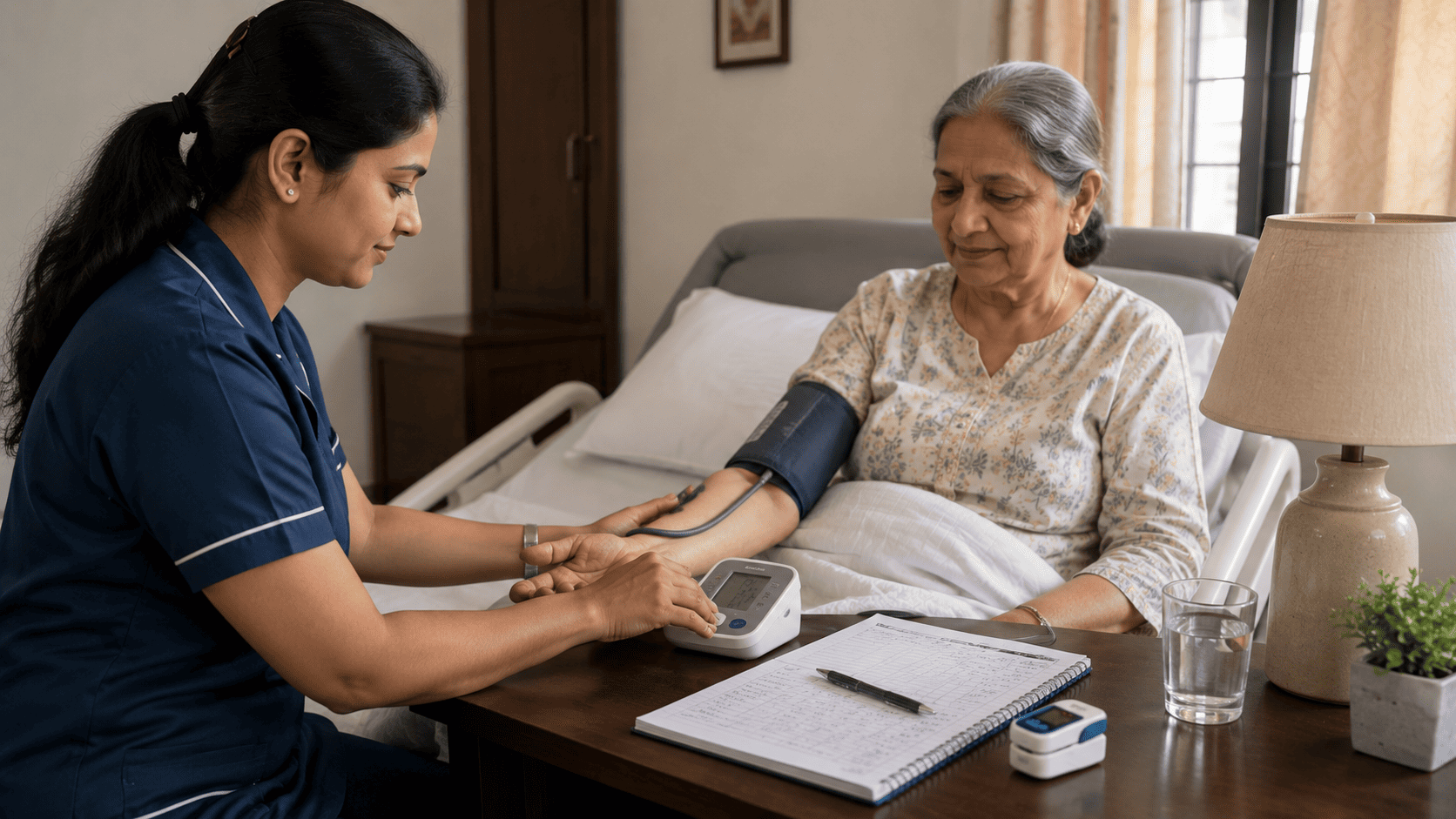
Week one is about safety and routine. Week two is about the first follow-up and correcting whatever is not working. Weeks three and four are about stepping activity up and equipment down. The single most useful habit across all four weeks is a daily log — observations, intake, medicines given and anything that felt different. For a surgical discharge, the wound, drain and weight-bearing timeline sits on top of this — see recovery at home after surgery.
| Period | Focus | What usually goes wrong |
|---|---|---|
| Day 0–2 | Bed and equipment installed, medicine list reconciled, routine written on paper, first monitoring readings logged. | Equipment ordered after the patient is already home, and a night spent improvising. |
| Day 3–7 | Positioning routine settled, physiotherapy started, wound and device care running, intake being counted. | Fever, wound redness or reduced intake noticed but "watched" for two days too long. |
| Week 2 | First follow-up visit with the folder, the medicine box and the log. Doses adjusted. | Follow-up postponed because the patient "seems fine" or transport is difficult. |
| Week 3 | Sitting out longer, walking distance increasing, self-care tasks handed back to the patient. | Doing everything for the patient, which slows recovery and increases dependence. |
| Week 4 | Review what is still needed. Step equipment down. Plan the next month of therapy. | Keeping a full hospital setup for months out of caution, at unnecessary cost. |
A workable daily routine
- Morning. Reposition, skin check, oral hygiene, sit fully upright, medicines, breakfast, vitals logged.
- Through the day. Position change roughly every two hours for bedbound patients, sitting out of bed as tolerated, therapy exercises split into short sessions.
- Every meal. Upright, unhurried, prescribed texture, 30 minutes upright afterwards, mouth cleaned.
- Evening. Skin check, gentle range-of-motion, medicines, comfortable resting position, night light on.
- Weekly. Weigh if possible, review the log, write down questions for the next doctor or therapy visit.
And a point that is not sentimental: the caregiver is part of the plan. Back injuries from unassisted lifting and exhaustion from unbroken 24-hour duty are among the commonest reasons home care collapses in the second month. Learn transfers from the physiotherapist, use the bed's height adjustment, and arrange relief before it becomes urgent.
When should you call the doctor or go back to hospital?
Seek medical help immediately if you see any of these
- Fever with breathlessness, fast breathing or falling oxygen saturation on the pulse oximeter.
- Chest pain, sudden breathlessness, or swelling, warmth and pain in one calf.
- New weakness, facial droop, slurred speech or sudden vision loss — treat as a stroke and call an ambulance.
- Rapid weight gain, new swelling in the legs, or breathlessness on lying flat.
- Sudden confusion, drowsiness, or a patient who cannot be woken properly.
- A wound that is spreading redness, discharging, smelling, or opening up.
- No urine for several hours, or a blocked catheter.
- Repeated vomiting, inability to keep medicines down, or no food and fluid intake for a day.
- Bleeding, black stools or unusual bruising, especially in a patient on blood thinners.
- A fall — particularly with a head injury or in a patient on blood thinners, even if they seem fine afterwards.
- Broken skin or a black or blistered area over a pressure point.
When in doubt, call the treating team rather than waiting for the next scheduled visit. A phone call costs nothing; a delayed infection costs a readmission.
Should you rent or buy equipment after a hospital discharge?
Rent while the requirement is still changing. Post-discharge needs are usually at their maximum in week one and shrink from there, so buying at discharge locks a household into the patient's worst week — and it lands immediately after hospital bills, when cash is tightest. Buy only what turns out to be permanent.
| Consideration | Renting | Buying |
|---|---|---|
| Upfront cost | Monthly rental plus applicable deposit. | Full purchase price immediately, usually right after hospital bills. |
| If the patient improves | Equipment can be returned or stepped down as mobility returns. | Items sit unused, and resale value on used medical equipment is poor. |
| If needs change | Equipment may be swapped according to availability and requirement. | A different requirement usually means a second purchase. |
| Servicing | Usually supported during the rental period. | Owner is responsible according to warranty and service terms. |
| Short recovery expected | Well suited to the first weeks after discharge. | Rarely economical for a few weeks of use. |
| Long-term stable requirement | Rental costs accumulate over time. | Makes sense once the requirement is clearly permanent. |
A practical middle path many families use: rent the full discharge list for the first one to three months, then buy only the one or two items still in daily use at the end of that period.
Where Healthy Jeena Sikho delivers home care equipment
Delhi NCR: Delhi, Noida, Greater Noida, Gurugram, Faridabad and Ghaziabad. Chandigarh Tricity: Chandigarh, Mohali, Panchkula and Kharar, served from the head office and store in Sector 73, Mohali. Punjab: Ludhiana, Jalandhar and Bathinda. Rajasthan and Uttar Pradesh: Jaipur and Lucknow.
Equipment sales are available more widely across India. Delivery, installation, home nursing and attendant support are limited to the cities listed above, subject to serviceable pin code and stock. Call +91 98769 78488 or WhatsApp +91 98759 15278 with the delivery pin code and the discharge date.
How Healthy Jeena Sikho supports families after discharge
- Send us the discharge summary. Share it on WhatsApp and our team can help translate the instructions into an equipment list, so nothing essential is missed on day one.
- Delivery timed to the discharge. Tell us the discharge date and we aim to install the bed and mattress before the patient reaches home rather than after.
- The whole list from one place. Hospital beds, air and alpha mattresses, wheelchairs, walkers, commode chairs, oxygen concentrators, CPAP and BiPAP machines, suction machines and nebulisers.
- Rental-first flexibility. Equipment can be stepped down as the patient recovers, instead of a purchase that stops being useful in month two.
- Home physiotherapy alongside the equipment. Therapy and equipment arranged together, not as two separate hunts.
- Cities we deliver to. Delhi, Noida, Greater Noida, Gurugram, Faridabad, Ghaziabad, Chandigarh, Mohali, Panchkula, Kharar, Ludhiana, Jalandhar, Bathinda, Jaipur and Lucknow, subject to serviceable pin code.
- Installation, demonstration and service support. Our team sets up the equipment, demonstrates safe operation and basic maintenance, and supports it through the rental tenure.
Frequently Asked Questions About Home Care After Discharge
What is the checklist for discharge from hospital to home?
Before leaving, secure the discharge summary, a reconciled medicine list with doses and timings, instructions for wounds, catheters or feeding tubes, diet and swallow instructions, activity and weight-bearing limits, the follow-up date and department, a contact number for questions, and a written list of warning signs. Ask separately what equipment is needed at home and arrange delivery for the discharge day itself.
How long does home care usually last after a hospital stay?
It varies with the condition and the patient's baseline function. Many patients need intensive support for two to six weeks and much less after that; some — particularly after stroke, major surgery in an older adult, or a long ICU stay — need support for several months. The practical approach is to review the requirement every two to four weeks and step equipment and help down as function returns.
What are the most common problems in the first weeks after discharge?
Medication-related problems are the largest single category in studies of patients discharged home, followed by procedure- or device-related complications, infections, falls and poor intake. In a prospective study of 400 patients discharged home from a general medical service, 19% experienced an adverse event in roughly the three weeks after discharge, and about three in five of those events were judged preventable or able to have been made less severe.
Do we need a hospital bed at home after discharge?
A hospital bed becomes worth it as soon as the patient cannot get in and out of bed unaided or cannot sit themselves up. The backrest elevation, adjustable height and side rails are what make feeding, medicines, cleaning and transfers manageable for one caregiver — and the height adjustment is what protects the caregiver's back. If the patient also cannot shift their own weight, a pressure-redistributing air or alpha mattress is usually added.
Can we arrange oxygen at home after discharge?
Yes, when it has been prescribed. The prescription should state the flow rate in litres per minute and the number of hours per day, and the concentrator must be able to deliver that flow at an adequate purity. A pulse oximeter at home is essential for monitoring, and a backup plan for power cuts should be agreed before the patient comes home. Oxygen settings are never adjusted at home based on how the patient looks.
How soon should physiotherapy start after discharge?
As early as the treating team allows — usually within days rather than weeks. The gap between hospital discharge and the first home session is a common weak point in Indian home care, and early weeks are the highest-yield weeks for regaining strength and mobility. Arranging therapy before discharge rather than after avoids losing that window.
Is a nurse or an attendant needed at home?
A trained nurse is needed for clinical tasks: injections, wound dressings, catheter care, tube feeding, tracheostomy suctioning and close monitoring after an ICU stay. An attendant or a trained family member can handle bathing, feeding, positioning, toileting and mobility support. Many families use an attendant through the day with scheduled nursing visits for the clinical tasks.
How often should a bedridden patient be turned at home?
A common recommendation is a position change roughly every two hours, day and night, adjusted to the patient's skin condition and the treating team's advice. An air or alpha mattress reduces sustained pressure but does not replace repositioning and daily skin checks over the tailbone, heels, hips, elbows and shoulder blades.
What should we do if the patient refuses to eat after discharge?
First check whether it is appetite or ability — pain, nausea, a sore mouth, constipation, a medication side effect or an unsafe swallow all present as "not eating". Count what is actually going in over a day rather than estimating, offer small frequent feeds, and report persistent poor intake to the treating team rather than waiting for the next appointment. Poor intake and dehydration are a common route back to hospital.
Which cities does Healthy Jeena Sikho deliver home care equipment to?
Delhi, Noida, Greater Noida, Gurugram, Faridabad, Ghaziabad, Chandigarh, Mohali, Panchkula, Kharar, Ludhiana, Jalandhar, Bathinda, Jaipur and Lucknow, subject to serviceable pin code and equipment availability. Share the delivery pin code along with the discharge summary and the team will confirm what can be installed and by when.
How quickly can equipment be delivered for a discharge?
Delivery time depends on location, stock and service availability. Same-day delivery may be available in selected locations within the serviceable cities. Where possible, share the discharge date and the discharge summary a day in advance so the bed, mattress and any oxygen or suction equipment are installed and tested before the patient arrives home. Call +91 98769 78488 or message +91 98759 15278 on WhatsApp.
Should we rent or buy equipment after discharge?
Rent while the requirement is still changing, which for most discharges means the first one to three months. Needs after discharge usually shrink as the patient recovers, so buying at discharge means paying permanently for a temporary situation. Buying makes sense once a requirement is clearly long-term and stable.
Which guide should you read next?
Recovery programmes
- Recovering at home — the general recovery routine, including recoveries that did not begin with a hospital admission.
- Recovery at home after surgery — wound care, drains, weight-bearing limits and the return-to-activity timeline.
- ICU care at home — for patients discharged with a tracheostomy, ventilator support, tube feeding or intensive monitoring needs.
- Stroke recovery at home — neuro physiotherapy, splints, tube feeding and positioning after a brain stroke.
- Joint replacement recovery at home — the week-by-week rehab plan after knee or hip replacement.
- Bedridden patient care at home — positioning, pressure-sore prevention, hygiene and safe handling.
Practical guides
- Bathroom safety after surgery or stroke — grab bar heights, commode chairs and seated bathing.
- Fall prevention during recovery — the highest-risk moments of the day and what to do after a fall.
- Nutrition during recovery at home — protein, hydration and what to do when intake drops.
Equipment and services
- Hospital beds on rent — manual, semi-electric and fully electric options with mattress choices.
- Oxygen concentrators on rent — matching flow rate to the prescription.
- CPAP and BiPAP machines — for patients discharged on non-invasive ventilation.
- Physiotherapy at home — starting rehabilitation without losing the early weeks.
Medically reviewed by Dr. Aman Jain, Healthy Jeena Sikho panel of doctors.
References and further reading
- Forster AJ, Murff HJ, Peterson JF, Gandhi TK, Bates DW. The incidence and severity of adverse events affecting patients after discharge from the hospital . Annals of Internal Medicine 2003;138(3):161–167.
- Forster AJ, Clark HD, Menard A, et al. Adverse events among medical patients after discharge from hospital . CMAJ 2004;170(3):345–349.
- Alqenae FA, Steinke D, Keers RN. Prevalence and nature of medication errors and medication-related harm following discharge from hospital to community settings: a systematic review . Drug Safety 2020.
- Agency for Healthcare Research and Quality, PSNet. Readmissions and adverse events after discharge .
- National Institute for Health and Care Excellence (NICE). Transition between inpatient hospital settings and community or care home settings for adults with social care needs, NICE guideline NG27 .
- European Pressure Ulcer Advisory Panel, National Pressure Injury Advisory Panel and Pan Pacific Pressure Injury Alliance. Prevention and Treatment of Pressure Ulcers/Injuries: Clinical Practice Guideline .
- World Health Organization. Medication Safety in Transitions of Care . Geneva: WHO, 2019.
Medical disclaimer. This page is general educational information about home care after a hospital discharge. It is not medical advice and does not replace the instructions of the treating hospital, physician, nurse or physiotherapist. Medication decisions, oxygen prescriptions, wound and device care, feeding and swallowing decisions, and activity limits must be set by the treating clinical team for the individual patient. Healthy Jeena Sikho supplies, installs and services home medical equipment and arranges therapy and nursing services; we do not diagnose conditions or independently set clinical parameters. If the patient deteriorates at home, contact the treating team or go to the nearest hospital immediately.