
Hospital Bed After Surgery: When Is It Actually Useful?
The short version
- The deciding question is not the surgery, it is the movement. If the patient can get in and out of bed and sit themselves up unaided, a normal bed is fine. If they cannot, a hospital bed stops being a comfort and becomes equipment.
- Height adjustment is the most underrated function. Families choose beds by backrest and ignore height, then spend six weeks bending over a low mattress. Caregiver back injury is what usually breaks home care.[2]
- Three functions covers most recovery cases. Backrest, knee raise and height adjustment. Five-function and ICU beds matter for fully dependent or ventilated patients, not for a routine post-operative recovery.
- The bed and the mattress are two separate decisions. A good bed with a plain foam mattress still allows pressure sores in an immobile patient.[1]
- Rent for anything under about six months. Most post-surgical patients need a bed for four to eight weeks, and the requirement shrinks rather than grows.
- Plenty of patients do not need one at all. After cataract, dental, hernia or most day-care surgery, a back rest and a firmer mattress are usually enough.
"Hospital bed le lo" is standard discharge advice in India, given without much explanation of which type, for how long, or whether it is needed at all. Families then either spend heavily on a five-function bed for a patient who will be walking in ten days, or struggle for two months on a low double bed with a patient who cannot sit up. This guide covers how to decide, what each function actually does, and when a hospital bed is genuinely not required.
What makes a hospital bed different from a normal bed?
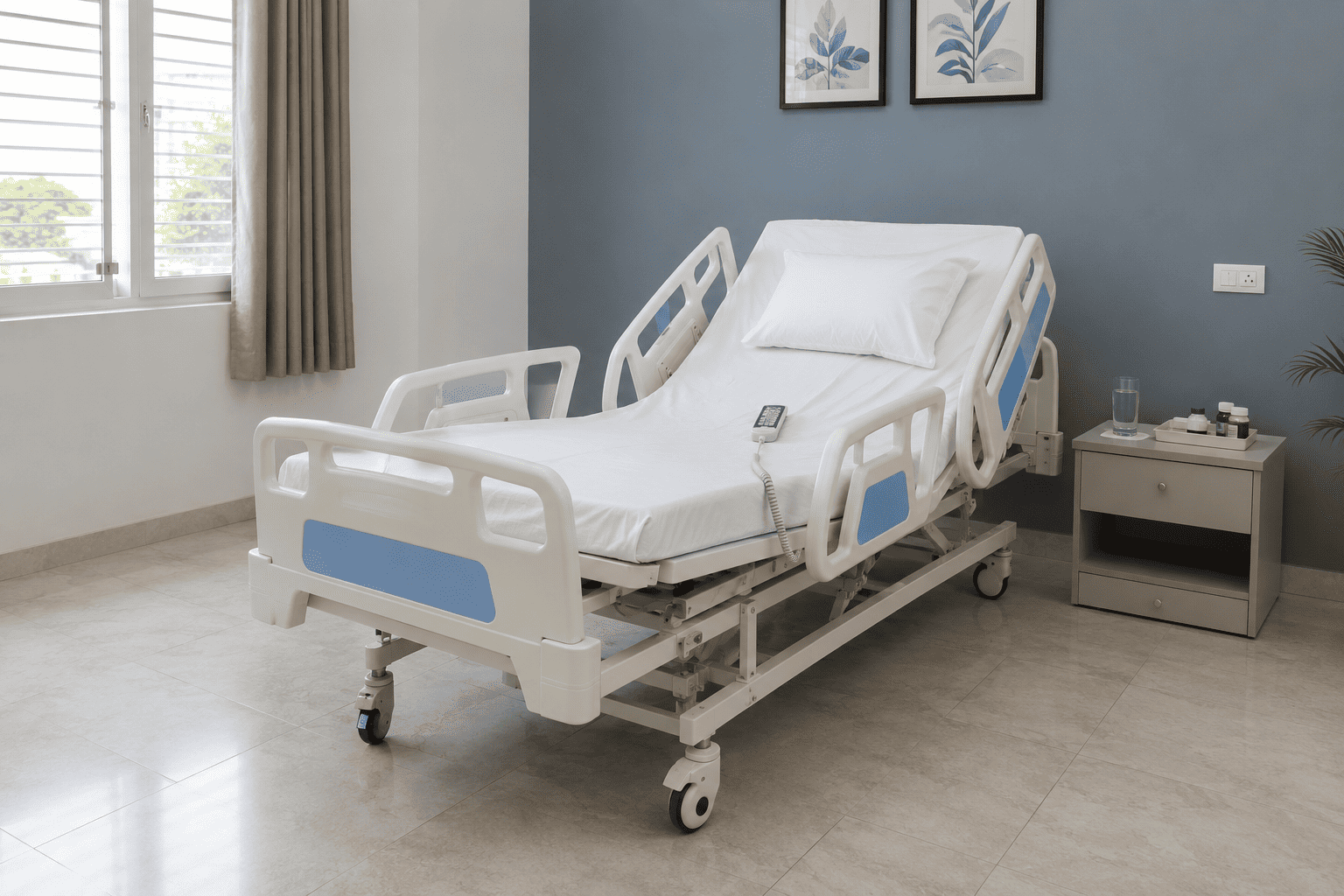
Four things: an adjustable backrest, a knee or leg raise, height adjustment, and side railings, on a firm base with locking wheels. Each one solves a specific daily problem — sitting up to eat, stopping the patient sliding down, saving the caregiver's back, and preventing a roll out of bed.
Backrest elevation
Sits the patient upright for meals, medicines, breathing exercises and chest clearance, without anyone hauling them forward.
Knee break
Raises the knees slightly so the patient does not slide down the bed when the backrest is up. Sliding is what shears the skin over the tailbone.[1]
Height adjustment
Raises the bed to the caregiver's waist for turning and cleaning, then lowers it for a safe transfer into a wheelchair.[2]
Side railings
Stop a confused or restless patient rolling out, and give the patient something solid to pull against when turning.[3]
Firm base
A soft household mattress sinks in the middle, which makes every transfer and turn harder and worsens pressure points.
Locking castors
The bed can be moved for cleaning or an emergency, then locked so it does not shift mid-transfer.
How do you decide whether you need one?
Answer five questions about the patient's movement, not their diagnosis. If the answer to two or more is no, a hospital bed is usually worth it. If the answer to all five is yes, a normal bed with a back rest will probably do.
- Can the patient get in and out of bed without help?
- Can they sit themselves up from lying flat?
- Can they shift and reposition their own weight in bed?
- Can they get to the bathroom safely, day and night?
- Is the recovery expected to be short, under about two weeks?
There is a sixth question that families rarely ask themselves: who is going to do the physical work, and can their back take it? An elderly spouse caring for an elderly patient on a low double bed is the situation where a hospital bed makes the most difference, even when the patient's own needs are moderate.[2]
| Surgery or condition | Hospital bed usually | Why |
|---|---|---|
| Hip replacement | Yes, height adjustment matters most | A low bed forces the hip past the safe bending angle when getting up[4] |
| Knee replacement | Often yes, for the first few weeks | Backrest and height make getting in and out possible without twisting the knee |
| Spine surgery | Yes | Backrest lets the patient sit up without bending or twisting the spine |
| Major abdominal surgery | Usually yes | Sitting up unaided strains the wound; the backrest removes that entirely |
| Cardiac surgery | Usually yes | Sternal precautions prevent pushing up with the arms, and upright positioning helps breathing |
| Stroke with weakness | Yes | Positioning, turning, feeding angle and transfers all depend on the bed |
| Long-term bedridden care | Yes, with an air mattress | Pressure care and safe handling are daily, not occasional |
| Cataract, dental, minor day surgery | No | Mobility is barely affected; extra pillows are usually enough |
| Laparoscopic or keyhole surgery, walking on day one | Usually no | Short recovery with independent movement does not need equipment |
What do 1, 2, 3 and 5 function beds actually mean?
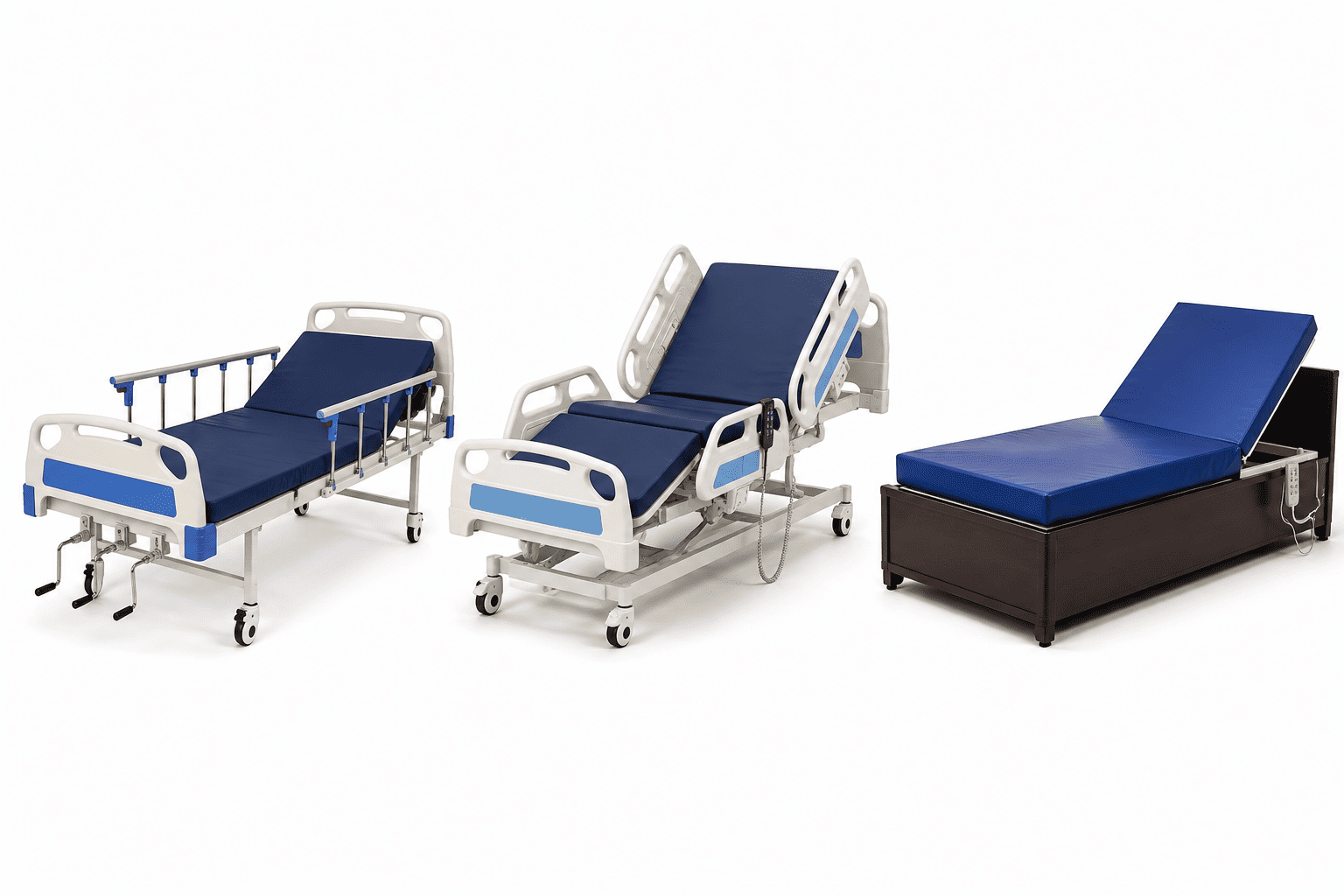
The number counts the movements the bed can make. One function is the backrest only. Two adds the knee raise. Three adds height adjustment — the point at which the bed starts helping the caregiver as much as the patient. Five adds Trendelenburg and reverse Trendelenburg, which tilt the whole bed head-down or foot-down.
| Bed type | Movements | Best suited for |
|---|---|---|
| Semi-Fowler (manual, 2 crank) | Backrest and knee raise, by hand crank | Short recoveries, budget-conscious families, patients who mainly need to sit up |
| Fowler / full manual (3 crank) | Backrest, knee raise and height, by hand crank | Same as above where power supply is unreliable, but cranking several times a day is tiring |
| 1 function electric | Motorised backrest only | Patients who can move but need to sit up often and want to do it themselves |
| 2 function electric | Motorised backrest and knee raise | Post-operative patients who slide down the bed when propped up |
| 3 function electric | Backrest, knee raise and height adjustment | The usual choice for most home recovery and long-term care, because height protects the caregiver |
| 5 function electric | Adds Trendelenburg and reverse Trendelenburg tilt | Fully dependent, high-dependency and ICU-at-home patients under medical supervision |
| ICU / Paramount grade | Five functions plus advanced positioning and clinical features | Ventilated, tracheostomy and critical-care patients being managed at home |
Trendelenburg is not a comfort setting
Tilting the whole bed head-down is a clinical position used for specific medical reasons, and it can raise pressure inside the head, worsen breathing and increase reflux in the wrong patient. It should only be used when the treating doctor has specifically advised it. For everyday home recovery, a five-function bed offers little that a three-function bed does not.
Manual or electric?
| Consideration | Manual (crank) | Electric (remote) |
|---|---|---|
| Cost | Lower rental and purchase price | Higher, but usually justified beyond a few weeks |
| Effort per adjustment | Someone must crank at the foot of the bed each time | A button press, from the bed or the bedside |
| Patient independence | None — the patient always needs to call someone | The patient can sit themselves up, which matters psychologically |
| Night use | Every position change wakes the caregiver | Small adjustments can be made without help |
| Power dependence | Works in any power cut | Needs a socket; most beds have a manual override for emergencies |
| Best for | Short recoveries, mobile patients, unreliable power supply | Anything over a few weeks, dependent patients, elderly caregivers |
The bed and the mattress are two separate decisions
A hospital bed solves positioning and handling. It does not solve pressure. For a patient who can shift their own weight, a firm foam mattress is fine. For a patient who cannot, an alternating pressure air mattress is needed on top of the bed, and it works alongside two-hourly repositioning rather than replacing it.[1]
- Firm foam mattress — patients who move independently and are in bed only part of the day.
- Bubble type alternating mattress — moderate risk, lighter patients, shorter-term use.
- Tubular alternating mattress — fully immobile, high-risk and long-term bedridden patients.
- Waterproof breathable protector — for incontinence, instead of a rubber sheet that traps sweat.
Which mattress, how often to turn, and how to spot a sore before the skin breaks are covered in pressure sore prevention at home.
Which accessories are worth having?
| Accessory | What it does | Worth it when |
|---|---|---|
| Side railings | Prevent rolling out, and give the patient a handhold for turning | Almost always; essential for confused, restless or heavily sedated patients[3] |
| Over-bed table | Meals, medicines, phone and books at the right height without leaning | Any patient spending most of the day in bed |
| IV pole | Holds drips and feed bags at the correct height | IV medication, Ryle's tube or PEG feeding at home |
| Self-lift pole (monkey pole) | Lets the patient pull themselves up using their arms | Strong upper body with weak legs, such as after knee or leg surgery |
| Mattress protector | Keeps the mattress hygienic without trapping sweat | Incontinence, drainage, or heavy sweating |
| Back rest wedge | Props the upper body up on a normal bed | Short recoveries where no hospital bed is needed at all |
Should you rent or buy a hospital bed?
Rent for anything under roughly six months, buy when the need is clearly permanent. Post-surgical patients typically need a bed for four to eight weeks and the requirement shrinks as they recover, so a rented bed goes back. Long-term bedridden care, where the requirement is stable and open-ended, is where purchase starts to make sense.
| Consideration | Renting | Buying |
|---|---|---|
| Upfront cost | Monthly rental plus a refundable deposit | Full price immediately, usually right after hospital bills |
| If the patient improves | Bed goes back when it is no longer needed | It occupies a room, and used medical equipment resells poorly |
| If needs change | A 2-function can usually be swapped for a 3-function or an ICU bed | A different requirement means buying again |
| Servicing | Usually covered during the rental period | Owner's responsibility after warranty |
| Installation | Delivered, assembled and demonstrated in the room | Depends on the seller; often delivered flat-packed |
| Long stable requirement | Rental adds up over years | Makes sense once the need is clearly permanent |
A practical middle path many families use: rent for the first two to three months while the picture is still changing, and only convert to a purchase if it becomes clear the bed will be needed indefinitely.
What to check before and at delivery
Check the room, the route and the bed itself. A bed that cannot get through the staircase turn, or that leaves no working space beside it, creates a bigger problem than the one it solves.
Before it arrives
- Measure the route — main door, staircase turn, lift, and the bedroom door.
- Plan the position so at least 90 cm stays clear on the working side and 60 cm on the other, with the headboard against a solid wall.
- Check the sockets if the bed is electric, and keep one free near the head of the bed.
- Clear the room of furniture that will not be used during the recovery.
- Confirm bed size and weight capacity against the patient, especially for a heavier patient.
- Ask what the rental includes — mattress, railings, over-bed table, delivery, installation and service.
At delivery, before the team leaves
- Run every function — backrest, knee, height, and the manual override if it is electric.
- Test the railings lock and release smoothly on both sides.
- Lock the castors and push the bed to confirm it does not move.
- Run the mattress pump for ten minutes and set the firmness to the patient's weight.
- Have the remote explained to whoever will actually use it, including the patient.
- Get the service number and ask what happens if something fails at night.
Room layout, clearances, electrical planning and the fall-safety sweep are covered in full in how to set up a patient room at home and fall prevention during recovery.
When you do not need a hospital bed
When the patient walks, sits up and gets out of bed on their own. Buying or renting equipment that is not needed does not speed recovery, and in one specific way it slows it: a patient who stays in bed because the bed is comfortable loses strength faster than one who gets up.[5]
- Cataract, dental and most day-care procedures — mobility is barely affected.
- Laparoscopic surgery where the patient walks on day one — a back rest wedge is usually enough.
- Short recoveries under two weeks in an otherwise independent patient.
- Patients already using a firm, correct-height bed who only need help sitting up — a back rest and a self-lift pole may be all that is required.
What helps in these cases: a firm mattress rather than a soft one, a back rest wedge, a bedside table within reach, a night light, and a commode chair beside the bed for the first nights if the bathroom is far.
When should the bed go back?
When the patient is getting in and out of it independently and sleeping through the night without adjustments — and once the physiotherapist agrees. Keeping a hospital bed longer than needed is not harmless, because a bed that is easy to lie in is also easy to stay in.
- The patient sits up and gets out unaided, several times a day, without using the remote.
- No night-time position changes are needed by anyone else.
- Transfers no longer need the height adjustment or the railings.
- The physiotherapist confirms that a normal bed is safe at the patient's current mobility.
- Return before the next rental cycle rather than paying for a month of storage.
Where Healthy Jeena Sikho delivers and installs hospital beds
Delhi NCR: Delhi, Noida, Greater Noida, Gurugram, Faridabad and Ghaziabad.
Chandigarh Tricity: Chandigarh, Mohali, Panchkula and Kharar, served from the head office and store in Sector 73, Mohali, Punjab.
Punjab: Ludhiana, Jalandhar and Bathinda.
Rajasthan and Uttar Pradesh: Jaipur and Lucknow.
Equipment sales are available more widely across India. Delivery, installation, home nursing and attendant support are limited to the cities listed above, subject to serviceable pin code and stock. Call +91 98769 78488 or WhatsApp +91 98759 15278.
How Healthy Jeena Sikho supplies hospital beds
- The right type, not the biggest one. Semi-Fowler, 1, 2, 3 and 5 function electric, ICU and Paramount grade beds, recommended against how the patient actually moves.
- Free home assessment before delivery. The team checks the route, the room, the working clearance and the sockets, so nothing is discovered on delivery day.
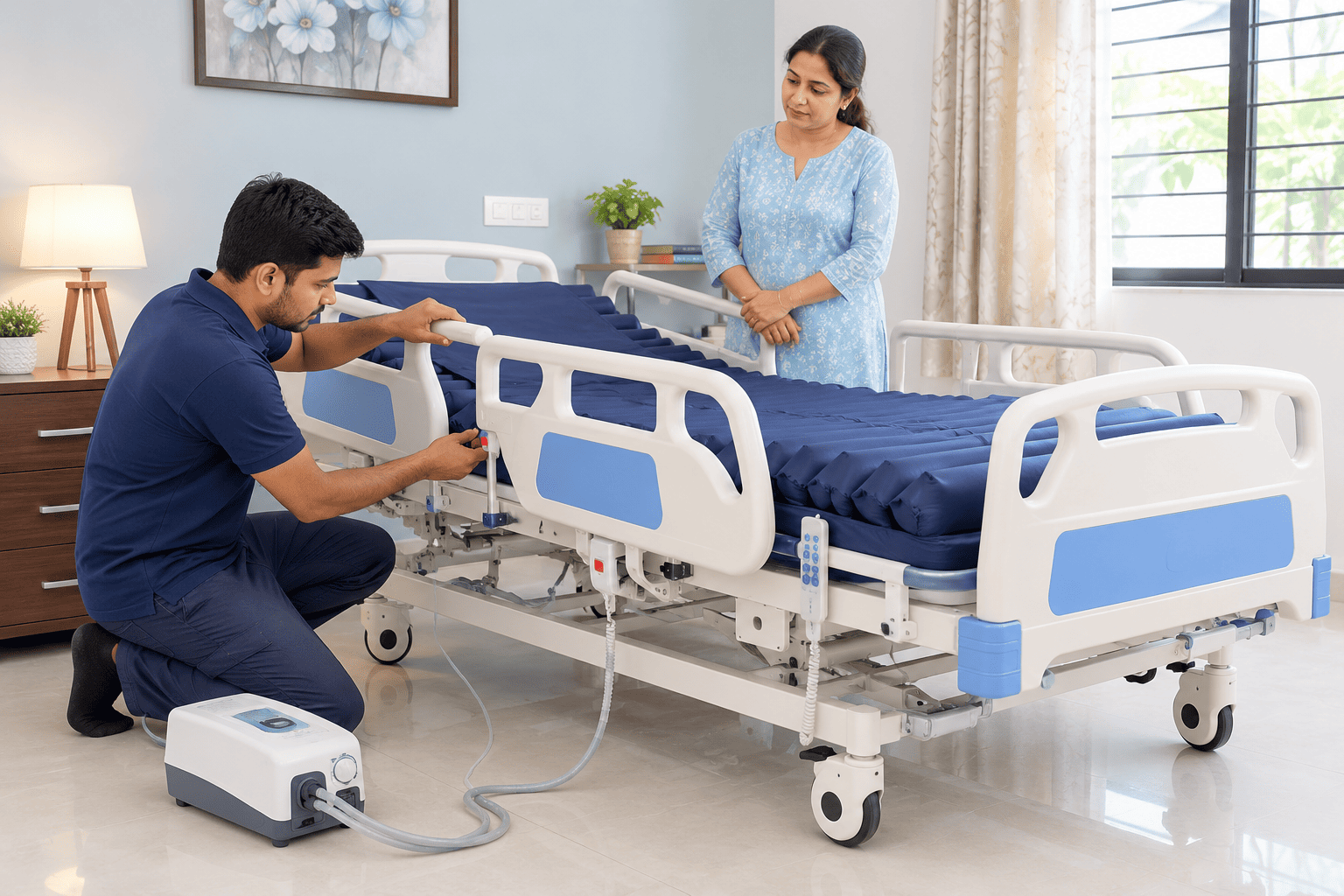
- Installed in position and demonstrated. A technician assembles the bed where it will stand, fits the railings, runs the mattress pump and shows the family and patient how to use it.
- Bed, mattress and accessories together. Air and alpha mattresses, side railings, over-bed tables, IV poles and self-lift poles supplied as one arrangement.
- Monthly rental with service support. Equipment is serviced during the rental period, upgraded if the requirement changes, and returned when it is no longer needed.
- Delivery across North India. Delhi, Noida, Greater Noida, Gurugram, Faridabad, Ghaziabad, Chandigarh, Mohali, Panchkula, Kharar, Ludhiana, Jalandhar, Bathinda, Jaipur and Lucknow.
Bed models and current options are listed on the hospital bed on rent page. For the complete setup see after surgery recovery at home, joint replacement recovery at home, bedridden patient care at home or ICU care at home. Safe handling on the bed is covered in how to move and transfer a patient.
Free home assessment and same-day installation may be available in serviceable locations, subject to stock and service availability. Call +91 98769 78488 or WhatsApp +91 98759 15278.
Frequently Asked Questions About Hospital Beds at Home
Is a hospital bed necessary after surgery?
Not always. It depends on movement rather than on the surgery itself. If the patient can get in and out of bed, sit up unaided and reach the bathroom safely, a normal bed with a back rest is usually enough. If they cannot do those things, or if the caregiver is elderly and will be turning and lifting daily, a hospital bed becomes worthwhile.
What is the difference between a 2 function and 3 function hospital bed?
A 2 function bed adjusts the backrest and the knee raise. A 3 function bed adds height adjustment, which lets the caregiver raise the bed to waist level for turning and cleaning and lower it for transfers. That third function is what protects the caregiver's back, and it is the reason 3 function is the usual choice for anything beyond a short recovery.
Do you need a 5 function bed at home?
Rarely, for routine recovery. The two extra movements on a 5 function bed are Trendelenburg and reverse Trendelenburg, which tilt the whole bed head-down or foot-down. These are clinical positions used on medical advice, not comfort settings, and they matter mainly for fully dependent or ICU-at-home patients. Most home recoveries are well served by a 3 function bed.
Manual or electric hospital bed — which is better?
Manual costs less and works during power cuts, but someone has to crank at the foot of the bed for every adjustment. Electric lets the patient sit themselves up with a remote, which matters several times a day and through the night. For anything beyond a few weeks, or where the caregiver is elderly, electric is usually worth the difference. Most electric beds also have a manual override for emergencies.
Should a hospital bed be rented or bought?
Rent for anything under roughly six months. Most post-surgical patients need a bed for four to eight weeks and the requirement shrinks as they recover, so a rented bed can be returned or downgraded. Purchase makes sense once the requirement is clearly permanent, as in long-term bedridden care.
Does a hospital bed come with a mattress?
That depends on the supplier and the package, so confirm it before booking. The bed and the mattress are separate decisions in any case: a firm foam mattress suits patients who can shift their own weight, while an alternating pressure air mattress is needed for patients who cannot, and it works alongside two-hourly repositioning rather than replacing it.
How much space does a hospital bed need in a room?
Plan for at least 90 cm of clear floor on the working side, 60 cm on the other side and 75 cm at the foot, with the headboard against a solid wall. Also measure the route in — main door, staircase turn, lift and bedroom door — because a bed that cannot reach the room is a common and avoidable problem on delivery day.
Are side railings safe for every patient?
They prevent rolling out of bed and give the patient a handhold for turning, which is why they suit most dependent patients. For a confused or restless patient who may try to climb over them, the treating team should advise, since climbing over a railing causes a worse fall than rolling off a low bed. Railings should always be fully raised or fully lowered, never left partly up.
Can a hospital bed be used for a heavier patient?
Yes, but check the weight capacity before booking rather than assuming. Standard frames have a stated safe working load, and bariatric beds with reinforced frames and wider sleeping surfaces are available for patients above that limit. A wider bed also needs more room clearance, so measure the space at the same time.
When should the hospital bed be returned?
When the patient gets in and out independently, needs no night-time position changes, and no longer relies on the height adjustment or railings for transfers, with the physiotherapist agreeing that a normal bed is safe. Returning it promptly matters, because a bed that is easy to lie in is also easy to stay in, and staying in bed costs strength.
In which cities does Healthy Jeena Sikho deliver hospital beds?
Delivery, installation, home nursing and attendant support are available in Delhi, Noida, Greater Noida, Gurugram, Faridabad, Ghaziabad, Chandigarh, Mohali, Panchkula, Kharar, Ludhiana, Jalandhar, Bathinda, Jaipur and Lucknow, subject to serviceable pin code and stock. Equipment sales are available more widely across India. Call +91 98769 78488 or WhatsApp +91 98759 15278 to check your location.
References and further reading
- National Institute for Health and Care Excellence (NICE). Pressure ulcers: prevention and management, clinical guideline CG179 — including support surface selection.
- Health and Safety Executive (UK). Moving and handling in health and social care — guidance on equipment that reduces manual handling risk for carers.
- Medicines and Healthcare products Regulatory Agency (MHRA). Safe use of bed rails — guidance on bed rail selection and entrapment risk.
- American Academy of Orthopaedic Surgeons. Activities and precautions after total hip and total knee replacement.
- World Health Organization. WHO global report on falls prevention in older age.
Medical disclaimer. This page is general educational information about hospital beds for recovery at home. It is not medical advice and does not replace assessment by a qualified physician, physiotherapist or occupational therapist. Whether a patient needs a hospital bed, which positions are safe, the use of tilt positions such as Trendelenburg, the choice of mattress and the use of bed rails must be determined by the treating clinical team, since these differ between patients. Healthy Jeena Sikho supplies, installs and services home medical equipment and arranges nursing, attendant and physiotherapy services, and does not diagnose conditions or independently set clinical parameters.