
Wheelchair Use During Recovery: Choosing the Right Size and Using It Safely

The short version
- A wheelchair that is too wide is not "comfortable", it is wrong. Seat width should be the patient's hip width plus roughly 2.5 to 5 cm in total. Extra width means poor posture, sore shoulders, and a chair that will not fit through your bathroom door.[1]
- Two or three fingers behind the knee. That is the correct seat depth. Too deep and the seat edge presses into the back of the knee; too shallow and the thighs get no support.[1]
- Sitting is higher pressure than lying. The whole upper body rests on two small sit bones, so a cushion and a position shift every 15 to 30 minutes matter more in a chair than in bed.[3]
- Down a ramp, go backwards. Pushing a chair forwards down a slope tips the patient out. Turn around and walk down backwards, controlling the descent.[2]
- Never let anyone stand on the footplates. The chair tips forward. Swing the footrests away before every transfer, every time.
- Soft tyres mean brakes that do not hold. Wheelchair brakes work by pressing on the tyre. Check tyre pressure weekly — it is the most-skipped safety check in home care.[2]
Most families buy or rent a wheelchair the day before discharge, choose whichever one is in stock, and discover afterwards that it does not fit through the bathroom door, that the patient slides forward in it within ten minutes, and that nobody knows how to get it down the two steps at the gate. A wheelchair is a piece of prescribed equipment with measurements, not a chair with wheels. This guide covers how to size one, how to use it safely at home and outside, and when the patient should be moving off it.
Who needs a wheelchair during recovery, and for how long?
Anyone whose walking endurance is shorter than the distances they need to cover. That includes patients who can walk a few steps indoors but cannot manage a corridor, a hospital follow-up visit or a trip to the car. Most recovery patients need one for a few weeks to a few months, which is why renting usually makes more sense than buying.
The important distinction families miss: a wheelchair for distance does not replace walking practice. After a stroke or joint replacement, the patient should still be walking the amount their physiotherapist has prescribed, and using the chair for the journeys that walking cannot yet cover. Used that way, a wheelchair increases activity rather than reducing it, because the patient actually leaves the house.
| Situation | Typical wheelchair need | Usual duration |
|---|---|---|
| Knee or hip replacement | Outdoor distances and hospital visits while walking builds up | 2 to 8 weeks |
| Stroke with one-side weakness | Daily use early on, tapering as gait training progresses | 3 to 6 months |
| Major abdominal or cardiac surgery | Short-term, mainly for fatigue and hospital follow-ups | 2 to 6 weeks |
| Spine surgery | Only if prescribed; many patients are encouraged to walk instead | As advised by the surgeon |
| Fracture with no weight bearing | Primary mobility until weight bearing is allowed | 6 to 12 weeks |
| Elderly with low endurance | Distance use alongside a walker indoors | Long term, reviewed periodically |
| Bedridden patient | Getting out of bed daily, which helps lungs, mood and skin | Long term |
Durations above are general patterns, not a prescription. The physiotherapist decides when a specific patient is ready to reduce wheelchair use.
Which type of wheelchair is right?
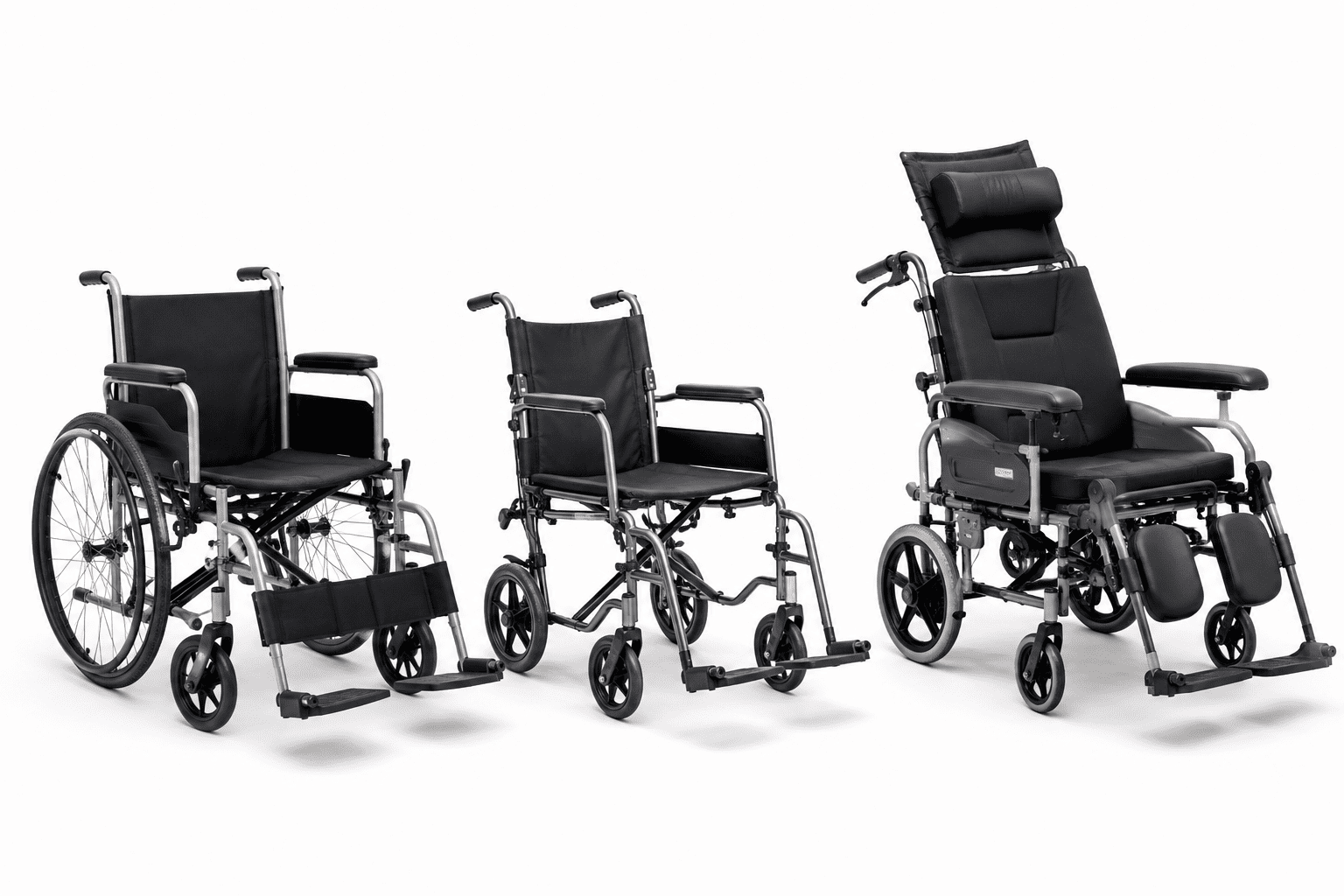
It depends on who is doing the pushing and how much trunk control the patient has. A patient with strong arms who wants independence needs large rear wheels to self-propel. A patient who will always be pushed by someone else is better served by a lighter transport chair. A patient who cannot sit upright unsupported needs a reclining high-back chair.[1]
| Type | Best for | Trade-off |
|---|---|---|
| Standard folding wheelchair | Most recovery patients; large rear wheels allow self-propelling and a caregiver can push | Heavier to lift into a car boot |
| Transport / attendant-propelled chair | Patients who will always be pushed; small wheels, lighter, more compact | The patient cannot move it themselves at all |
| Lightweight folding chair | Frequent car travel and hospital visits, or an elderly caregiver | Costs more than a standard chair |
| Reclining high-back chair | Poor trunk control, very weak patients, long sitting periods, pressure relief by tilting | Bulky, harder to manoeuvre in a small Indian flat |
| Elevating leg-rest chair | Knee replacement, leg fractures, swelling that needs the leg raised | Longer footprint, harder to turn in tight spaces |
| Commode wheelchair | Patients who cannot walk to the bathroom; wheels to the toilet and doubles as a commode | Not designed for long sitting or outdoor use |
| Hemiplegia (low-seat) chair | Stroke patients who propel using the sound foot on the floor | Lower seat makes standing up harder without armrest support |
| Powered / electric wheelchair | Long-term users with weak arms who want independence | Heavy, needs charging, and rarely justified for short recovery |
| Bariatric wheelchair | Heavier patients, with a reinforced frame and wider seat | Wider overall, so doorway width must be checked first |
How do you measure for the right wheelchair size?
Measure the patient seated, not standing, and match four numbers: seat width, seat depth, seat height and backrest height. Getting seat width and depth right solves most posture, sliding and pressure problems before they start.[1]
| Measurement | How to take it | Why it matters |
|---|---|---|
| Seat width | Measure across the widest part of the hips while seated, then add roughly 2.5 to 5 cm in total | Too narrow presses on the hips; too wide causes leaning, shoulder strain and a chair that will not fit through doors |
| Seat depth | From the back of the buttock to the back of the knee, then subtract about 5 cm — roughly two to three fingers of clearance | Too deep presses behind the knee and restricts circulation; too shallow leaves the thighs unsupported |
| Seat height and footrest | Feet flat on the footplates with thighs level or very slightly higher than the knees; footplates at least 5 cm off the ground | Wrong height throws weight onto the tailbone or lets the footplates catch on kerbs and thresholds |
| Backrest height | Just below the shoulder blades for a patient who self-propels; higher for a patient with poor trunk control | A backrest that is too high blocks arm movement; too low gives no support to a weak trunk |
| Armrest height | Elbows resting at about 90 degrees with the shoulders relaxed and level | Too high hunches the shoulders; too low makes the patient lean and slump |
| Overall width | Measure the chair's total width and compare with your narrowest doorway | A standard chair is roughly 60 to 66 cm wide and needs about 75 to 80 cm of clear door opening[4] |
Measure your doorways before the chair arrives
The commonest and most expensive mistake is a chair that cannot reach the bathroom. Measure the actual clear opening of every door the chair must pass through — the gap when the door is fully open, not the frame — plus the width of any corridor turn. Also check the lift, if there is one, and the gate. It takes ten minutes and saves an exchange.
Seating posture and pressure care in a wheelchair
A seated patient carries their entire upper-body weight on two small sit bones, which makes pressure per square centimetre higher in a chair than in bed. Use a proper pressure-relieving cushion, shift position every 15 to 30 minutes, and limit unbroken sitting time rather than treating chair time as a rest from pressure care.[3]
Getting the posture right
- Hips right back in the seat before anything else. A patient who starts perched forward will slide.
- Both feet flat on the footplates, or flat on the floor if the patient propels with their feet.
- Weak arm supported on the armrest, a pillow or a tray after a stroke — never left hanging, which pulls on the shoulder.[5]
- Cushion under the sit bones, not a folded towel or a donut ring, which concentrates pressure instead of spreading it.
- Position shift every 15 to 30 minutes — leaning to one side, leaning forward, or being tilted back in a reclining chair.
- Check the skin over the sit bones and tailbone daily, the same as for a bedridden patient.
- Watch for sliding forward. A patient who slumps into a semi-lying position in the chair is shearing the skin over the tailbone.
The turning schedule, the blanch test and cushion choice are covered in detail in pressure sore prevention at home, and the same rules apply in the chair as in the bed.
How to push a wheelchair safely

On the flat, push steadily with the brakes off and the patient's arms and feet inside the chair. On slopes, go up forwards and come down backwards, and on kerbs and thresholds tilt the chair back on its rear wheels using the tipping lever so the small front castors clear the edge.[2]
Slopes and ramps
- Going up: face forwards, lean into the push, keep a steady pace and do not stop halfway on a steep slope.
- Coming down: turn around and walk backwards, letting the chair come down in front of you under control. Pushing forwards down a slope tips the patient out.
- Never leave the chair unattended on a slope, even with the brakes on.
- A home ramp should be gentle — roughly a 1:12 gradient, meaning 12 units of length for every 1 unit of height, if the patient is to manage it independently. Steeper ramps always need an assistant.[4]
Kerbs, thresholds and steps
- Going up a kerb: approach square on, press down on the tipping lever with your foot while pulling back on the handles to lift the front castors onto the kerb, then push forward so the rear wheels roll up.
- Coming down a kerb: turn around, roll the rear wheels down first while walking backwards, then lower the front castors gently.
- Steps and staircases need two people minimum and preferably should be avoided altogether. One person should never take a loaded chair down stairs.
- Tell the patient before you tilt. An unwarned tilt makes people grab, lean or panic, which is when chairs go over.
Rules that prevent most wheelchair accidents
- Brakes on before every transfer, and check them by pushing the chair.
- Swing the footrests away before the patient stands. Standing on a footplate tips the chair forward.
- Keep hands, elbows and clothing away from the wheels, especially loose dupattas and saree pallus, which catch in the spokes.
- Do not hang heavy bags on the push handles. The weight tips the chair backwards when the patient is not seated.
- Fit anti-tip bars if the chair has them available, particularly for patients who lean back.
- Do not use a wheelchair as a car seat. The patient transfers into the vehicle seat.
Using a wheelchair in an Indian home and neighbourhood
The chair is rarely the limiting factor — the building is. Narrow doorways, a step at every threshold, a lift that is smaller than the chair, and footpaths with no kerb ramp are what actually keep patients indoors. Solve these before blaming the equipment.
| Obstacle | Practical fix | Note |
|---|---|---|
| Narrow bathroom door | Use a narrower transport chair or a commode wheelchair, or transfer to a walker at the door | Removing the door stopper often gains the few centimetres needed |
| Raised threshold at every door | Small rubber or wooden threshold ramps | Cheap, and they also help walker users |
| Steps at the main gate | A portable folding ramp, or two people to lift the chair | Never one person alone on more than a single step |
| Small lift | Measure the lift interior before choosing the chair; consider a compact transport chair | Reversing in is usually easier than turning inside |
| Uneven footpaths and open drains | Larger rear wheels handle rough surfaces better than small castors | Plan the route in advance rather than improvising outside |
| Car transfer | Park close, transfer to the car seat, then fold the chair into the boot separately | A lightweight chair matters most for families making frequent hospital trips |
| Monsoon and wet ramps | Anti-slip strips on home ramps and extra care with braking | Wet tyres slow braking noticeably |
What changes for specific conditions
| Condition | Chair setup | Watch for |
|---|---|---|
| Stroke / hemiplegia | Lower seat height if the patient propels with the sound foot; weak arm supported on the armrest or a tray | Weak arm slipping off and hanging, which causes shoulder pain and blocks rehabilitation |
| Knee replacement | Elevating leg rest to support the operated leg and manage swelling | The leg rest catching on doorways and furniture when turning |
| Hip replacement | Higher seat so the hip does not bend deeply; transfer towards the unoperated side | Low seats and deep bending to reach the footplates |
| Spine surgery | Firm upright back support, no slouching, brace worn if prescribed | Sliding forward into a slumped position, which loads the spine |
| Amputation | Rear wheels set back and anti-tip bars fitted, because the centre of gravity shifts backwards | Tipping backwards on slopes and kerbs |
| Bedridden or very weak patients | Reclining high-back chair with headrest and a pressure cushion | Long unbroken sitting and pressure over the sit bones |
| Catheter in place | Bag hung below bladder level on the chair frame, tubing given slack | Tubing caught in the wheel or bag lifted above the bladder |
| Oxygen dependent | Cylinder holder fitted to the chair, tubing routed clear of the wheels | Tubing dragging on the ground or wrapping around a castor |
Weekly wheelchair safety check

The single most important item is tyre pressure. Most wheelchair brakes work by pressing a pad against the tyre, so a soft tyre means the brake will not hold — and it will not hold at exactly the moment the patient is transferring into the chair.[2]
- Tyre pressure weekly on pneumatic tyres, inflated to the pressure printed on the tyre wall.
- Brakes tested by pushing the chair with the brakes engaged — it should not move at all.
- Front castors spun by hand to check for hair, thread or grit wound around the axle, which makes the chair veer.
- Footplates checked for cracks, and the swing-away mechanism checked for smooth movement.
- Folding cross-brace and armrest locks checked for looseness or missing screws.
- Upholstery checked for sagging, which throws the pelvis out of position and causes sliding.
- Cushion checked for flattening; a compressed cushion has stopped protecting the skin.
- Anything wobbly reported to the supplier rather than tightened with household tools.
When should the patient move off the wheelchair?
As soon as the physiotherapist says walking distance allows it — and usually in stages, not all at once. Most recovery patients move from wheelchair to walker indoors first, keep the chair for outdoor distance for a few more weeks, and then return it. Staying in a chair longer than needed costs muscle strength and confidence.
The usual progression is wheelchair, then walker, then a quad stick or single stick, then unaided walking, with each step signed off by the physiotherapist rather than decided at home. Some patients keep a chair permanently for long outings while walking normally indoors, and that is a sensible outcome rather than a failure.
This is also the practical argument for renting. A patient who needs a chair for six weeks and a walker for the four weeks after that pays for each only while it is in use, instead of owning two items that end up in a store room. Healthy Jeena Sikho bills monthly, so equipment can be swapped or returned as the patient progresses. Session planning for the walking side is covered in physiotherapy at home after hospitalisation.
Common mistakes with wheelchairs at home
| Mistake | What goes wrong | Fix |
|---|---|---|
| Choosing a wider chair for comfort | Patient leans to one side, shoulders strain, and the chair will not fit through the bathroom door. | Hip width plus roughly 2.5 to 5 cm in total, no more. |
| Skipping the cushion | Pressure sores over the sit bones, which are slower to heal than most bed sores. | Proper pressure-relieving cushion, not a folded blanket. |
| Transferring with footrests down | Patient steps on the footplate and the chair tips forward. | Swing footrests away or remove them every time. |
| Pushing forwards down a ramp | The patient is pitched out of the front of the chair. | Turn around and walk down backwards. |
| Ignoring tyre pressure | Brakes stop holding, and the chair rolls during a transfer. | Weekly pressure check as part of the routine. |
| Bags hung on the push handles | The chair tips backwards when the patient stands or is not seated. | Use an under-seat bag or carry it separately. |
| Sitting for hours without a break | Sliding, slumping and pressure damage over the tailbone. | Position shifts every 15 to 30 minutes and planned rests in bed. |
| Buying before measuring the doorways | The chair cannot reach the bathroom, which is the one place it is needed most. | Measure every clear door opening first, then choose. |
Where Healthy Jeena Sikho delivers wheelchairs
Delhi NCR: Delhi, Noida, Greater Noida, Gurugram, Faridabad and Ghaziabad.
Chandigarh Tricity: Chandigarh, Mohali, Panchkula and Kharar, served from the head office and store in Sector 73, Mohali, Punjab.
Punjab: Ludhiana, Jalandhar and Bathinda.
Rajasthan and Uttar Pradesh: Jaipur and Lucknow.
Equipment sales are available more widely across India. Delivery, installation, home nursing and attendant support are limited to the cities listed above, subject to serviceable pin code and stock. Call +91 98769 78488 or WhatsApp +91 98759 15278.
How Healthy Jeena Sikho helps with wheelchairs at home
- Free home assessment before delivery. The team checks doorway widths, thresholds, lift size and the route from bed to bathroom, so the chair that arrives actually fits the house.
- The full range on monthly rent. Standard folding, lightweight, transport, reclining high-back, elevating leg-rest and commode wheelchairs, matched to the patient's condition.
- Sized to the patient, not to stock. Seat width, depth and height chosen from the patient's measurements rather than whatever is available.
- Delivered assembled and demonstrated. Brakes, footrests, folding and the tipping lever are shown to the family before the team leaves.
- Swap as the patient improves. Wheelchair to walker to stick, with items returned at the end of the month they stop being used.
- Delivery and installation across North India. Delhi, Noida, Greater Noida, Gurugram, Faridabad, Ghaziabad, Chandigarh, Mohali, Panchkula, Kharar, Ludhiana, Jalandhar, Bathinda, Jaipur and Lucknow.
Models and current options are listed on the wheelchair on rent and electric wheelchair pages. For the wider setup, see recovering at home, joint replacement recovery at home or stroke recovery at home. Transfer technique is covered in how to move and transfer a patient, and bathroom access in bathroom safety after surgery or stroke.
Free home assessment and same-day delivery may be available in serviceable locations, subject to stock and service availability. Call +91 98769 78488 or WhatsApp +91 98759 15278.
Frequently Asked Questions About Wheelchair Use
How do I choose the right wheelchair size?
Measure the patient seated. Seat width should be the widest part of the hips plus roughly 2.5 to 5 cm in total. Seat depth should leave about two to three fingers of clearance behind the knee. The feet should rest flat on the footplates with the thighs level or very slightly higher than the knees, and the elbows should sit at about 90 degrees on the armrests with the shoulders relaxed.
Will a wheelchair fit through my bathroom door?
A standard wheelchair is roughly 60 to 66 cm wide and needs about 75 to 80 cm of clear door opening. Measure the actual gap when the door is fully open, not the frame, for every door the chair must pass through, plus any corridor turn and the lift. Where the bathroom door is too narrow, a narrower transport chair, a commode wheelchair, or transferring to a walker at the door are the usual solutions.
How often should a patient shift position in a wheelchair?
Every 15 to 30 minutes. Sitting concentrates the whole upper-body weight on two small sit bones, so pressure per square centimetre is higher in a chair than in bed. Leaning to one side, leaning forward or tilting back in a reclining chair all relieve it, alongside a proper pressure-relieving cushion.
How do you take a wheelchair down a ramp safely?
Backwards. Turn around and walk down with the chair in front of you, controlling the descent. Pushing a chair forwards down a slope can pitch the patient out of the front. Going up, face forwards with a steady pace, and never leave a chair unattended on a slope even with the brakes on.
How do you get a wheelchair over a kerb?
Approach square on, press down on the tipping lever with your foot while pulling back on the push handles so the front castors lift onto the kerb, then push forward so the rear wheels roll up. Coming down, turn around and bring the rear wheels down first while walking backwards. Tell the patient before you tilt, because an unwarned tilt makes people grab or lean.
Why do wheelchair brakes stop holding?
Usually because the tyres are soft. Most wheelchair brakes work by pressing a pad against the tyre, so low tyre pressure means the brake no longer grips. Check pneumatic tyres weekly against the pressure printed on the tyre wall, and test the brakes by trying to push the chair with them engaged.
Should a wheelchair be rented or bought?
Rent for recovery, buy for permanent need. Most post-surgical patients need a chair for a few weeks and most stroke patients for a few months, after which they move to a walker or stick. Renting monthly also allows the chair to be swapped if the size or type turns out to be wrong, which happens more often than families expect.
Which wheelchair is best for a stroke patient?
Often a lower-seat hemiplegia chair, which lets the patient propel using their sound foot on the floor, with the weak arm supported on the armrest or a tray so it never hangs unsupported. The final choice depends on trunk control, arm strength and how much the patient will self-propel, so the physiotherapist should advise before the chair is ordered.
Can a patient stay in a wheelchair all day?
No. Long unbroken sitting causes pressure damage over the sit bones and tailbone, sliding into a slumped posture, and stiffness. Break up chair time with position shifts every 15 to 30 minutes and planned rests lying down, and follow the physiotherapist's guidance on how long the patient should sit out each day.
When can a patient stop using a wheelchair?
When the physiotherapist confirms that walking distance and balance are sufficient, usually in stages: wheelchair to walker indoors first, chair kept for outdoor distance for a few more weeks, then returned. Staying in a chair longer than needed costs muscle strength and confidence, so the progression should be reviewed regularly rather than left to habit.
In which cities does Healthy Jeena Sikho deliver wheelchairs?
Delivery, installation, home nursing and attendant support are available in Delhi, Noida, Greater Noida, Gurugram, Faridabad, Ghaziabad, Chandigarh, Mohali, Panchkula, Kharar, Ludhiana, Jalandhar, Bathinda, Jaipur and Lucknow, subject to serviceable pin code and stock. Equipment sales are available more widely across India. Call +91 98769 78488 or WhatsApp +91 98759 15278 to check your location.
References and further reading
- World Health Organization. Guidelines on the provision of manual wheelchairs in less resourced settings — wheelchair selection, fitting and user training.
- World Health Organization. Wheelchair Service Training Package: Basic Level — measurement, cushion selection and safe wheelchair skills including slopes and kerbs.
- National Institute for Health and Care Excellence (NICE). Pressure ulcers: prevention and management, clinical guideline CG179 — including seating and repositioning.
- Bureau of Indian Standards. IS 4963: Recommendations for building and facilities for persons with disabilities — clear door widths, corridor space and ramp gradients.
- American Heart Association / American Stroke Association. Guidelines for adult stroke rehabilitation and recovery — including seating, positioning and shoulder protection.
Medical disclaimer. This page is general educational information about wheelchair use during recovery at home. It is not medical advice and does not replace assessment by a qualified physiotherapist or occupational therapist, who should advise on wheelchair type, size, cushion selection and how long the patient should sit out each day. Weight-bearing status, walking progression and post-surgical precautions must be determined by the treating clinical team, since these differ between patients. Ramps and home modifications should be built by a competent person. Healthy Jeena Sikho supplies, installs and services home medical equipment and arranges nursing, attendant and physiotherapy services, and does not diagnose conditions or independently set clinical parameters.