
When Should Physiotherapy Start After Knee Replacement? TKR Recovery Timeline
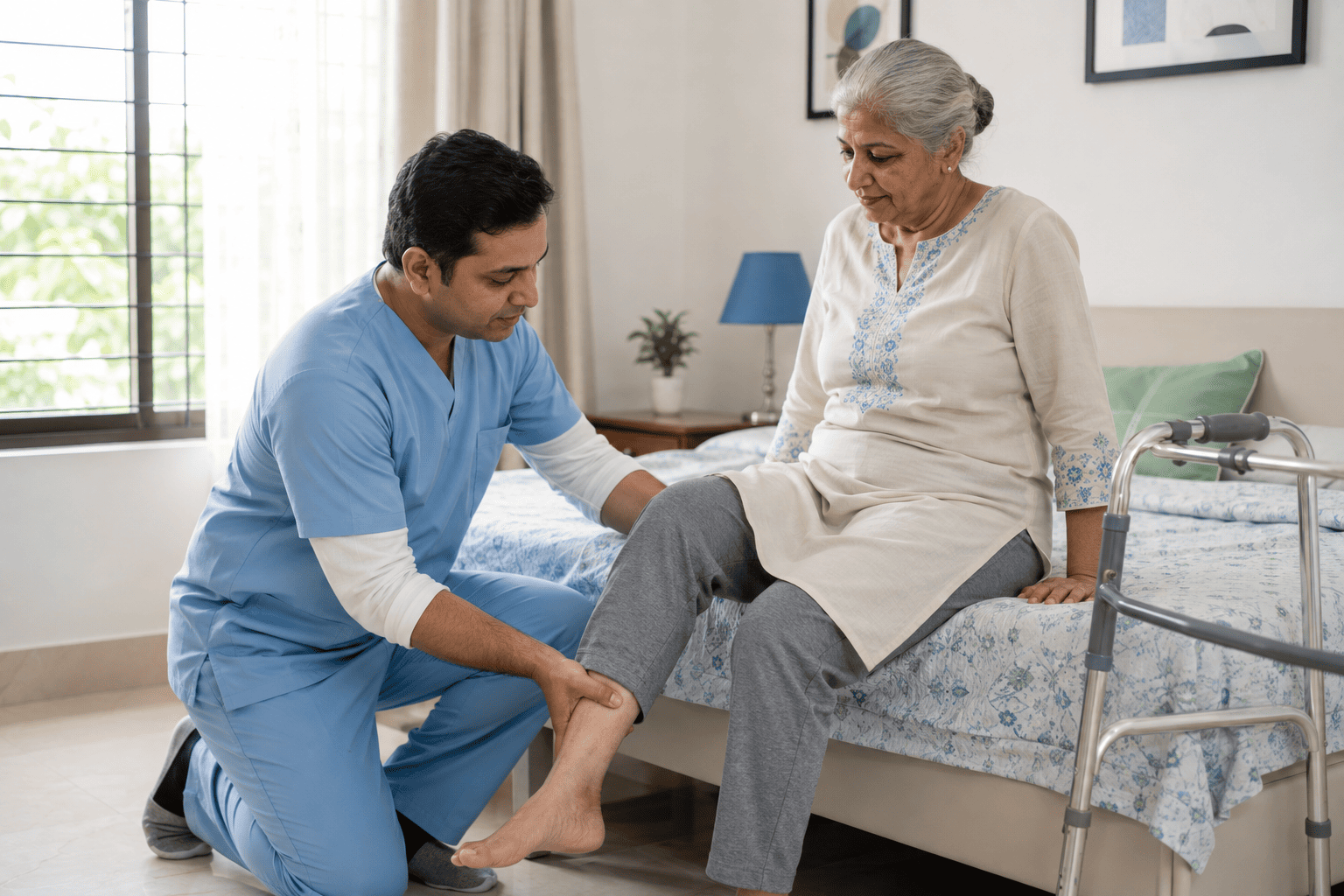
The short version
- Physiotherapy starts within 24 hours of surgery, not after discharge. NICE guidance recommends that a physiotherapist or occupational therapist offers rehabilitation within 24 hours of a primary knee replacement.2 Most patients stand and take a few steps on day zero or day one.
- The gap after discharge is where recoveries are lost. Families often wait one to two weeks to arrange home physiotherapy. Those are the most valuable weeks of the entire recovery.
- The first six weeks largely decide the final range of movement. Scar tissue matures over this period. Movement gained early is kept; stiffness allowed to set in becomes much harder to reverse.
- Getting the knee fully straight matters more than bending it early. A knee that will not straighten causes a permanent limp and ongoing pain. Full extension is the first priority.
- Swelling for weeks to months is normal. Some swelling and warmth around the knee can persist for three to six months and is not by itself a sign that something is wrong.
- If bending is not progressing by six to twelve weeks, say so early. Stiffness that is caught early can often be managed. Left alone, it may need a procedure under anaesthesia.
Most patients in Chandigarh, Mohali, Panchkula and Kharar leave hospital three to five days after a total knee replacement with a walker, a folder of medicines and the instruction "physiotherapy karwa lena". Then two weeks pass while the family looks for a physiotherapist, waits for the wound to settle, or decides the patient should rest first. That delay is the single most common reason a technically successful knee replacement ends with a stiff, painful knee. This guide sets out when physiotherapy actually starts, what happens week by week, and what milestones to expect.
When should physiotherapy start after knee replacement?
Within 24 hours of the operation. NICE guidance recommends that a physiotherapist or occupational therapist offers rehabilitation within 24 hours of surgery for people who have had a primary knee replacement, including a home exercise programme and getting the patient moving.2 In practice most patients are helped to stand and take a few supported steps on the day of surgery or the day after, and physiotherapy should then continue at home with no gap after discharge.3
This surprises many families, who expect rest first and exercise later. Knee replacement rehabilitation works the other way round. The knee is most willing to move in the first days and weeks, before scar tissue becomes organised and tight. Waiting for pain and swelling to settle completely before starting means starting after the easiest window has already closed.
| Stage | What physiotherapy involves | Who provides it |
|---|---|---|
| Day 0 to 1 (in hospital) | Ankle and breathing exercises, sitting up, standing, first supported steps with a walker | Hospital physiotherapist |
| Day 2 to discharge | Walking short distances, stairs practice if needed, early bending and straightening work, home exercise programme taught | Hospital physiotherapist |
| Discharge onwards | Continued daily exercises, range of movement work, strengthening, gait training, swelling management | Home physiotherapist, with the family supervising exercises between visits |
| The dangerous gap | Nothing, while the family arranges therapy or waits for the patient to feel stronger | Nobody — and this is where range of movement is lost |
Arrange the physiotherapist before discharge, not after
The most useful thing a family can do is book home physiotherapy while the patient is still in hospital, so the first home session happens within a day or two of coming home. Searching for a physiotherapist after discharge typically costs a week, and that week comes out of the period when progress is easiest to make.
Knee replacement scheduled or already done?
Healthy Jeena Sikho arranges qualified home physiotherapists across Chandigarh, Mohali, Panchkula and Kharar, so there is no gap between hospital and home.
Why the first six weeks decide the final result
Because the body lays down and then tightens scar tissue around the new joint over the early weeks. Range of movement gained while that tissue is still soft is generally kept. Range lost while it matures becomes progressively harder to recover, and beyond about three months, regaining lost bend often needs more than exercise alone.1
This is the reason physiotherapists push in the first six weeks in a way that can feel unsympathetic to families watching a parent in pain. The alternative is a comfortable first month followed by a permanently stiff knee. Two patients with identical surgery, identical implants and the same surgeon can end up with very different knees purely on the basis of what happened in weeks one to six.
Movement
Bending and straightening every day keeps the developing scar tissue mobile instead of letting it set short.
Swelling control
A swollen knee physically cannot bend fully. Ice, elevation and gentle movement reduce swelling and therefore increase range.
Quadriceps strength
The thigh muscle switches off after surgery. Reactivating it is what lets the patient straighten, stand and stop relying on a walker.
Pain control
Exercises done about half an hour after pain medication are done properly. Exercises done in severe pain are done badly or not at all.
Daily repetition
Three sessions a week with a therapist plus daily home exercise beats therapy alone. The home programme is where the range is won.
Walking
Walking with a correct pattern from the start prevents the limp that otherwise becomes a habit and outlasts the recovery.
The two numbers your physiotherapist is watching
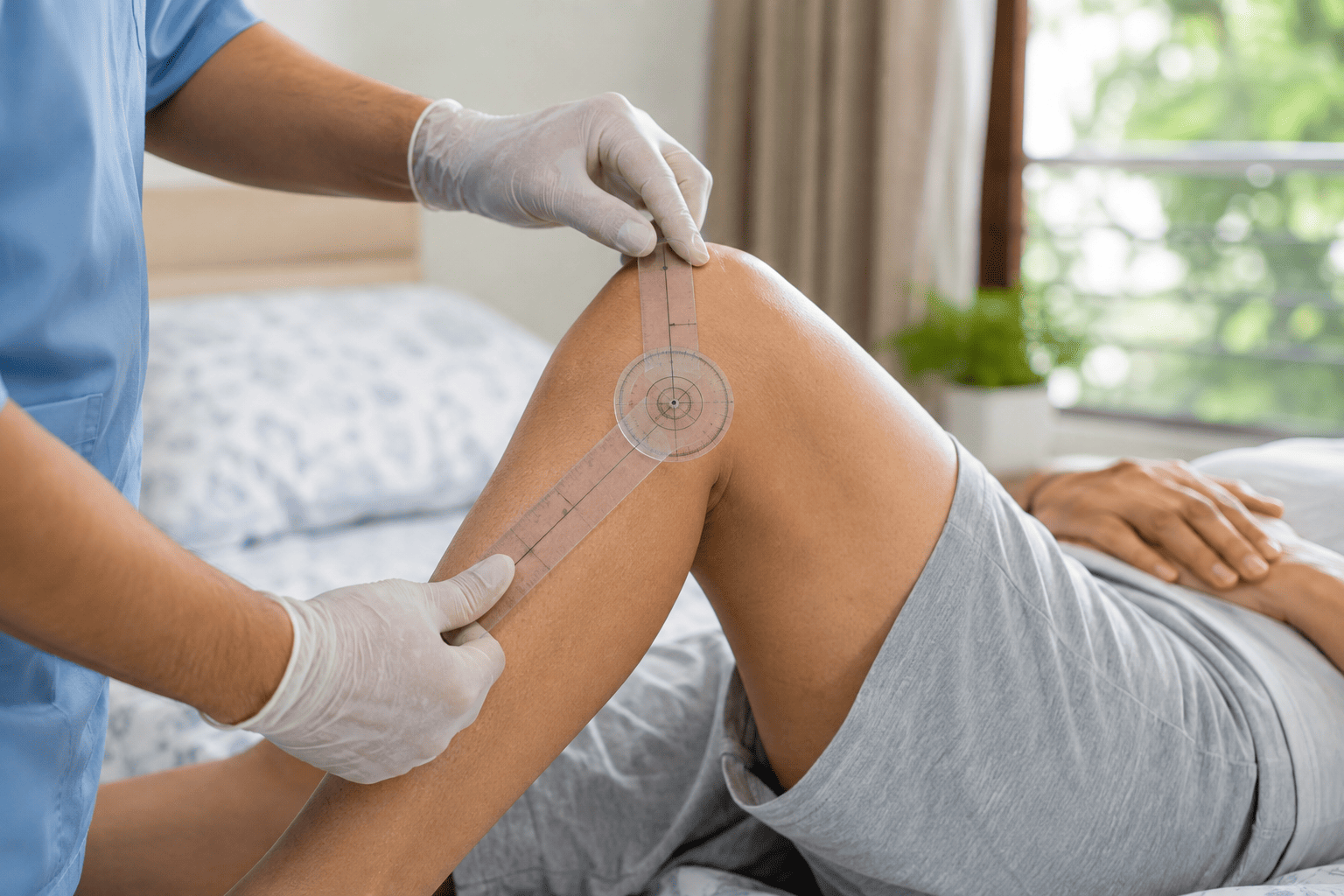
Extension and flexion — how straight the knee goes, and how far it bends. Extension is the first priority, because a knee that cannot straighten fully produces a limp, loads the other joints and causes lasting pain. Flexion determines what the patient can do: sit in a chair, climb stairs, get into a car, use an Indian-style toilet.
| Movement | Why it matters | Typical priority |
|---|---|---|
| Extension (straightening) | A knee that will not straighten causes a permanent limp, thigh muscle fatigue, and pain in the hip, back and other knee | First priority from day one. Harder to regain later than flexion |
| Flexion (bending) | Determines sitting, stairs, getting in and out of a car, and using a chair comfortably | Built steadily through the first three months |
| Quadriceps control | Needed to straighten the leg actively and to stop relying on a walker | Worked on from the first session |
| Walking pattern | A limp learned in week two can persist long after the knee itself has healed | Corrected continuously, not at the end |
Your surgeon and physiotherapist will set the specific targets for your knee and measure them at each review. Targets differ between patients depending on the implant, the pre-operative stiffness, body weight and what the knee was like before surgery, so comparing your numbers with a relative's is rarely useful.
Do not chase bending at the cost of straightening
Patients and families often focus entirely on how far the knee bends, because bending is visible and feels like progress. If the knee is not also going fully straight, tell the physiotherapist. A knee with good bend and poor extension is a worse functional outcome than the reverse.
TKR recovery timeline, phase by phase
The phases below describe a typical uncomplicated recovery. Individual timelines vary considerably with age, weight, the state of the knee before surgery, other medical conditions and how consistently the home programme is done. Your surgeon's protocol overrides any general timeline.
Phase 1 — Day 0 to Day 7
Goal: get moving, control swelling, protect the wound, get the knee straight.
- Physiotherapy begins within 24 hours of surgery in hospital.2
- Standing and walking short distances with a walker, usually from day zero or one.
- Ankle pumps and breathing exercises from the first day, to reduce clot and chest risk.
- Early work on straightening the knee fully, and gentle bending within comfort.
- Ice and elevation for swelling, as advised by the treating team.
- Discharge typically around day three to five, with home physiotherapy starting immediately.
- Walking to the bathroom with a walker; a raised toilet seat or commode chair makes this manageable.
Phase 2 — Week 2 to Week 6
Goal: the critical window. Build range of movement and reactivate the thigh muscle.
- Home physiotherapy typically several sessions a week, with daily exercises in between.
- Steady, measured gains in bending; full straightening maintained.
- Stitches or staples usually removed around the second week, per the surgeon.
- Progression from walker towards a stick as balance and quadriceps strength return.
- Walking distance increased gradually, indoors before outdoors.
- Stair practice with the correct sequence taught by the physiotherapist.
- Swelling still present and normal; ice and elevation continue.
- This is the phase where outcomes diverge. Patients who do the daily programme end up in a different place from those who only exercise when the therapist visits.
Phase 3 — Week 6 to Week 12
Goal: strength, endurance and normal walking without an aid.
- Most patients are walking without a stick indoors, and using one outdoors if needed.
- Focus shifts from range of movement to strengthening and balance.
- Longer walks, and gradual return to household activities.
- Driving is usually considered somewhere in this period, but only when the surgeon confirms it is safe.
- Sessions may reduce in frequency as the home programme takes over.
- If bending has not progressed as expected by now, this is the point to raise it — not later.
Phase 4 — Month 3 to Month 6
Goal: normal daily life, with continued strengthening.
- Walking normally without an aid for most patients, over increasing distances.
- Stairs managed with a normal pattern rather than one step at a time.
- Return to work depending on the nature of the job and the surgeon's clearance.
- Swelling reducing but often still present after activity, which is expected.
- Exercise continues even though the patient feels largely recovered, because strength lags behind comfort.
Phase 5 — Month 6 to Month 12
Goal: final outcome, and protecting the joint long term.
- Continued gradual improvement in strength, stamina and confidence.
- Occasional aches, stiffness after sitting, and weather sensitivity are common and usually settle.
- Low-impact activity — walking, cycling, swimming — encouraged; high-impact activity generally avoided.
- Weight management protects the implant over the long term.
- Follow-up reviews as scheduled by the surgeon.
Still in the first six weeks?
This is the phase that decides the final range of movement. Healthy Jeena Sikho provides home physiotherapy across Chandigarh, Mohali, Panchkula and Kharar, along with walkers, wheelchairs and commode chairs and hospital beds on rent for the recovery period.
What a home physiotherapy session involves
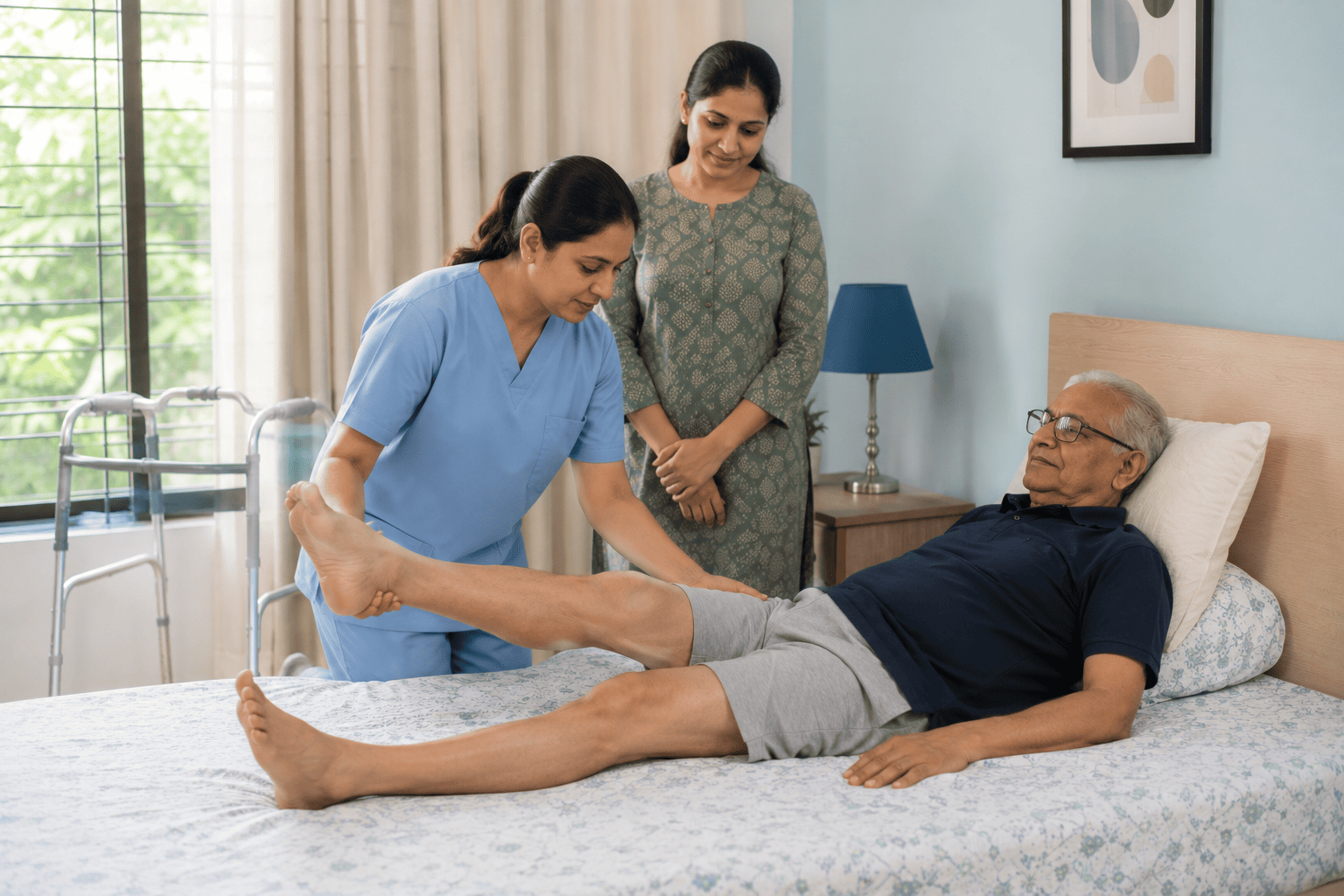
A typical session runs about 45 minutes and follows the same structure each time: check the knee, work on movement, work on strength, practise walking and stairs, and leave a home programme. The first visit is longer because it includes assessment, measurement and goal setting.
| Part of the session | What happens |
|---|---|
| Assessment | Pain, swelling, wound appearance, range of movement measured, and how the home exercises went since the last visit |
| Swelling management | Positioning, elevation and ice as advised, since a swollen knee cannot achieve its full range |
| Range of movement work | Assisted and active bending and straightening, worked to the patient's tolerance rather than to a fixed number |
| Strengthening | Quadriceps activation, straight leg work, and progressive resistance as the knee allows |
| Walking and balance | Gait correction with the walker or stick, weight shifting, and progression towards walking unaided |
| Functional practice | The patient's actual stairs, their own bed, their own bathroom, getting in and out of their own chair |
| Home programme | Specific exercises with repetitions and frequency, taught to the family member who will supervise them |
The exercises themselves — ankle pumps, static quadriceps contractions, heel slides, assisted knee bending, straight leg raises, seated knee extension and supported walking — are standard, but which ones, how many and how hard is a clinical decision. The physiotherapist sets them based on your knee, your surgeon's protocol and your progress, and adjusts them at every visit. Exercises copied from a video without assessment can push a knee too hard or not hard enough.
Walker to stick to walking unaided
Progression is decided by balance and quadriceps strength, not by the calendar. Moving off the walker too early causes a limp and a fall risk; staying on it too long delays strength. The physiotherapist decides when to change, based on how the patient actually walks.
| Stage | Typically when | What has to be true first |
|---|---|---|
| Walker | From day zero or one, for the first weeks | Nothing — this is the starting point |
| Walker outdoors, stick indoors | Often around weeks two to four | Steady balance indoors, no giving way, reasonable quadriceps control |
| Stick everywhere | Often around weeks four to six | Confident walking indoors without support, knee straightening well |
| No aid indoors | Often around weeks six to eight | Normal walking pattern without limping, good balance |
| No aid outdoors | Often around weeks eight to twelve | Stamina for distance, confidence on uneven ground |
*Indicative ranges only. Progression is determined by the treating surgeon and physiotherapist for each patient.
Choosing the right walker or wheelchair, and the room and bathroom setup that makes early walking safe, are covered in wheelchair use during recovery, bathroom safety after surgery and fall prevention during recovery.
Is a CPM machine necessary after knee replacement?
A CPM (continuous passive motion) machine slowly bends and straightens the knee while the patient rests. It is commonly used in India and some surgeons prescribe it routinely, but the evidence for meaningful long-term benefit over good active physiotherapy is limited, and it is not universally recommended.1 It supplements active exercise rather than replacing it. Follow your surgeon's instruction.
- If your surgeon has prescribed it, use it as directed for the specified duration and settings.
- It does not replace active exercise. The patient's own muscle work is what produces strength and lasting range.
- It is usually a short-term rental for a few weeks, which is why most families rent rather than buy.
- Do not increase the settings yourself to speed up progress.
What delays knee replacement recovery
| Cause of delay | What happens | What to do instead |
|---|---|---|
| Waiting to start physiotherapy | The easiest window for gaining movement passes while the knee stiffens | Book home physiotherapy before discharge so there is no gap |
| Only exercising when the therapist visits | Two hours of supervised work a week is not enough to change a joint | Do the home programme daily; that is where the range is won |
| Uncontrolled pain | The patient cannot participate, so exercises are done badly or skipped | Take pain medication as prescribed and time sessions about 30 minutes after |
| Uncontrolled swelling | A swollen knee physically cannot reach its full range | Ice, elevation and gentle movement as advised by the treating team |
| Focusing only on bending | The knee gains flexion but never straightens, producing a permanent limp | Prioritise full extension and tell the physiotherapist if it is not improving |
| Fear of damaging the new joint | The patient guards the knee, avoids weight bearing and loses strength | Follow the surgeon's weight-bearing instruction; the implant is built to be used |
| Staying on the walker too long | Quadriceps strength does not develop and the limp becomes a habit | Let the physiotherapist decide progression based on how you walk |
| Bed rest as "recovery" | Muscle strength falls further, stiffness increases, clot risk rises | Sit out of bed and walk as advised from the first days |
| Poor nutrition | Wound healing and muscle rebuilding both slow down | Adequate protein and energy, unless the doctor has set restrictions |
Related guides: physiotherapy at home after hospitalisation, nutrition during recovery at home and the full joint replacement recovery at home programme.
What if the knee is not bending as expected?
Say so early. If bending has stalled by around six to twelve weeks despite consistent physiotherapy, the surgeon needs to know while there are still options. Stiffness identified early can often be addressed with intensified therapy; stiffness left for months may require a procedure to release the scar tissue, usually done under anaesthesia.
Families sometimes delay reporting slow progress out of embarrassment, or because they assume it is the patient's fault for not trying hard enough. It usually is not. Some knees scar more than others, some were very stiff before surgery, and some patients have pain that has not been adequately controlled. All of these are manageable, and all of them are easier to manage at week eight than at month six.
Contact the surgeon urgently if
For sudden breathlessness or chest pain, do not wait for a callback. In India, dial 112 for emergency services, or 108 for an ambulance in states where that service operates.
- Increasing redness spreading from the wound, pus or discharge, a foul smell, or the wound edges separating.4
- Fever, or fever with shivering.
- Pain in one calf, with swelling, warmth or tenderness — possible deep vein thrombosis.5
- Sudden breathlessness or chest pain, which needs emergency care — a clot may have travelled to the lungs.5
- Sudden severe pain in the knee, or a sensation of something giving way.
- Inability to bear weight when you could before.
- Sudden loss of movement that was previously present.
- The knee becoming hot, very swollen and much more painful after a period of improvement.
Milestone checklist
A rough guide to what most patients manage by when. Use it to spot when progress has stalled and a conversation is needed — not to judge yourself against someone else's recovery.
- Day 0 to 1: standing and taking a few supported steps with a walker.
- By discharge: walking short distances with a walker, managing to the bathroom, and knowing the home exercises.
- Week 1: home physiotherapy under way, daily exercises being done, wound healing normally.
- Week 2: steady gains in bending, knee straightening well, walking further indoors.
- Week 4: often progressing towards a stick indoors, climbing a few stairs with guidance.
- Week 6: usually walking indoors with little or no support; range of movement should be clearly better than week two.
- Week 12: usually walking unaided, managing stairs, returning to most household activities.
- Month 6: normal walking over distance, occasional aches, continued strengthening.
*Indicative only. Recovery speed varies considerably between patients and your surgeon's protocol takes precedence.
Where Healthy Jeena Sikho provides this
Home physiotherapy:Chandigarh, Mohali, Panchkula and Kharar only, delivered from the head office and store in Sector 73, Mohali, Punjab and the physiotherapy centre in Sector 71, Mohali.
Equipment delivery and installation: Delhi, Noida, Greater Noida, Gurugram, Faridabad, Ghaziabad, Chandigarh, Mohali, Panchkula, Kharar, Ludhiana, Jalandhar, Bathinda, Jaipur and Lucknow.
Equipment sales are available more widely across India. Both are subject to serviceable pin code, stock and therapist availability. Call +91 98769 78488 or WhatsApp +91 98759 15278.
Home physiotherapy after knee replacement in the Tricity
- No gap after discharge. Book while the patient is still in hospital so the first home session can happen soon after coming home — which is when it matters most.
- Physiotherapists experienced in joint replacement. Qualified physiotherapists who work to the operating surgeon's protocol, assess before treating, measure range of movement and record progress.
- Therapy in your own house. The patient practises on their actual stairs, their own bed height and their own bathroom — not on gym equipment they will never use again.
- A written home programme. Exercises with repetitions and frequency, taught to the family member who will supervise them between visits.
- Equipment supplied alongside. Walkers, sticks, wheelchairs, commode chairs, raised toilet seats, hospital beds and CPM machines on monthly rent, delivered and installed.
- A physiotherapy centre and home visits. Healthy Jeena Sikho runs a physiotherapy centre in Sector 71, Mohali, and provides home physiotherapy across Chandigarh, Mohali, Panchkula and Kharar.
- Charges confirmed in advance. Session and package charges shared in writing before the first visit, so the whole rehabilitation period can be planned.
For the complete recovery setup see joint replacement recovery at home, after surgery recovery at home and the recovering at home hub. Equipment options are on the hospital bed on rent and wheelchair and mobility aids pages.
Home physiotherapy across Chandigarh, Mohali, Panchkula and Kharar. Same-day scheduling may be available, subject to therapist availability.
Frequently Asked Questions About Physiotherapy After Knee Replacement
When should physiotherapy start after knee replacement?
Within 24 hours of surgery. NICE guidance recommends that a physiotherapist or occupational therapist offers rehabilitation within 24 hours of a primary knee replacement, including mobilisation and a home exercise programme.2 Most patients stand and take a few supported steps on the day of surgery or the day after, and physiotherapy should continue at home with no gap after discharge.
How long does physiotherapy continue after a knee replacement?
Typically several sessions a week for the first six weeks, then reducing in frequency as the home programme takes over, with most patients continuing formal physiotherapy for around six to twelve weeks in total. Home exercises usually continue for several months beyond that. The assessing physiotherapist and operating surgeon set the actual plan.
Why are the first six weeks so important after knee replacement?
Because the body lays down and then tightens scar tissue around the new joint over this period. Range of movement gained while that tissue is still soft is generally kept, while range lost as it matures becomes much harder to recover. Two patients with identical surgery can end up with very different knees based largely on what happened in weeks one to six.
Is it better to focus on bending or straightening the knee after TKR?
Straightening comes first. A knee that will not fully straighten produces a permanent limp, tires the thigh muscle and causes pain in the hip, back and opposite knee, and it is harder to regain later than bending. Bending is built steadily over the first three months. If the knee is gaining bend but not straightening, tell the physiotherapist.
Is home physiotherapy or clinic physiotherapy better after knee replacement?
Home physiotherapy is usually more practical in the early weeks. The patient does not spend limited energy travelling, sessions happen reliably, the family learns the exercises, and practice happens on the patient's own stairs, bed and bathroom. Clinic sessions become more useful later, when the patient travels comfortably and needs equipment that cannot be brought home.
How long will I need a walker after knee replacement?
Most patients use a walker for the first two to four weeks, then move to a stick for a few more weeks, and walk unaided indoors somewhere around six to eight weeks. These are indicative ranges only. Progression is decided by balance and thigh muscle strength rather than by the calendar, and the physiotherapist decides when to change.
Is swelling normal weeks after a knee replacement?
Yes. Some swelling and warmth around the knee can persist for three to six months and often increases after activity. What is not expected is a knee that suddenly becomes hot, much more swollen and much more painful after a period of improvement, or swelling with fever or wound discharge, which need urgent contact with the surgeon.
Is a CPM machine necessary after knee replacement?
It is commonly used in India and some surgeons prescribe it routinely, but the evidence for meaningful long-term benefit over good active physiotherapy is limited and it is not universally recommended. It supplements active exercise rather than replacing it. If your surgeon has prescribed it, use it as directed and do not change the settings yourself.
What if my knee is not bending as much as expected after TKR?
Raise it with the surgeon and physiotherapist early, by around six to twelve weeks if bending has stalled despite consistent therapy. Stiffness identified early can often be managed with intensified physiotherapy and better pain control, while stiffness left for months may need a procedure under anaesthesia to release the scar tissue.
Can knee replacement exercises be done from a video instead of with a physiotherapist?
The home programme between sessions is essential and family members should supervise it. But which exercises, how many and how hard is a clinical decision based on your knee, your surgeon's protocol and your measured progress, and it changes at each visit. Exercises copied from a video without assessment can push a knee too hard or leave it doing far too little.
When can I climb stairs and drive after a knee replacement?
Stairs are usually practised with the physiotherapist from the first weeks using a specific sequence, and managed with a normal pattern by around three months for most patients. Driving is typically considered somewhere between six and twelve weeks, but it depends on which knee was operated, the vehicle and reaction time, and it must be cleared by the operating surgeon.
Do you provide home physiotherapy after knee replacement in the Tricity?
Yes. Healthy Jeena Sikho provides home physiotherapy across Chandigarh, Mohali, Panchkula and Kharar, and runs a physiotherapy centre in Sector 71, Mohali. Walkers, wheelchairs, commode chairs, raised toilet seats, hospital beds and CPM machines are available on monthly rent alongside the therapy, and equipment delivery covers a wider set of North Indian cities than the physiotherapy service does.
References
- National Institute for Health and Care Excellence. Joint replacement (primary): hip, knee and shoulder , NICE guideline NG157 — care before, during and after knee replacement, including postoperative rehabilitation.
- National Institute for Health and Care Excellence. Joint replacement (primary): hip, knee and shoulder — Recommendations , NICE guideline NG157 — rehabilitation should be offered within 24 hours of surgery, including home exercise programmes and mobilisation.
- National Institute for Health and Care Excellence. Joint replacement (primary): hip, knee and shoulder , NICE quality standard QS206 — quality statements on rehabilitation advice before and after surgery.
- National Institute for Health and Care Excellence. Surgical site infections: prevention and treatment , NICE guideline NG125.
- NHS. Deep vein thrombosis (DVT) — leg symptoms after surgery, and the emergency signs suggesting a clot has travelled to the lungs.
Medical disclaimer. This page is general educational information about physiotherapy and recovery after total knee replacement. It is not medical advice and does not replace assessment and treatment by a qualified physiotherapist or the instructions of your operating surgeon. All timelines, milestones and progression ranges given here are indicative only and vary considerably between patients. Weight-bearing status, range of movement targets, which exercises are appropriate, the use of a CPM machine, walking aid progression, and clearance to climb stairs, return to work or drive must all be determined by your treating surgeon and physiotherapist. Do not begin, change or intensify an exercise programme without professional guidance. Healthy Jeena Sikho supplies home medical equipment and arranges nursing, attendant and physiotherapy services, and does not diagnose conditions or independently set clinical parameters. Contact your surgeon urgently for wound infection signs, fever, calf pain or swelling, or sudden severe knee pain, and for sudden breathlessness or chest pain dial 112 or go to the nearest hospital.