
When Should You Call the Doctor After Discharge?

The short version
- Sort every symptom into one of three levels. Emergency now, call the doctor today, or mention at the next visit. Families get into trouble by treating everything as level three.
- New confusion in an elderly patient is a medical emergency signal, not "just old age". It is often the first and only sign of infection, and it needs the same day attention.
- Fever plus a rapidly unwell patient is treated as sepsis until proven otherwise. Slurred speech or confusion, extreme shivering, passing no urine in a day, severe breathlessness, mottled or discoloured skin — any one of these needs emergency care.2
- Any head injury in a patient on blood thinners is urgent — even if they got up, seem fine and insist nothing happened.
- Calf pain or swelling in one leg, or sudden breathlessness, is never a wait-and-watch symptom.3
- You will not be scolded for calling. The commonest reason for a preventable readmission is a family that noticed something on Tuesday and called on Friday.
Discharge day comes with a bag of medicines, a follow-up date and, if the family is lucky, one line about what to watch for. Three days later the patient has a low fever and is not quite themselves, and the family sits around the bed debating whether to disturb the doctor. That debate is the dangerous part. This guide sorts the common post-discharge warning signs into three clear levels, so the decision takes seconds rather than an evening.
The three levels of urgency
Every symptom after discharge belongs in one of three boxes: go to hospital now, contact the treating doctor today, or note it for the next follow-up. Deciding which box a symptom sits in is easier than deciding what the symptom means — and it is the only decision a family actually has to make.
Level 1 — Emergency now
Call an ambulance or go to the nearest hospital immediately. Do not wait for the treating doctor to call back, and do not drive the patient yourself if they are collapsing or unresponsive.
Level 2 — Same day
Contact the treating doctor or surgeon the same day. If they are unreachable within a few hours, treat it as level one rather than waiting overnight.
Level 3 — Next visit
Write it down and raise it at the follow-up appointment. Still worth recording, because a pattern of small things often explains a big one.
One rule overrides all three: if the patient looks seriously unwell, act on that, not on the list. Families who have cared for someone for years notice deterioration before any measurement shows it. That instinct is worth acting on.
Level 1: go to hospital immediately
Call an ambulance or reach the nearest hospital now
In India, dial 112 for emergency services, or 108 for an ambulance in states where that service operates. If you already have a nearby hospital's ambulance number, use whichever will reach you fastest.
- Chest pain or pressure, especially spreading to the arm, neck or jaw, or with sweating and nausea.
- Severe breathlessness at rest, or the patient cannot complete a sentence without stopping for breath.
- Blue or grey lips, tongue or fingertips, or skin that is mottled, blotchy or discoloured.2
- Any new stroke sign — face drooping, arm weakness, slurred or confused speech, sudden vision loss or sudden severe imbalance.4
- Unresponsiveness, a seizure, or a sudden drop in alertness.
- Heavy bleeding, or a wound that has burst open.
- Sudden severe abdominal pain with a hard, swollen abdomen, or persistent vomiting with no wind or stool passing.
- Head injury in a patient on blood thinners, even if they seem completely fine afterwards.
- Sudden breathlessness with chest pain, or coughing up blood — a possible clot in the lung.3
- Signs suggesting sepsis: slurred speech or confusion, extreme shivering or muscle pain, passing no urine in a day, severe breathlessness, mottled or discoloured skin, or a feeling that something is very badly wrong.12
Take the discharge summary and the current medicine list with you. Do not give food or water to a patient who is drowsy, confused or showing stroke signs.
Level 2: contact the doctor the same day

These are the symptoms that are not emergencies yet, and become emergencies if left. The commonest mistake is waiting for the scheduled follow-up because the appointment is "only three days away". Three days is long enough for a wound infection to become a systemic one.5
| Area | Call the doctor today if | Why it matters |
|---|---|---|
| Wound | Increasing redness spreading from the edges, swelling, heat, pus or discharge, foul smell, increasing pain after day three, or the wound edges separating | Early surgical site infection is far easier to treat than a late one5 |
| Fever | Any new fever, or a fever with shivering, in a patient recently discharged or with a catheter, drain or line in place | Fever after discharge is an infection until proven otherwise6 |
| Breathing | New or worsening breathlessness on mild activity, a new cough, thick discoloured sputum, or oxygen saturation falling below the doctor's stated number | Chest infection is a leading cause of readmission after surgery |
| Legs | Pain, swelling, warmth, tenderness or discolouration in one calf or thigh | Possible deep vein thrombosis, which can travel to the lungs3 |
| Urine | Burning, cloudy or foul-smelling urine, passing much less than usual, blood in the urine, or a catheter that has stopped draining | Urinary infection and blocked catheters both escalate quickly |
| Bowels | No bowel movement for several days with abdominal pain or bloating, or new diarrhoea with fever | Obstruction and infection both need assessment, not home remedies |
| Mental state | New confusion, disorientation, unusual drowsiness, agitation or hallucinations | Often the earliest sign of infection or a medication problem in older patients |
| Pain | Pain that is increasing day on day rather than easing, or pain not controlled by the prescribed medication | Worsening pain usually signals a complication rather than slow healing |
| Eating and drinking | Almost no intake for more than a day, persistent vomiting, or signs of dehydration such as very dark urine and dizziness on standing | Dehydration causes falls, kidney problems and delirium |
| Skin | A red patch over a bony point that does not fade when pressed, or any broken skin over a pressure area | Stage one pressure damage is reversible; broken skin is much harder to heal |
| Blood sugar | Readings much higher or lower than usual, sweating and shakiness, or a diabetic patient eating far less than normal on the same medicine dose | Reduced intake with unchanged medication risks dangerous low sugar |
| Falls | Any fall, even without apparent injury, and especially a second fall | Repeated falls signal a medical cause that needs investigating |
Why new confusion is never "just age"
In older patients, a sudden change in thinking, alertness or behaviour is often the first sign of a physical illness — most commonly a urinary or chest infection, dehydration, constipation, pain, low blood sugar or a medication effect. It frequently appears before fever, before any urinary symptom, and before the patient can describe feeling unwell.
Families routinely dismiss this. The patient is old, they have been through a lot, they are not sleeping properly — so a day or two passes while an infection progresses. The rule worth remembering is simple: if a patient who was mentally clear last week is not clear today, that is a same-day call, and if they are drowsy or unrousable, it is an emergency.
What to describe when you call
- What changed, and when it started — "clear until Tuesday, confused since Wednesday morning".
- Whether it fluctuates through the day, which is typical of delirium.
- Whether they are drowsier than usual, or agitated and restless.
- Whether they are eating, drinking and passing urine normally.
- Any new medicine started, or any dose changed since discharge.
Extra warning signs by type of patient
| Patient type | Additional signs that need urgent attention |
|---|---|
| After abdominal surgery | Wound edges separating, anything visible at the wound, persistent vomiting, a hard distended abdomen, or no wind or stool passing |
| After joint replacement | Sudden severe pain in the operated joint, inability to bear weight when they could before, a limb that looks shortened or rotated, calf pain or swelling |
| After spine surgery | New weakness or numbness in the legs, loss of bladder or bowel control, or severe new back pain |
| After cardiac surgery | Chest pain, a clicking or unstable feeling in the breastbone, sudden weight gain with swelling of the legs, or increasing breathlessness lying flat |
| After a stroke | Any new stroke sign, a seizure, choking during feeding, or sudden worsening of alertness4 |
| On blood thinners | Any head injury however minor, black or bloody stools, blood in urine, coughing or vomiting blood, unusual bruising, or bleeding that does not stop |
| With a catheter | No urine draining, blood in the bag, fever, or pain in the lower abdomen or back |
| On oxygen | Saturation below the doctor's stated number, increasing drowsiness or confusion, or new morning headaches |
| With diabetes | Sweating, shakiness and confusion suggesting low blood sugar, or a wound on the foot that is not healing |
| Cancer patient on treatment | Any fever at all, which in a patient with low immunity is treated as an emergency |
Do not "manage" these at home first
A specific pattern causes real harm in Indian households: giving a leftover antibiotic, a neighbour's painkiller or a home remedy to see whether the symptom settles before calling. Antibiotics taken without assessment can mask an infection while it worsens, painkillers can hide a complication, and both make the doctor's job harder when the call finally comes. Report first, treat on advice.
What to have ready when you call
A doctor can only act on what you can tell them. Five minutes of preparation turns "he is not well since two days" into a call that produces an actual decision.
- The discharge summary and the name of the operating surgeon or treating consultant.
- The current medicine list, including anything bought over the counter and any ayurvedic or supplement product.
- When the symptom started and whether it is getting better, worse or staying the same.
- Temperature, pulse, blood pressure and oxygen saturation if you have them, with the time each was taken.
- What the patient is eating, drinking and passing — urine output and bowel movements.
- A photograph of the wound in good light, which is often more useful than any description.
- Whether they are more or less alert than yesterday.
- Any fall, however minor, since discharge.
Who to call
| Problem | Who to contact first |
|---|---|
| Anything to do with the wound or operated area | The operating surgeon's team |
| Fever, breathing, general deterioration | The treating physician, or the surgeon if very recently operated |
| Medication side effects or dosing questions | The prescribing doctor; the pharmacist for interactions |
| New neurological symptoms | Emergency services, then the neurologist |
| Equipment failure at night | The equipment provider's service line, with a clinical call in parallel if the patient is dependent on it |
| You cannot reach anyone and the patient is deteriorating | Nearest hospital emergency department. Do not keep waiting for a callback |
Keep one card taped near the bed with the surgeon's number, the physician's number, the nearest hospital with an emergency department, the ambulance number and the equipment service number. On the night it is needed, nobody should be searching a phone for it. Setting the room up properly is covered in how to set up a patient room at home.
What to monitor daily so you notice early
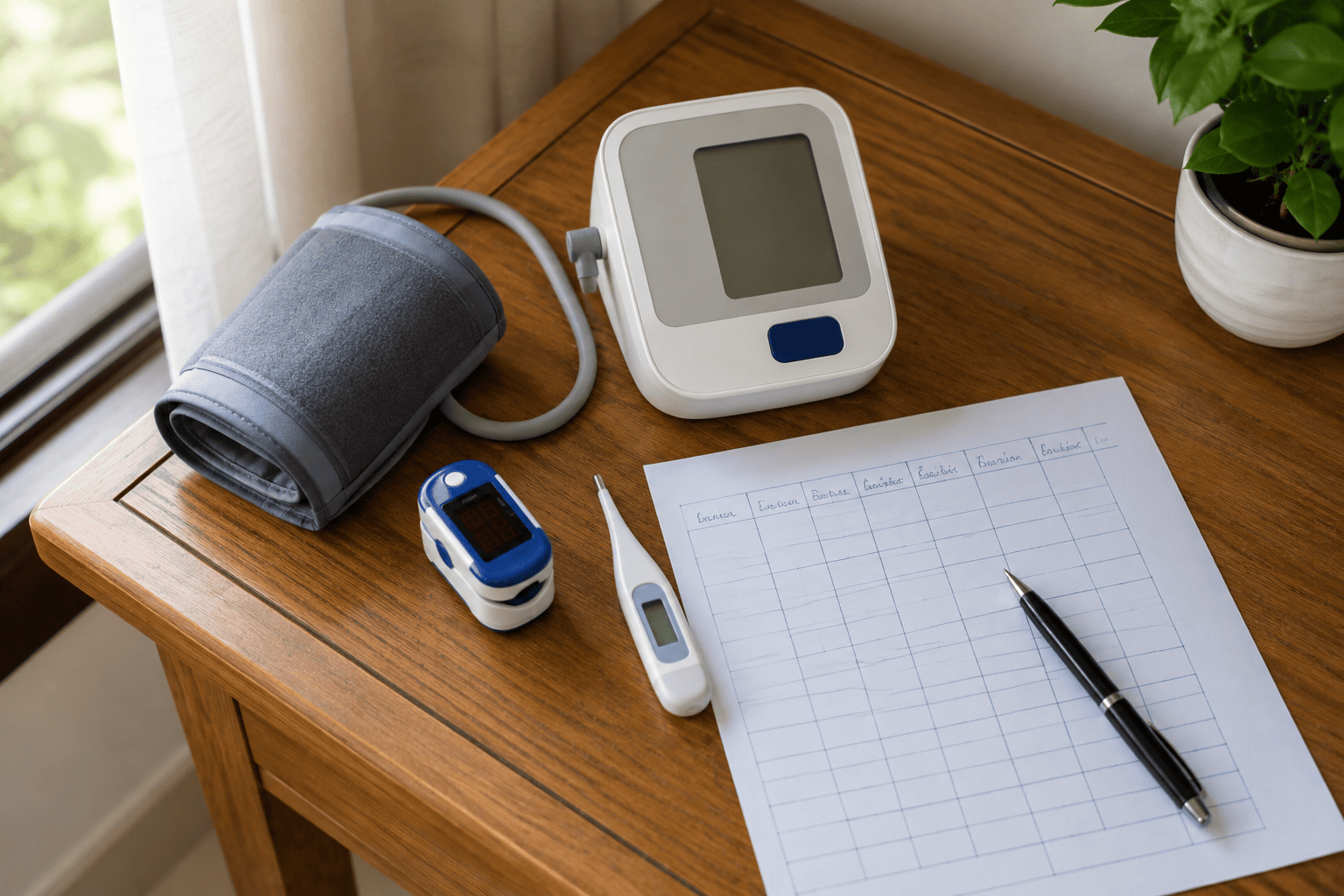
Most post-discharge complications announce themselves a day or two before they become urgent. A simple written chart is what makes that visible, because it turns "he seems a bit off" into a trend somebody can act on.
| What to record | How often | What you are watching for |
|---|---|---|
| Temperature | Once or twice daily | Any new fever, or a rising trend |
| Pulse and blood pressure | Daily, same time | Rising pulse, or blood pressure well outside the usual range |
| Oxygen saturation | Daily, if advised | A downward trend, or falling below the doctor's stated number |
| Wound appearance | At every dressing change | Spreading redness, discharge, smell, edges separating |
| Pain score out of ten | Daily | Pain rising day on day rather than easing |
| Food and fluid intake | Daily | Steadily reducing intake |
| Urine and bowels | Daily | Reduced urine, no bowel movement for days, any change in colour or smell |
| Alertness and mood | Daily | New confusion, drowsiness, withdrawal or agitation |
| Weight | Weekly | Steady loss, or sudden gain with leg swelling in heart patients |
Why families delay calling, and why not to
Every reason for delaying is understandable, and every one of them costs time that the patient does not have to spare. Naming them makes them easier to override.
| The thought | The reality |
|---|---|
| "The doctor will be annoyed at being disturbed" | Treating teams would far rather take a call that turns out to be nothing than see the same patient readmitted a week later. |
| "The follow-up is in three days anyway" | An infection, a clot or a blocked catheter does not wait for an appointment. |
| "It is probably just weakness after the operation" | Sometimes true. But weakness that is worsening rather than improving is a symptom, not a stage of recovery. |
| "He does not want to go back to hospital" | Completely understandable, and not a clinical decision. Calling is not the same as being admitted. |
| "It is the middle of the night" | Emergency departments run all night for exactly this. Night-time deterioration is more concerning, not less. |
| "Let us try one more day" | This single sentence accounts for a large share of avoidable readmissions. |
| "We will give the leftover antibiotic first" | It can mask the infection while it spreads and complicates later treatment. |
Where Healthy Jeena Sikho provides nursing, attendants and equipment
Delhi NCR:Delhi, Noida, Greater Noida, Gurugram, Faridabad and Ghaziabad.
Chandigarh Tricity:Chandigarh, Mohali, Panchkula and Kharar, served from the head office and store in Sector 73, Mohali, Punjab.
Punjab:Ludhiana, Jalandhar and Bathinda.
Rajasthan and Uttar Pradesh:Jaipur and Lucknow.
Equipment sales are available more widely across India. Nursing, attendant support and installation are limited to the cities listed above, subject to serviceable pin code and availability. Healthy Jeena Sikho does not provide emergency medical care — for an emergency, dial 112 or go to the nearest hospital.
How Healthy Jeena Sikho helps families notice early
- Trained attendants and nurses who chart daily. Temperature, pulse, intake, output, wound appearance and alertness recorded in writing, so a trend is visible before it becomes an emergency.
- Nurses trained to escalate. Staff who know which changes need a same-day call rather than waiting for the family to decide.
- Monitoring equipment on rent. BP monitors, pulse oximeters, thermometers and patient monitors supplied alongside beds and other equipment.
- Doctors on panel. Critical care, rehabilitation and pain management consultants available where a clinical review is needed at home.
- Service support during the rental. Equipment troubleshooting and replacement, so a machine failure at night is not an emergency on its own.
- Delivery across North India. Delhi, Noida, Greater Noida, Gurugram, Faridabad, Ghaziabad, Chandigarh, Mohali, Panchkula, Kharar, Ludhiana, Jalandhar, Bathinda, Jaipur and Lucknow.
For the complete setup after discharge see recovering at home, or the programmes for after surgery recovery, ICU care at home and bedridden patient care at home. Related warning signs are covered in fall prevention during recovery and pressure sore prevention at home.
Healthy Jeena Sikho provides equipment, nursing and attendant services. For a medical emergency, dial 112, contact emergency services, or go to your nearest hospital directly.
Frequently Asked Questions
Is fever after discharge always serious?
It should always be reported the same day. A new fever after a hospital stay is treated as an infection until proven otherwise, particularly in a patient with a wound, a catheter, a drain or a line in place. If fever comes with shivering, confusion, severe breathlessness, passing no urine or mottled skin, that is an emergency rather than a same-day call.12
How do you know if a surgical wound is infected?
Warning signs include redness spreading outward from the wound edges, increasing swelling and heat, pus or discharge, a foul smell, pain that increases after about the third day rather than easing, and wound edges separating. Report any of these the same day, since early surgical site infection is far easier to treat than a late one.5 Photograph the wound in good light before you call.
Why is new confusion in an elderly patient urgent?
Because it is often the first sign of a physical problem rather than a mental one — commonly a urinary or chest infection, dehydration, constipation, pain, low blood sugar or a medication effect. It frequently appears before fever and before any other symptom. If a patient who was mentally clear last week is not clear today, contact the doctor the same day; if they are drowsy or hard to rouse, treat it as an emergency.
What are the warning signs of a blood clot after surgery?
Pain, swelling, warmth, tenderness or discolouration in one calf or thigh suggests a possible deep vein thrombosis and needs same-day assessment. If it is accompanied by sudden breathlessness, chest pain that worsens on breathing in, or coughing up blood, that suggests a clot may have travelled to the lungs and is an emergency.3
Why is a head injury urgent in a patient on blood thinners?
Because blood thinners increase the risk of bleeding inside the skull, and that bleeding can develop slowly over hours after an apparently minor knock. A patient can get up, seem completely normal and deteriorate later. Any head injury in a patient on anticoagulants should be assessed urgently, regardless of how well they appear immediately afterwards.
Should you give a leftover antibiotic while waiting to speak to the doctor?
No. Antibiotics taken without assessment can partially suppress an infection while it continues to worsen, make it harder to identify the organism later, and contribute to resistance. The same applies to borrowing someone else's painkillers, which can mask a complication. Report the symptom first and treat on medical advice.
What should you have ready before calling the doctor?
The discharge summary, the current medicine list including over-the-counter and ayurvedic products, when the symptom started and whether it is worsening, recent temperature, pulse, blood pressure and oxygen saturation with times, what the patient is eating, drinking and passing, a photograph of the wound if relevant, and any fall since discharge.
Who should you call, the surgeon or the physician?
Anything involving the wound or the operated area goes to the operating surgeon's team. Fever, breathing problems and general deterioration go to the treating physician, or to the surgeon if the operation was very recent. New neurological symptoms are an emergency first. If you cannot reach anyone and the patient is deteriorating, go to the nearest emergency department rather than continuing to wait for a callback.
Is it normal for pain to increase a few days after surgery?
No. Post-operative pain should generally ease day by day. Pain that is increasing rather than settling, or that is not controlled by the prescribed medication, usually signals a complication such as infection and should be reported the same day rather than managed with extra painkillers at home.
What should be monitored daily at home after discharge?
Temperature, pulse and blood pressure, oxygen saturation if advised, wound appearance at each dressing change, a pain score, food and fluid intake, urine and bowel movements, alertness and mood, and weight weekly. Writing it down matters, because most complications show as a trend over a day or two before they become urgent.
What number should you call for an emergency in India?
Dial 112, the national emergency number, or 108 for an ambulance in states where that service operates. If the hospital that discharged the patient has its own ambulance number, use whichever will reach you fastest. Keep all of these written on a card near the bed rather than searching a phone during an emergency, and take the discharge summary and current medicine list with you.
References
- NHS. Sepsis — symptoms, when to seek emergency care, and risk factors including recent surgery, wounds and catheters.
- The UK Sepsis Trust. Spotting the signs of sepsis — the adult warning signs, including slurred speech or confusion, extreme shivering, passing no urine in a day, severe breathlessness and mottled or discoloured skin.
- NHS. Deep vein thrombosis (DVT) — symptoms in the leg, and the emergency signs suggesting a clot has travelled to the lungs.
- NHS. Stroke — recognition of stroke symptoms and the need for emergency treatment.
- National Institute for Health and Care Excellence. Surgical site infections: prevention and treatment , NICE guideline NG125.
- National Institute for Health and Care Excellence. Sepsis: recognition, diagnosis and early management , NICE guideline NG51.
Medical disclaimer. This page is general educational information about recognising warning signs after hospital discharge. It is not medical advice, is not a diagnostic tool, and does not replace assessment by a qualified physician. The lists here are not exhaustive: a patient can be seriously unwell without any of these specific signs. If a patient looks seriously unwell, deteriorates suddenly, or you are worried for any reason, seek medical help immediately rather than checking against a list. Never start, stop or change any medication, and never give leftover or borrowed medicines, without medical instruction. Healthy Jeena Sikho supplies home medical equipment and arranges nursing, attendant and physiotherapy services, and does not diagnose conditions, provide emergency medical care or independently set clinical parameters. In an emergency, dial 112, contact emergency services, or go to the nearest hospital.