
Caregiver Checklist for the First 7 Days at Home

The short version
- Set the room up before the patient arrives, not after. Assembling a bed around someone already lying on a floor mattress is how most families start, and it is the hardest possible way to begin.
- Medicines are the biggest week-one failure. Patients come home on more medicines than they went in with, often with changed doses. One box, one chart, one person responsible.1
- Build the rota on day one, before anyone is exhausted. Care arranged in a crisis on day five is worse and costs more than care arranged calmly on day one.
- Write everything down from the first evening. Temperature, intake, urine, pain, alertness. Most complications show as a trend a day or two before they become urgent.
- Confirm the follow-up appointment on day one. Do not assume it is booked. Also confirm who to call at 2 am, and put that number on the wall.
- The caregiver is part of the care plan. Home care that collapses in month two usually collapses because one person did not sleep in week one.
The first week home is the week that decides how the next three months go. It is also the week when everyone is most tired, least organised and most reluctant to ask for help. This checklist is built to be worked through in order — what to do before the patient arrives, then day by day — so that decisions get made while there is still time to make them calmly.
Before the patient arrives
Ideally done the day before discharge. A room prepared in advance takes two to three hours including delivery; the same work done around a patient who has already arrived takes most of a day, with everybody tense and the patient waiting on a sofa.
At the hospital, before you leave
- Get the discharge summary in hand and read it before leaving. It should set out the diagnosis, what was done, medicines started, stopped or changed, and why.1
- Ask what the patient can and cannot do — weight bearing, bending, lifting, stairs, driving, bathing and when the wound may get wet.
- Ask when physiotherapy should start, and whether a referral has been made.
- Get every prescription filled before you go home, not the next morning.
- Confirm the follow-up date and who to contact for the wound, for general deterioration, and at night.
- Ask what warning signs to watch for specifically for this patient and this operation.
- Take photographs of the wound and the dressing as it looks on day zero, so changes are obvious later.
- Ask the nurse to demonstrate anything you will have to do — dressing, catheter care, injections, feeding.
At home, before they walk in
- Bed installed in position, tested, with 90 cm clear on the working side and the headboard against a solid wall.
- Route from bed to bathroom walked in the dark and cleared of rugs, wires, stools and thresholds.
- Bathroom fitted with a grab bar, raised seat or commode chair, and a non-slip mat.
- Sockets tested, with a dedicated one for any concentrator or pump.
- Reach zone built — water, phone, medicines, tissues, call bell, spectacles, bed remote on the patient's stronger side.
- Hygiene corner set up near the door with gloves, sanitiser, wipes, spare linen and a covered bin.
- Night lights placed along the route, and a light switch within arm's reach of the bed.
- Emergency card taped to the wall — surgeon, physician, nearest hospital, ambulance, equipment service number.
Full room measurements, clearances and electrical planning are in how to set up a patient room at home, and the bathroom fixes in bathroom safety after surgery or stroke.
Day by day through the first week
Day 1 — Arrival
Goal: get them settled, get the medicines right, get the paperwork in order.
- Settle the patient first, then do everything else. Do not start organising around a person still sitting in the car.
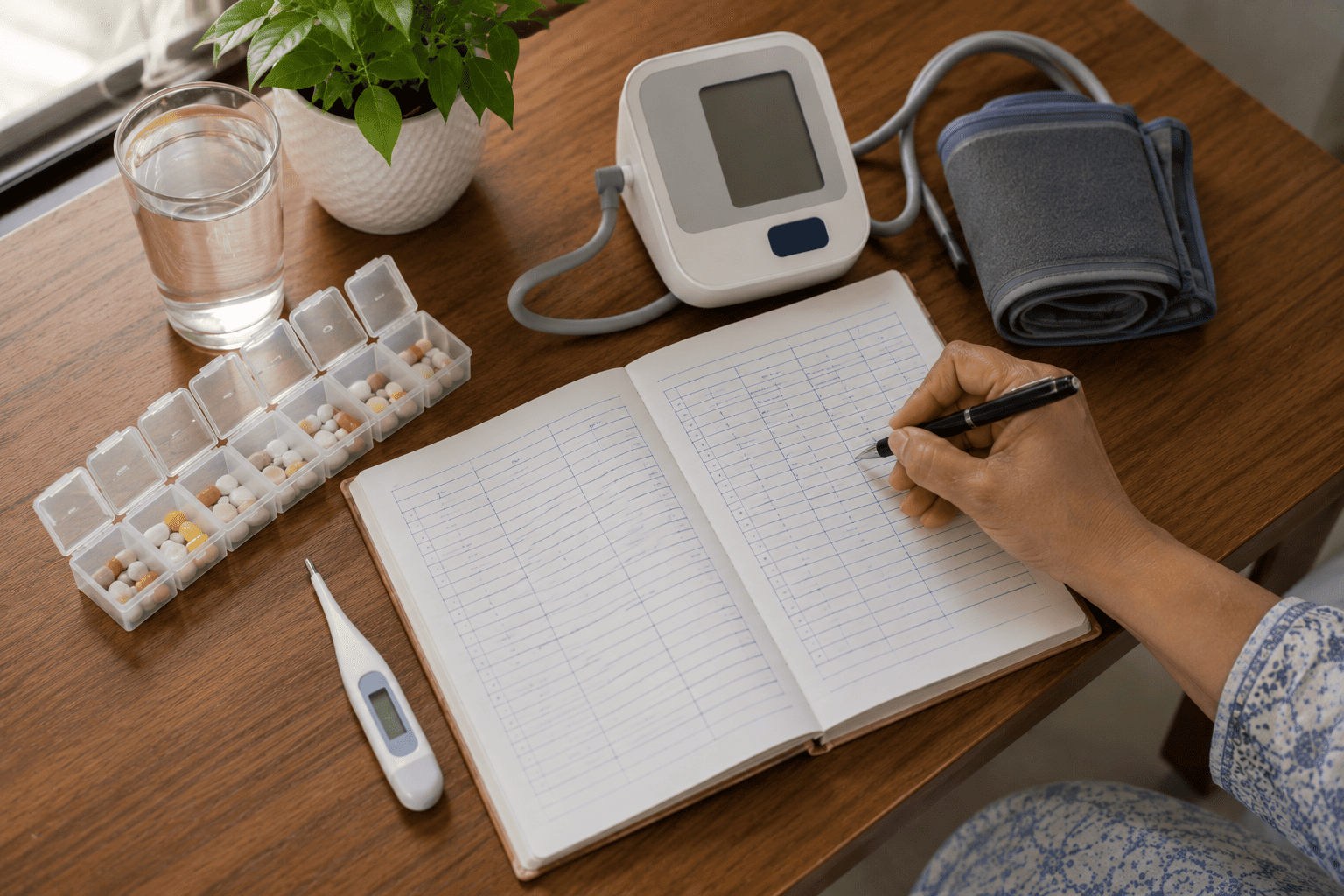
- Build the medicine system — one box, one written chart with names, doses and times, and one person responsible for giving them.
- Compare the new list against the old one. Something the patient took before hospital may have been stopped, and taking both is a common and serious error.1
- Confirm the follow-up appointment is actually booked. Do not assume.
- Start the monitoring chart tonight — temperature, pulse, intake, urine, pain, alertness.
- Agree who is on duty tonight, and where they will sleep.
- Keep visitors away. Day one is not for guests, however well-meaning.
- Expect a bad first night. Unfamiliar bed, disturbed sleep pattern, some pain and some anxiety are all normal.
Days 2 to 3 — Establishing the routine
Goal: turn improvisation into a routine, and start moving.
- Fix meal, medicine and toilet times so the day has a shape instead of being reactive.
- Get the patient sitting out of bed, as advised. Upright time helps breathing, digestion, mood and pressure care.
- Start breathing exercises if advised — short sets several times a day, not one long session.
- Watch for constipation. By day three with no bowel movement, act rather than wait; it is very common after surgery on painkillers.
- Check the wound at each dressing change and photograph it in the same light.3
- Check the skin at every position change — tailbone, heels, hips, elbows.
- Begin physiotherapy if the treating team has cleared it. Waiting for the patient to "get stronger first" works backwards.
- Reassess the equipment. Anything missing usually becomes obvious by day three.
Days 4 to 5 — The dip
Goal: recognise that this is the hardest stretch, and get help before it breaks something.
- Expect a low patch. The relief of being home has worn off, progress feels slow, and both patient and caregiver are tired. This is normal and it passes.
- Watch mood carefully — withdrawal, refusing food and therapy, or not wanting to talk. Low mood after illness is common and treatable, so raise it with the doctor.
- Review the caregiver rota honestly. If one person has done four nights, that is the problem to fix today, not next week.
- Arrange night cover now if it is needed. Night duty is what exhausts a single caregiver fastest.
- Push gently on activity. Slightly more each day, within whatever the surgeon allowed.
- Re-check intake. Appetite is often lowest around now, so enrich small meals rather than serving bigger ones.
- Do not compare progress with someone else's recovery. Rates differ enormously.
Days 6 to 7 — Reviewing and adjusting
Goal: take stock before week two, and prepare for the follow-up.
- Read back through the chart. Is the trend up, flat or down across the week?
- Prepare for the follow-up appointment — chart, medicine list, wound photographs, and written questions.
- List what is not working: pain control, sleep, appetite, bowels, the rota, the equipment.
- Reassess the equipment. Anything unused can go back; anything struggled with should be added.
- Check the caregiver. Sleep, meals, back pain, mood. If the answer to any of these is bad, week two needs a different plan.
- Set week-two goals with the physiotherapist rather than drifting.
- Note anything that improved and tell the patient. A week of small gains is invisible from inside it.
The daily routine that runs through all seven days
The days differ, but the underlying rhythm should not. Households that manage the first week well are the ones where the same things happen at the same times, rather than whenever somebody remembers.
| When | What happens | Why |
|---|---|---|
| Morning | Sponge bath or wash, full skin check in good light, fresh linen pulled smooth, medicines, breakfast sitting fully upright, first vitals recorded | Best light for spotting skin changes, and appetite is often best early |
| Mid-morning | Physiotherapy or the home exercise programme, sitting out of bed, breathing exercises | Energy is highest, and activity improves appetite for lunch |
| Afternoon | Lunch upright with 30 minutes sitting up afterwards, rest, position change, a small nourishing snack | Upright after meals helps digestion and reduces choking risk |
| Evening | Second skin check, dressing if due, second vitals, dinner, medicines, night plan confirmed with whoever is on duty | Catches anything that developed through the day before night falls |
| Night | Position changes on schedule, commode beside the bed, night lights on, call bell within reach | Night is when routines break and when most falls and skipped turns happen |
| Throughout | Position change roughly every two hours for anyone who cannot shift their own weight, fluids offered, chart updated | Pressure care and hydration are continuous, not scheduled events |
Medicines: the biggest week-one failure
Patients typically come home on more medicines than they went in with, with some doses changed and some old medicines stopped. The discharge summary should record exactly what was started, stopped or changed and why.1 If yours does not say clearly, ask before you leave the hospital.
- One box, one chart, one person. Loose strips in a drawer is how doses get missed or doubled.
- Write the chart by time of day, not by medicine name, so whoever is on duty can read it at a glance.
- Explicitly check what has been stopped. Continuing a pre-admission medicine that was discontinued is a common and dangerous error.
- Watch for duplicates — the same drug under two brand names is easy to miss.
- Note what needs food, and what must be spaced apart from other medicines.
- Plan the refill before the strip runs out, especially for blood thinners, insulin and cardiac medicines.
- Never give leftover or borrowed medicines, and never add an antibiotic without advice.
- Take the whole list, including supplements and ayurvedic products, to the follow-up appointment.
Ask for a medication review if the patient is unsteady
Sleeping tablets, sedatives, blood pressure medicines, diuretics, opioid painkillers and some diabetes medicines all raise fall risk, and risk rises with the number of medicines taken.2 Never stop or adjust anything yourself. Take the full list to the doctor and ask which could be causing unsteadiness and whether any can be reduced or timed differently.
Dividing the work before anyone burns out
The default arrangement in most Indian households is that one person does everything and everybody else helps occasionally. It works for about five days. Building a real rota on day one is not pessimism; it is the difference between a family that copes for three months and one that is exhausted by week three.
Name the roles
Medicines, meals, hygiene, physiotherapy supervision, appointments and paperwork, nights. Write who owns each one.
Protect the nights
Nobody should do more than two nights in a row. Night duty is what breaks caregivers fastest.
Give distant relatives real tasks
Pharmacy runs, insurance paperwork, appointment calls, groceries. Sympathy calls are not help.
Decide about paid help early
An attendant arranged calmly on day one is cheaper and better than one arranged in a crisis on day six.
One person talks to doctors
Prevents contradictory instructions and means one person holds the whole picture.
Handover properly
Two minutes at each shift change, using the chart. "All fine" is not a handover.
Looking after the caregiver

This is not a soft section. If the caregiver's health gives way, the patient goes back to hospital. Back injury, sleep deprivation and skipped meals in week one are the commonest reasons home care fails in month two, and all three are preventable.
- Sleep is not optional. Four hours a night for a week impairs judgement, and judgement is what keeps the patient safe.
- Eat proper meals sitting down. Caregivers who eat standing at the counter stop eating properly within days.
- Protect your back. Raise the bed, use a draw sheet, get a second person for anything you are unsure about. Never lift under the armpits.
- Take one break outside the house in the first week, even for thirty minutes.
- Accept specific offers of help and refuse vague ones. "Bring dinner Thursday" is help; "call me if you need anything" is not.
- Keep one thing that is yours — a walk, a call to a friend, a show. Losing every personal routine at once is what makes caregiving feel like disappearance.
- Talk to someone about it, not only about logistics. Anger, resentment and guilt are normal and worth saying out loud.
Warning signs in the caregiver, not the patient
Constant exhaustion that sleep does not fix, snapping at the patient and then feeling guilty, dreading going into the room, losing weight, persistent back pain, or feeling that there is no end to this. These are signs that the arrangement needs to change — more hands, paid help, night cover — not that you are failing.
If you feel persistently low or hopeless, or you are struggling to cope, please speak to a doctor about your own health as well. Caregiver exhaustion is treated as a real medical issue, not a personal weakness, and it is far easier to address early than after a collapse.
What is normal in week one, and what is not
| Expected in the first week | Not expected — report it |
|---|---|
| Tiredness, needing to rest often | Increasing drowsiness, or being difficult to rouse |
| Some pain, easing gradually day by day | Pain increasing day on day, or not controlled by prescribed medication |
| Reduced appetite for a few days | Almost no intake for more than a day or two, or persistent vomiting |
| Disturbed sleep and odd sleep timing | New confusion, disorientation, agitation or hallucinations |
| Mild bruising and swelling near the wound | Spreading redness, pus, foul smell, or wound edges separating3 |
| Constipation in the first days | Several days with no bowel movement plus pain, bloating or vomiting |
| Feeling low or tearful at times | Complete withdrawal, refusing all food and therapy |
| Feeling weak on standing at first | A fall, repeated dizziness, or fainting |
| Slight breathlessness on exertion | Breathlessness at rest, a new cough with fever, or blue lips |
| Mild leg swelling on both sides | Pain, swelling or warmth in one calf4 |
Go to hospital immediately in the first week if
In India, dial 112 for emergency services, or 108 for an ambulance in states where that service operates. Use whichever will reach you fastest.
- Chest pain, or severe breathlessness at rest.
- Blue or grey lips or fingertips, or mottled, discoloured skin.5
- Any new stroke sign — face drooping, arm weakness, slurred speech.
- Unresponsiveness, a seizure, or a sudden drop in alertness.
- Heavy bleeding, or a wound that has burst open.
- Fever with shivering, confusion, passing no urine in a day, or a patient who is rapidly becoming very unwell — possible sepsis.5
- Sudden breathlessness with chest pain, or coughing up blood.4
- A head injury in a patient on blood thinners, even if they seem fine.
Take the discharge summary and medicine list with you.
The full three-level guide to what needs an ambulance, what needs a same-day call and what can wait for the follow-up is in when should you call the doctor after discharge.
The paperwork to sort in week one
Boring, and it gets forgotten until it becomes urgent. Twenty minutes on day two saves a scramble later, particularly for insurance claims which have time limits and document requirements that are easier to meet while everything is fresh.
- Discharge summary — one physical copy in the patient's file, one photographed on two phones.
- All reports and scans collected and kept together, not scattered across bags.
- Follow-up appointments confirmed and written on the wall calendar, not only in someone's phone.
- Insurance claim started, with bills, discharge summary and reports as required by the insurer.
- Medicine list typed or written cleanly and photographed, so it can be shared instantly in an emergency.
- Equipment rental paperwork and the service number filed with the rest.
- Contact card on the wall — surgeon, physician, nearest emergency hospital, equipment service, ambulance.
- A single notebook for the daily chart, questions for the doctor and anything unusual.
The end-of-week review
Sit down on day seven and answer six questions honestly. This twenty-minute review is what turns a reactive first week into a planned second one.
- Is the patient better, the same, or worse than day one? Use the chart, not impressions.
- What is not under control? Pain, sleep, appetite, bowels, mood, mobility.
- Is the equipment right? What is unused, and what is missing.
- Is the rota holding? Who has done too much, and what changes on Monday.
- Is anybody sleeping badly? Including the caregiver.
- What are the goals for week two, agreed with the physiotherapist and the treating doctor.
One last thing worth doing: tell the patient what improved. From inside a difficult week, progress is invisible. Being told they walked further than on day two, or ate a full meal for the first time, does more for motivation than any amount of encouragement in general terms.
Where Healthy Jeena Sikho sets up and staffs the first week
Delhi NCR:Delhi, Noida, Greater Noida, Gurugram, Faridabad and Ghaziabad.
Chandigarh Tricity:Chandigarh, Mohali, Panchkula and Kharar, served from the head office and store in Sector 73, Mohali, Punjab.
Punjab:Ludhiana, Jalandhar and Bathinda.
Rajasthan and Uttar Pradesh:Jaipur and Lucknow.
Equipment sales are available more widely across India. Delivery, installation, nursing and attendant support are limited to the cities listed above, subject to serviceable pin code and stock. Call +91 98769 78488 or WhatsApp +91 98759 15278.
How Healthy Jeena Sikho supports the first week at home
- Home assessment before discharge. The team checks the room, the route, the bathroom and the power points, so the setup is ready before the patient arrives.
- Everything delivered and installed together. Hospital beds, air mattresses, wheelchairs, commode chairs, walkers, oxygen concentrators and monitors, assembled in position and demonstrated to the family.
- Trained attendants and nurses, including night duty. 12-hour and 24-hour shifts, so the first week does not fall on one person.
- Daily charting. Vitals, intake, output, wound appearance and alertness recorded in writing, which is exactly what the doctor will ask for at the follow-up.
- Physiotherapy at home. Assessment and sessions in the actual room, with a written home programme the family can run between visits.
- Rental-first, so the setup can shrink. Equipment goes back as the patient improves rather than sitting unused.
For the complete setup see recovering at home, or the specific programmes for after surgery recovery, joint replacement recovery, stroke recovery, bedridden patient care and ICU care at home.
A free home assessment and same-day installation may be available in serviceable locations, subject to stock and service availability. Healthy Jeena Sikho does not provide emergency medical care — for an emergency, dial 112 or go to the nearest hospital.
Frequently Asked Questions
What should be arranged before the patient comes home?
The bed installed in position with clear working space, the bed-to-bathroom route cleared and lit, a grab bar and raised seat or commode chair in the bathroom, sockets tested, a reach zone beside the bed, a hygiene corner near the door, and an emergency contact card on the wall. Also collect the discharge summary, fill every prescription, and confirm the follow-up appointment before leaving the hospital.
What is the most common mistake in the first week at home?
Medicine errors. Patients usually come home on more medicines than they went in with, with some doses changed and some pre-admission medicines stopped. Continuing something that was discontinued, or taking the same drug under two brand names, is common and dangerous. Use one box, one written chart organised by time of day, and one person responsible.
How soon should the patient start moving after discharge?
As soon as the treating doctor or surgeon allows, usually within the first days. Sitting out of bed helps breathing, digestion, mood and pressure care, and physiotherapy generally begins as soon as the patient is medically stable. Waiting for the patient to feel stronger first works backwards, because strength continues to fall during bed rest.
Why do days four and five feel harder?
The relief of being home has worn off, progress feels slow, and both patient and caregiver are tired from several disturbed nights. It is a recognised dip rather than a sign that something is wrong, and it usually passes. It is also the point at which the caregiver rota should be reviewed honestly, and night cover arranged if one person has been carrying the nights.
How do you divide caregiving among family members?
Name the roles rather than leaving it informal: medicines, meals, hygiene, physiotherapy supervision, appointments and paperwork, and nights. Nobody should do more than two nights in a row. Give distant relatives concrete tasks such as pharmacy runs or insurance paperwork, and have one person be the single point of contact with doctors so instructions do not get contradictory.
What should be recorded daily at home?
Temperature, pulse and blood pressure, oxygen saturation if advised, wound appearance at each dressing change, a pain score, food and fluid intake, urine and bowel movements, and alertness and mood. Most complications appear as a trend over a day or two before they become urgent, and the chart is also exactly what the doctor will ask for at the follow-up.
When should a family arrange a paid attendant?
Ideally in the first days rather than after a crisis. An attendant arranged calmly on day one is easier to organise and usually works out better than one arranged urgently on day six. It is particularly worth doing where the patient needs turning through the night, where there is only one family caregiver, or where that caregiver is elderly.
What is normal and what is not in the first week?
Tiredness, some pain that eases day by day, reduced appetite for a few days, disturbed sleep and feeling low at times are all expected. Not expected: pain increasing day on day, new confusion, spreading redness or pus at the wound, breathlessness at rest, a fall, pain or swelling in one calf, or almost no food and fluid intake for more than a day or two. Those need a call to the doctor.
How do caregivers avoid burning out in the first week?
Protect sleep, eat proper meals sitting down, raise the bed and use a draw sheet to protect your back, take at least one break outside the house, and accept specific offers of help rather than vague ones. Warning signs worth acting on include exhaustion that sleep does not fix, dreading going into the room, or snapping and then feeling guilty. These mean the arrangement needs changing, not that you are failing. If you feel persistently low or unable to cope, speak to a doctor about your own health as well.
What paperwork needs sorting in the first week?
The discharge summary copied and photographed, all reports and scans kept together, follow-up appointments confirmed and written on a wall calendar, the insurance claim started with the required bills and documents, a clean copy of the medicine list photographed for sharing, equipment rental paperwork filed, and an emergency contact card on the wall.
In which cities does Healthy Jeena Sikho set up and staff the first week?
Delivery, installation, nursing and attendant support are available in Delhi, Noida, Greater Noida, Gurugram, Faridabad, Ghaziabad, Chandigarh, Mohali, Panchkula, Kharar, Ludhiana, Jalandhar, Bathinda, Jaipur and Lucknow, subject to serviceable pin code and stock. Equipment sales are available more widely across India. Call +91 98769 78488 or WhatsApp +91 98759 15278 to check your location.
References
- National Institute for Health and Care Excellence. Transition between inpatient hospital settings and community or care home settings for adults with social care needs , NICE guideline NG27 — including discharge planning, carer involvement and what a discharge summary should contain.
- National Institute for Health and Care Excellence. Falls in older people: assessing risk and prevention , NICE clinical guideline CG161 — including medication review as part of falls assessment.
- National Institute for Health and Care Excellence. Surgical site infections: prevention and treatment , NICE guideline NG125.
- NHS. Deep vein thrombosis (DVT) — leg symptoms, and the emergency signs suggesting a clot has travelled to the lungs.
- NHS. Sepsis — symptoms and when to seek emergency care, including risk after recent surgery.
Medical disclaimer. This page is general educational information about caring for a patient at home in the first week after hospital discharge. It is not medical advice and does not replace instructions from the treating doctor, surgeon or physiotherapist. Weight-bearing status, activity limits, wound care, when a patient may bathe, medication doses and the timing of rehabilitation must all be determined by the treating clinical team, since these differ between patients. Never start, stop or change any medication, and never give leftover or borrowed medicines, without medical instruction. The lists here are not exhaustive: a patient can be seriously unwell without any of the specific signs described. If a patient looks seriously unwell or deteriorates suddenly, seek medical help immediately — in India, dial 112 or go to the nearest hospital. Healthy Jeena Sikho supplies home medical equipment and arranges nursing, attendant and physiotherapy services, and does not diagnose conditions or provide emergency medical care.